

Introduction
“Life moves pretty fast,” Ferris Bueller warned. “If you don’t stop and look around once in a while, you could miss it.” Few corners of the market have learned that lesson as abruptly as SaaS (software as a service), long regarded as one of the highest-quality and highest-multiple business categories in the investable universe. Concerns that AI would displace legacy software began building in 2025, but accelerated sharply following Anthropic’s January 2026 release of Claude Cowork, which promptly erased approximately US$285 billion in market value across software and related stocks. By mid-April, the market had stopped looking around altogether: distinctions among software businesses had ceased to matter as investors priced existential AI risk into the entire sector. Several software ETFs had fallen more than 30%, and more than US$2 trillion in market value had disappeared in what felt like the blink of an eye.
What set the sell-off apart was not just its speed but its size. By some measures, the 2026 “SaaSpocalypse” was a sharper relative decline for the software sector than the 2000-2002 dot-com bust, the 2007-2009 Global Financial Crisis or the 2022 rate shock. The S&P 500 Software and Services group alone lost close to US$1 trillion in market value, and the prevailing view was that AI was disintermediating the software layer. Software, in other words, was dead.
Consider us skeptical of that verdict, though not eager buyers of software either. We agreed with those who called the February sell-off indiscriminate, and with the argument that the “muscle memory” of legacy software, plus prohibitive switching costs, meant reports of software’s death had been greatly exaggerated. But that view was hardly ours alone. Skepticism of the panic had become a crowded trade of its own, and prices, while lower, did not yet offer the asymmetric skew we look for. Without a differentiated view, lower valuations alone were not enough.
The harder problem was that no one, including us, could say with confidence who the winners and losers of AI disruption would be. We found it hard to believe a small or mid-sized business would find it worthwhile to spend on tokens to build anything remotely close to what Salesforce or ServiceNow offers. At the same time, the pace of product releases from the frontier labs, and the continued rush of capital toward anything AI (remember Allbirds? The shoe company?), put the timing of a software recovery squarely in our “too hard” pile.
Nor was the panic the whole story. Median public SaaS revenue growth had been slowing well before 2026, from roughly 35% in 2021 to about 12% in 2025, depending on the index. The AI scare, indiscriminate as it was, may also have been part of a broader re-rating of former favorites whose declining fundamentals, and multiples, it helped disguise. In many cases, the lower price was less a discount than a correction, and AI budgets were only widening the gap. Between public perception, shifting capital spending and genuinely weakening fundamentals, the fact of the matter is that most of the sector did not offer a margin of safety we were comfortable with.
So we took Ferris’s advice and stopped to look around. Rather than bet on which software companies AI would spare, we asked who was better equipped than we were to make that call, and whether we could own software as an asset class alongside them while keeping adequate downside protection front and center. That question led us to a name we know well: Constellation Software (CSU.TO), whose operators have spent three decades, and in many cases entire careers, inside the niche verticals they buy. We began building a position in February, drawn by a capital allocation record that we think should allow it to succeed regardless of which software businesses end up as AI winners or losers.
So, what exactly is Constellation Software? CSU is a permanent-capital owner of vertical-market software businesses. The most useful analogue is Berkshire Hathaway: CSU is less a conventional software company than a decentralized holding company whose chosen medium happens to be vertical-market software. It buys good businesses to hold indefinitely at what we believe are below average prices, leaves operating decisions to the people closest to the customer, and has compiled a capital-allocation record with few equals. Because we believe identifying AI winners and losers across most SaaS end markets will be difficult and slow, we wanted an owner that doesn’t need to pick them in advance. CSU can keep buying the survivors as the evidence comes in, which makes it, in our view, one of the most attractive risk-rewards in software today.
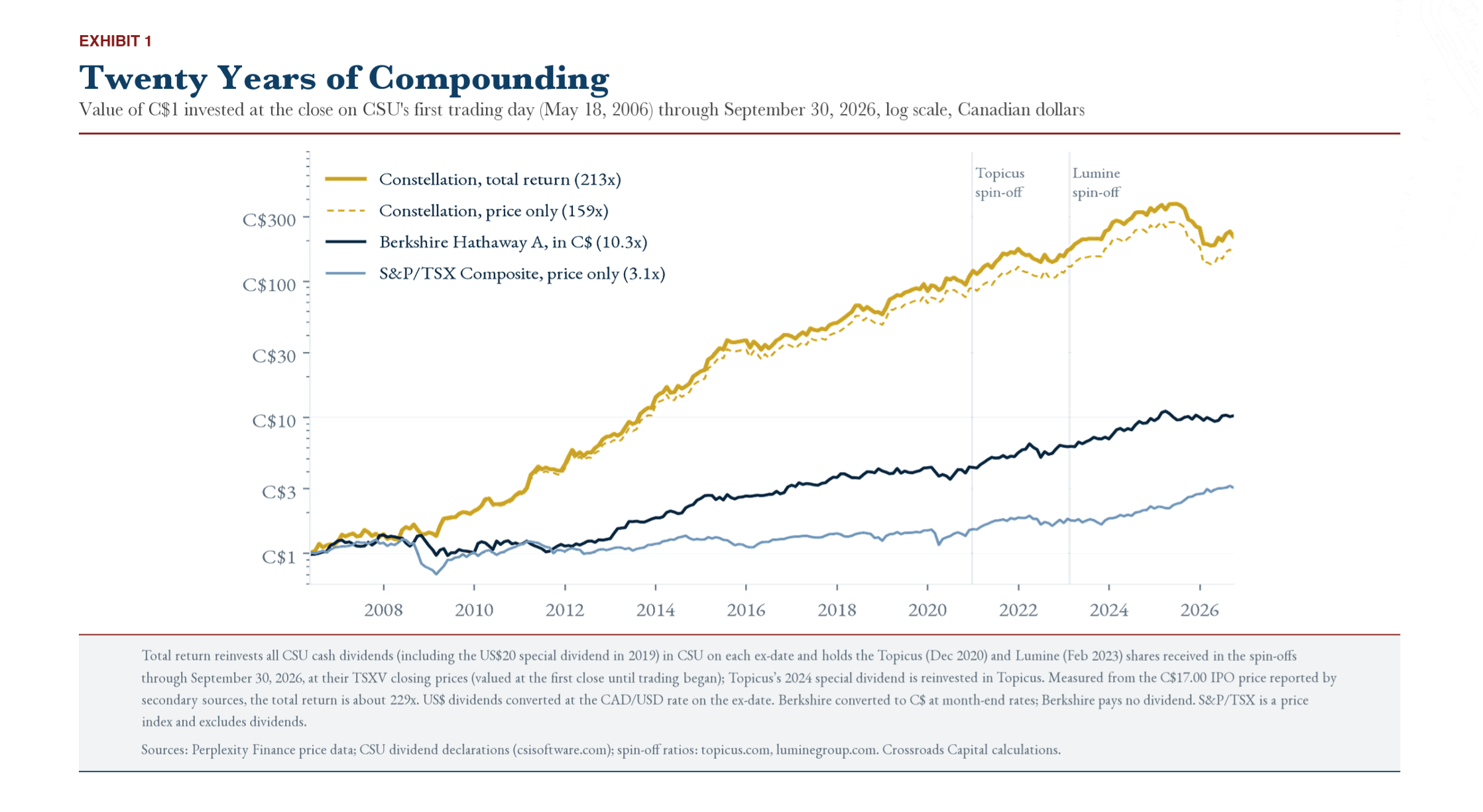
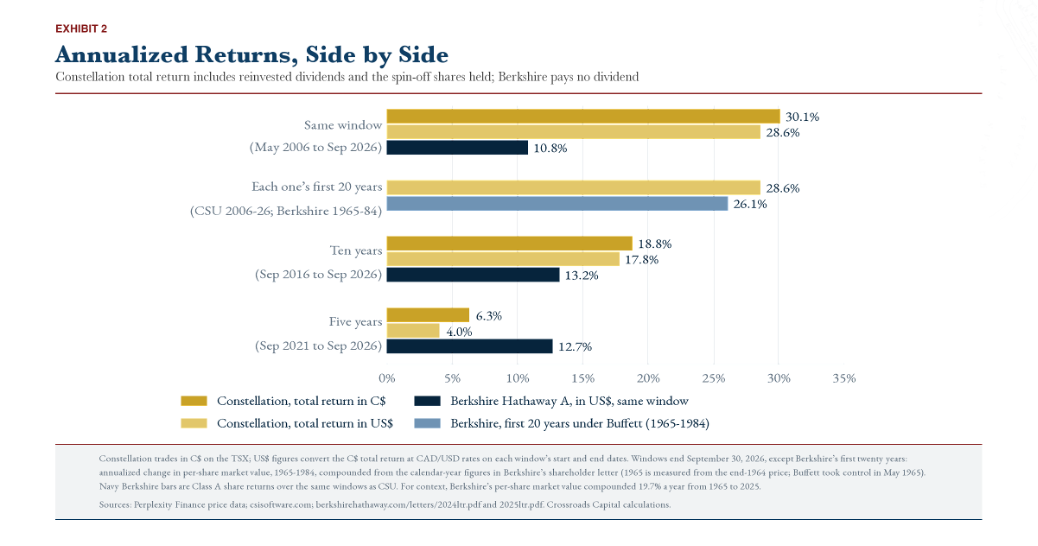
The record holds up to the comparison. From its first day of trading in May 2006 through September 30, 2026, CSU returned about 30% a year in Canadian dollars, turning every C$1 into about C$213 (Exhibit 1),1 assuming holders reinvested their dividends and kept the Topicus and Lumine shares they received in the spin-offs. Measured in US dollars, the return was about 29% a year, while Berkshire’s Class A shares returned about 11% a year over the same period (Exhibit 2). That comparison flatters CSU, because Berkshire spent those years as a mature giant. Berkshire’s per-share market value compounded at 19.7% a year from 1965 to 2025, the benchmark for this kind of record. But sixty years is the wrong yardstick. The fairer comparison is Berkshire’s own first twenty years, from 1965 through 1984, when its per-share market value compounded at about 26% a year. CSU’s first twenty have been faster still, at about 29% a year in US dollars,2 and it got there without issuing a single new share after its 2006 IPO, a tack Warren would surely approve of.
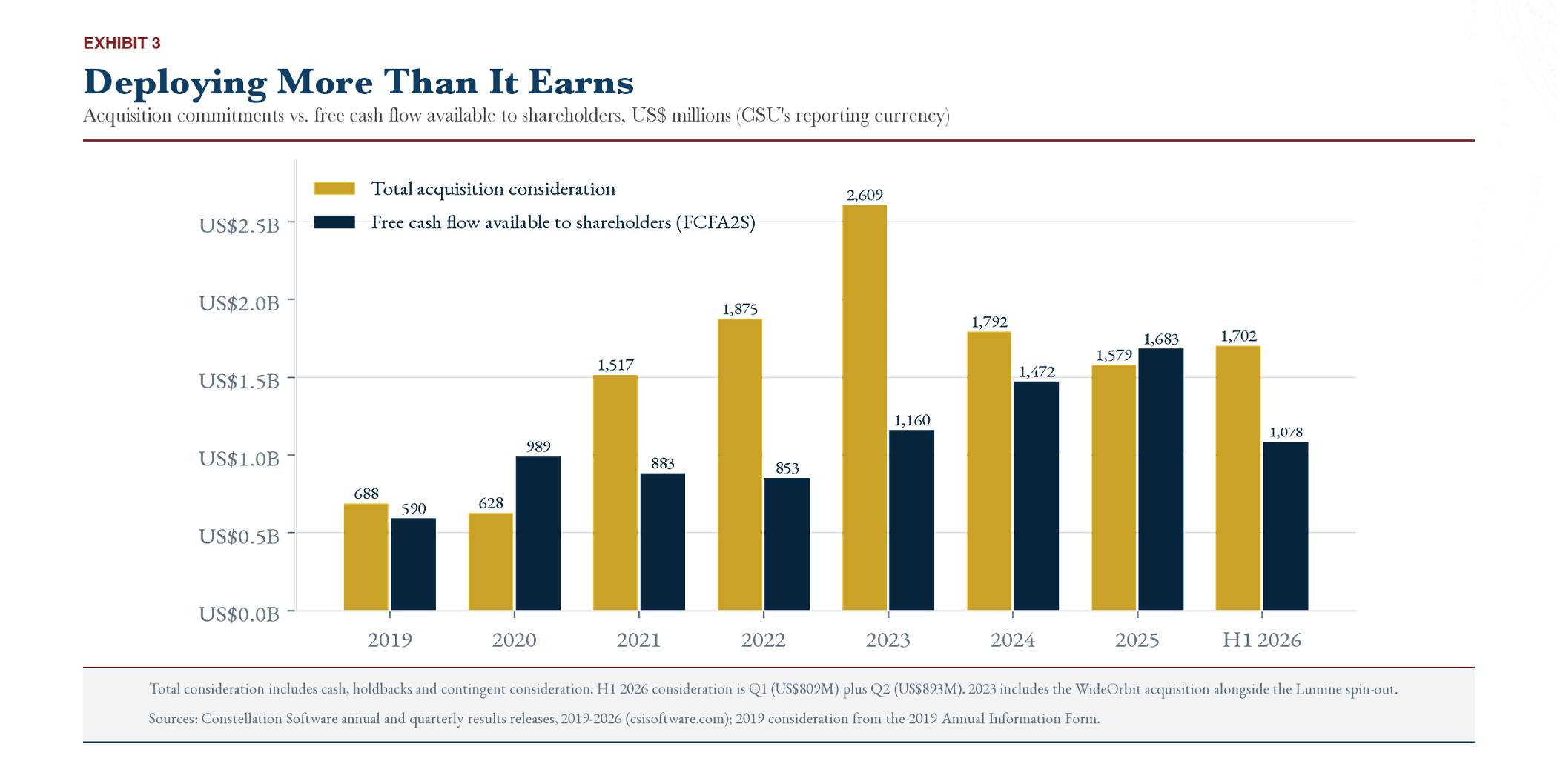
The differences matter as much as the similarities. Berkshire funds its acquisitions largely with insurance float and buys large businesses; CSU funds them largely with its own cash flow and buys small ones, often for a few million dollars each. And where Buffett kept capital allocation in Omaha, Leonard pushed it down to the portfolio managers inside CSU’s operating groups, which is why CSU can deploy more than its free cash flow without ever needing an elephant-sized deal. In the first half of 2026 alone, it committed US$1.7B to acquisitions against US$1.08B of free cash flow available to shareholders (FCFA2S), with the balance funded from its balance sheet and deferred payments.3 The two companies now share a succession test as well. Leonard stepped down as president in September 2025, and Buffett handed Berkshire’s chief executive role to Greg Abel at the start of 2026, then the chairmanship to his son Howard in September.4 Both were built to outlast their founders, and both are now being tested on it. In our view, CSU’s model will ultimately prove the more durable of the two, because it was never reliant on any single individual. That authority was spread across CSU’s operating group heads long before Leonard stepped down, so the engine that matters most was already running without him.
All of which is to say that we admired CSU long before we owned it. The business was never the obstacle; the price was. At its May 2025 peak, the shares traded at roughly 50x FCFA2S, a valuation that left little room for even an exceptional company to disappoint. So we kept watching.
Ed Thorp understood the distinction. The mathematician who first beat blackjack and then applied the same discipline to markets met Warren Buffett in 1968, when UC Irvine dean Ralph Gerard asked Buffett to evaluate Thorp as a potential steward of his capital. The two spent an evening playing bridge. Buffett gave Gerard his blessing, and Thorp went home and told his wife that Buffett would one day become the richest man in America. He later described the encounter as “one good stroke of good fortune” because it taught him that Berkshire was a business he wanted to own.5
Yet Thorp did not buy Berkshire for another fourteen years. When he finally did in 1982, he paid approximately $982.50 per Class A share, roughly eighty times what the stock had fetched in the mid-1960s. Berkshire had become vastly more expensive, but the great majority of its compounding still lay ahead. The lesson here is not that price ceases to matter when the business is exceptional, but that recognizing an exceptional compounder early and waiting for a sensible opportunity to own it can both be correct.
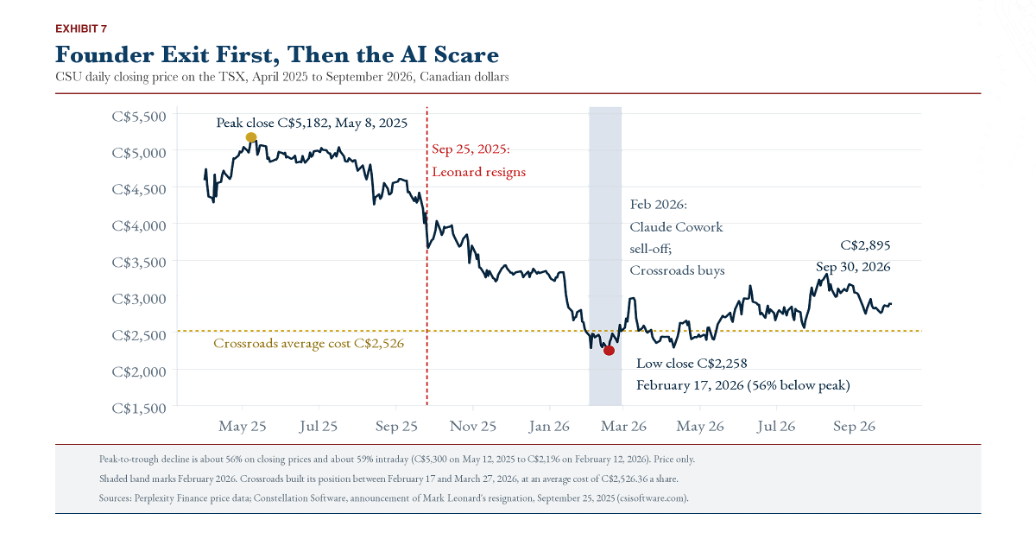
Our wait was a few years shorter, but still considerable. By February 2026, CSU’s shares had fallen more than 55% from their peak. We built our position at an average cost of approximately C$2,526 per share, less than half the peak price and roughly 12% above the February low. What mattered was that the qualities that first attracted us remained intact and that a price once dependent on perfection had finally begun to pay us for the uncertainty.
The clearest way to see what changed is to invert the multiple. At our average cost, CSU traded at 14-15x our estimate of the free cash flow available to shareholders over the following year.6 Put differently, every C$100 we invested bought a claim on approximately C$6.70 to C$7.10 of prospective annual cash flow. A 50x valuation, by contrast, represents a cash-flow yield of just 2%. The comparison is directional rather than strictly like-for-like, since the peak multiple is trailing and our entry yield is forward-looking, but it captures how dramatically the burden of expectations had shifted.
That starting yield gives the prospective return two possible engines. Consider a deliberately simple illustration rather than a forecast: if C$7 of cash flow per share compounds at 15% annually for five years, it becomes approximately C$14. At the same 7% yield, the shares would be worth roughly C$200 for every C$100 initially invested. If the market eventually required a 5% yield, equivalent to a 20x multiple, they would be worth closer to C$280. The first doubling comes from growth in the cash flow itself; the additional return comes from the market assigning a more ordinary valuation to it. We do not need the second engine for the first to produce an attractive result.
The center of our case, however, is not multiple expansion but continued growth in cash flow per share. If CSU can keep converting the cash generated by its existing businesses into additional cash flows at attractive returns, an unchanged valuation can still produce a highly satisfactory outcome. Any normalization in the yield the market requires would provide a second source of return on top, making capital allocation, rather than a forecast of CSU’s eventual multiple, the heart of the investment case. In that sense, the upside rests less on the market changing its mind than on CSU continuing to do what it has done for three decades.
Capital Allocation
Over the long term, returns for shareholders will be determined largely by the decisions a CEO makes in choosing which [capital allocation] tools to use (and which to avoid) among these various options. Stated simply, two companies with identical operating results and different approaches to allocating capital will derive two very different long-term outcomes for shareholders.
– William N. Thorndike Jr, The Outsiders: Eight Unconventional CEOs and Their Radically Rational Blueprint for Success
Thorndike’s point is the heart of our case. As we suggested at the outset, the key element of our investment is our belief that Constellation can allocate capital within software better than we could. During the SaaSpocalypse alone, CSU deployed US$809M in Q1 acquisitions, with that number reaching US$1.7B in H1 2026 (Exhibit 3). At that time, management described the opportunity set in their end markets as attractive, even compared to buying back shares at SaaSpocalypse-induced prices. Given that CSU has managed to grow its free cash flow per share nearly two and a half times since ChatGPT arrived in late 2022 to render it obsolete, and compounded at mind-boggling rates for two decades before that, we are inclined to give management the benefit of the doubt.7
While a full accounting of the reasons we’re happy to take management at its word is beyond the scope of this essay, keep in mind that how CSU buys matters as much as how much it buys. Its model follows a disciplined formula: acquire small software businesses whose cash flows are inherently more valuable in CSU’s hands than they are as independent companies. Executing that formula at scale requires a steady supply of willing sellers, which is why CSU has invested considerable time and effort in becoming the obvious first call for founders who decide to sell. Being the first call means rarely having to compete in an auction. Berkshire put the same idea more bluntly in the acquisition criteria it printed in its annual reports for decades: “We don’t participate in auctions.” Buffett summed up his view of auction-like sales with a line from a country song, “When the phone don’t ring, you’ll know it’s me.” Constellation lives by a version of it.8
That formula leads CSU to businesses most investors overlook in much the same way it has for Berkshire. In Constellation’s case, its targets typically grow more or less in line with GDP, a taboo growth rate for software businesses. If that sounds strange, consider that private equity owners and public software investors alike prize revenue growth above all else, because acceleration drives multiple expansion, and multiple expansion drives exits and IRRs. For decades, buying high and selling higher worked so well that few had reason to question the premise underneath it: that growth was the best proxy for quality.
Mind you, CSU can afford to sit out that game because it never has to sell. As a permanent capital vehicle, it owns businesses for a time horizon of… essentially forever. As such, its return on any acquisition comes down to a single relationship: its purchase price relative to the durability of acquired cash flows. It’s a good thing too as durability is exactly what mature vertical software offers. In other words, CSU’s competitively advantaged, low-growth bevy of vertical software businesses form a large and extremely sticky base of recurring revenue, about US$5B of maintenance and other recurring revenue in the first half of 2026 alone, which throws off annuity-like cash flow. Organic growth is therefore not the main driver of CSU’s shareholder returns, as it would be for other software investors. Rather, those returns are driven by CSU’s continued ability to collect the cash from niche businesses that need to retain little of it and let its portfolio managers redeploy that cash into new acquisitions at high incremental returns. The key question when investing in Constellation is not, “How fast do these businesses grow?” but “Can CSU keep buying low-growth, mature software businesses at attractive prices and returns, as it has for three decades?”
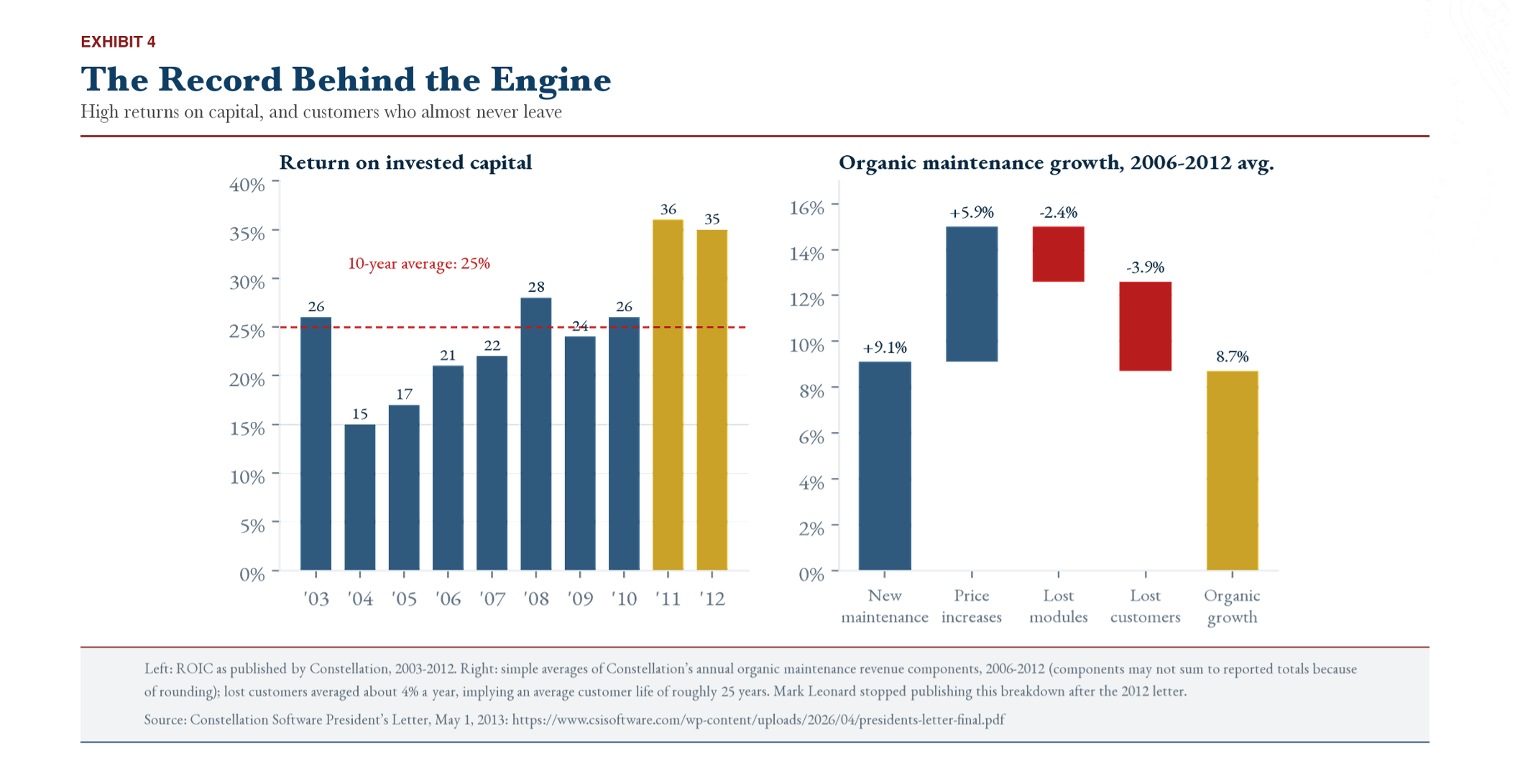
History answers that question better than any forecast. Over the decade through 2012, CSU’s own measure of return on invested capital averaged about 25%, never below 15% and as high as 36% (Exhibit 4). Its customers rarely left. From 2006 to 2012 it lost about 4% of them a year, which implies an average customer life of roughly 25 years, while price increases added 3% to 8% a year to maintenance revenue. Our point is simply that a business that keeps nearly all of last year’s customers and charges them a little more each year doesn’t need to grow quickly to compound.
That measure divides adjusted net income by shareholders’ equity capital, and CSU stopped publishing it after 2018. On a stricter basis that charges CSU for every dollar it has spent on acquisitions, our reconstruction from its financial statements shows returns averaging about 21% over the past fifteen years, with no year below 17%, while the capital base grew more than twenty-five-fold.9 Returns have come down from their peak, and Leonard told shareholders they would. In 2015, with ROIC at a record 37%, he wrote that CSU was “willing to make acquisitions that generate IRR’s that are much lower than 37%,” and that “if we are successful in deploying large amounts of capital, ROIC could drop sharply for a time.” Three years later he predicted that ROIC plus organic growth “should move asymptotically towards our hurdle rate” as CSU deployed all of its free cash flow.10 That is roughly where it sits today: high-teens returns plus 2-3% organic growth put CSU near the low end of the 20-30% hurdle rates it has long applied. In our view, the slide from about 25% in 2016-2018 to 17-18% is what a disciplined allocator looks like as it scales, not to mention most of it happened before ChatGPT launched.
The remaining question is supply, and CSU doesn’t appear anywhere even close to running short of businesses for its M&A engine to acquire. Constellation tracks more than 40,000 potential targets in a live database, yet management has said it was unaware of nearly 70% of the transactions involving businesses in that database in a given year, a sign that CSU still sees only a fraction of the deals that happen in its own universe. Vertical software is also unusually well suited to the model. In most industries, small businesses are cheap because they are fragile. Small vertical software businesses, by contrast, have historically been both inexpensive and remarkably sturdy. Their customers rarely leave, making their cash flows unusually predictable through good years and bad, a distinction that matters enormously in a market like today’s, which is pricing software businesses indiscriminately, including many of the very best. Just as important, CSU’s targets combine end-market diversity with business-model homogeneity: thousands of unrelated niches furnish an enormous opportunity set, while their shared economics allow CSU to apply the same diligence, pricing, and management playbook again and again.11
Yet CSU’s deals remain small. Its US$1.6B of 2025 acquisition consideration, spread across at least 72 deals, works out to approximately US$22M or less apiece.12 That’s the payoff of decentralization: every portfolio manager runs a pipeline, allowing CSU to scale by doing more deals rather than progressively larger ones. Smaller deals also protect returns. CSU has long applied reported hurdle rates of 20-30%, depending on deal size, and while the blended return will drift lower as larger transactions absorb a greater share of capital, that is principally a function of deal size rather than business quality. Our reconstructed all-capital ROIC averaged approximately 17.6% from 2023 through 2025, already near the low end of the return range we use in our underwriting. The comparison isn’t exact, but the implication is important: we are beginning from a period of already compressed returns, not extrapolating from a cyclical or historical peak. That’s not a guarantee of mean reversion, but it changes the shape of the bet in that further downside requires returns to deteriorate from an already subdued base, while even a partial recovery toward CSU’s historical economics would create meaningful upside.
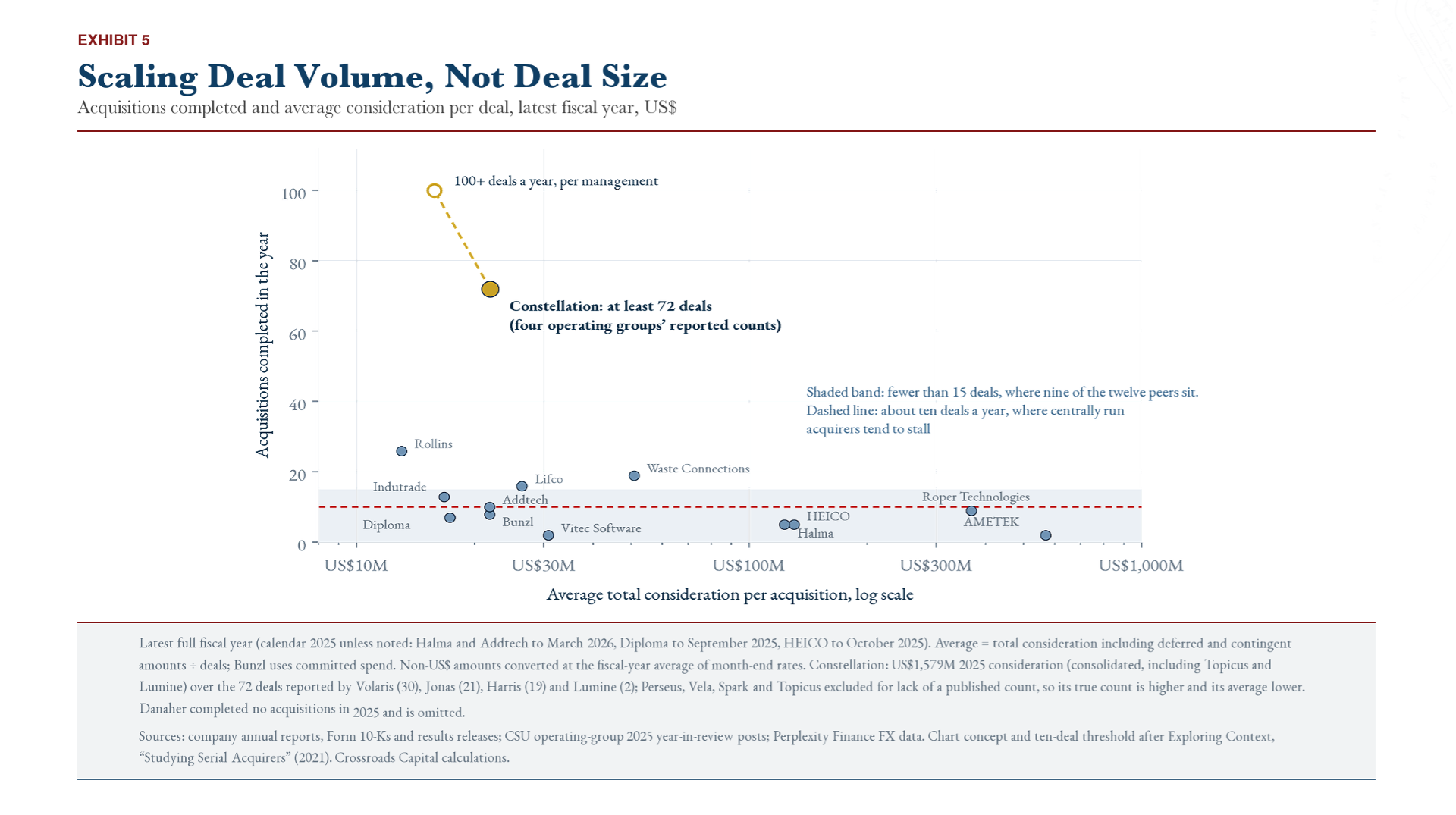
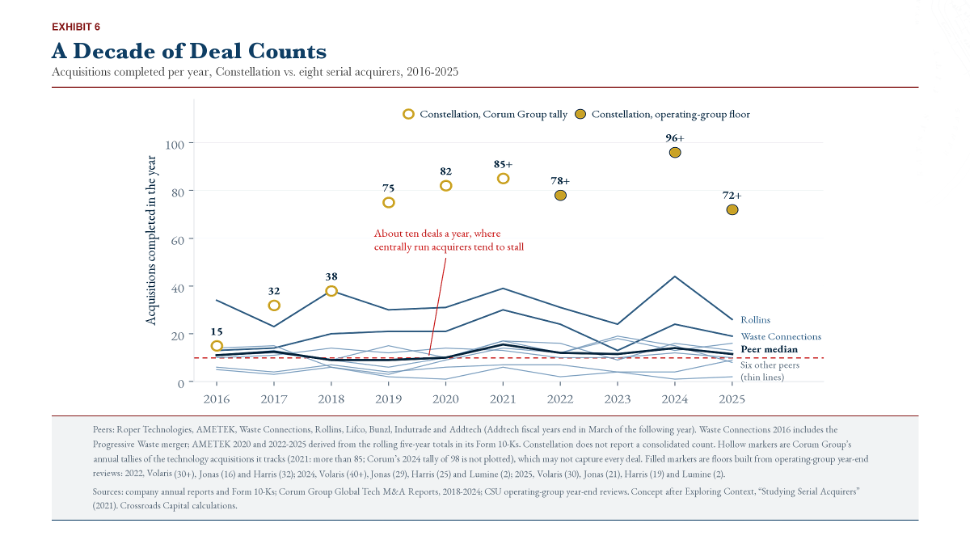
Decentralization also removes the constraint most serial acquirers eventually hit, which is people, not targets. When capital allocation rests with one or two executives at the top, deal count tends to stall at around ten a year, and the only way to keep deploying a growing stream of cash is to buy bigger businesses at higher prices, which is exactly how returns on new capital erode. Across the eight serial acquirers we tracked over the past decade,13 the median completed between 9 and 16 deals a year, and only Rollins and Waste Connections ever reached 30. Through 2018, CSU’s count was in the same range as the busiest of them. Then it pulled away: every count we could find since 2019 puts it above 70 a year, at least twice the busiest peer (Exhibit 6).14
That volume confers a second advantage: it transforms acquisition risk from a series of consequential individual bets into a diversified portfolio of small ones. CSU need not be right every time; its M&A engine need only be right on average.
Culture
Our favorite and most frequent acquisitions are the businesses that we buy from founders. When a founder invests the better part of a lifetime building a business, a long-term orientation tends to permeate all aspects of the enterprise: employee selection and development, establishing and building symbiotic customer relationships, and evolving sophisticated product suites. Founder businesses tend to be a very good cultural fit with Constellation.
– Mark Leonard, CSU Founder15
Nowhere to be found on any balance sheet, company “culture” is nevertheless a factor investors cite both excessively and incorrectly. At CSU, however, culture is unusually visible from the outside and can be observed in what the company measures, whom it promotes, how it rewards them, and which decisions it refuses to centralize. What matters is counted, performance is rewarded, and people who prove they can operate niche software businesses and allocate capital are entrusted with more of both.
In that respect, CSU once again resembles Berkshire: both combine permanent ownership, decentralized operations, and rigorous capital allocation. The important difference is where acquisition authority resides. Berkshire has historically concentrated major acquisition decisions among a small number of people at the center; CSU’s volume of small transactions requires it to cultivate capable capital allocators throughout the organization. Its culture is therefore not merely a way to preserve the businesses it acquires, but (quite literally) how CSU turns operators into the capital allocators that allow its acquisition capacity to compound.
The system begins with who runs the businesses. Constellation’s business-unit leaders are typically not generalists brought in from outside. Many are founders or specialists who have spent much of their professional lives inside a single software vertical, such as transit scheduling, golf-course operations, or marina management. Critically, they know not only the software but the industry surrounding it: the regulatory environment, the procurement rhythms, and the language customers use when something is not working.
The best of those operators are eventually asked to do more than run their own businesses. A founder who remains with CSU after an acquisition can progress from running one company to overseeing several and, eventually, become a portfolio manager responsible for deploying capital into new acquisitions. At that level, the mandate is twofold: deploy more capital without sacrificing returns. They understand that acquisition volume without adequate returns is not success, but neither is protecting a high return on a capital base too small to matter.
That dual mandate helps explain why Constellation’s operating philosophy differs so sharply from a buyout model built around consolidation, centralization, and cost rationalization. Its business units remain small and decentralized by design. Decentralization does not eliminate accountability; but rather places accountability with the people closest to the customer and most familiar with the consequences of their decisions. As Mark Leonard puts it:
We are the anti-economies of scale company. We believe in small teams outperforming large teams, and so given the choice of taking a 200-person business and [breaking] it up into two smaller ones, we would much prefer to do that and believe that the benefits are there as opposed to ramming businesses together, firing a bunch of people and moving a bunch of work offshore. There are a couple of hundred business units and every one of those managers has their own competitive environment in which they are competing and they are making decisions.16
The point is practical. Keeping the units small preserves proximity to customers, protects specialized knowledge, and allows trust to compound over time. CSU does not, however, abandon the advantages of scale. It simply captures them somewhere else. “Anti-economies of scale” describes how CSU organizes its businesses, not how it learns. The scale it does exploit is informational. More than a thousand acquisitions have produced a record of pricing, diligence, and post-acquisition performance that is truly in a league of its own. Operating practices, now including AI tools, can travel across business units without forcing those units to merge, employees can move from developer to manager to acquirer without leaving the company, and each business keeps its local judgment without having to learn every lesson alone.
CSU further reinforces its ecosystem through ownership. Its incentive plan rewards employees at multiple levels based on the profitability and growth of the businesses they oversee. Qualifying senior employees must reinvest a portion of their incentive compensation in CSU shares, while senior executives generally must invest 75% of their after-tax bonuses. Those shares are purchased in the open market and remain subject to multiyear holding restrictions. The cash bonus is still a real expense, but the resulting ownership is not financed by routinely issuing new shares to employees. Point being, the people making capital-allocation decisions must commit their own after-tax capital at the same market price available to outside shareholders and live with the long-term consequences.
AI’s Impact on CSU
While software once ate the world, AI is now perceived as eating software. That perception arrived after four years of slowing software growth, making the bear case that much easier to tell and that much harder to disprove. As of this writing, we don’t believe anyone can pick the ultimate winners and losers with any real confidence, and to its credit, neither does CSU. On a call devoted to AI’s impact on its businesses in September 2025, management was refreshingly candid about how little anyone can predict. As Mark Leonard put it: “So, we don’t know which way this is going to go. We’re monitoring the situation closely.”17 Bernard Anzarouth, CIO of Constellation, struck the same note on the company’s fourth-quarter call in March 2026: “It’s just there are going to be some winners, there are going to be some losers. It’s all in how you use the tools to get closer to your customers.”18 Leonard explained why that candor is a strength: “[Predicting] the future, really, really hard, particularly at times like these, but monitoring what’s happening in real time, a whole lot easier.” CSU’s edge was never prediction, but in its ability to see the present more clearly. With more than 1,100 businesses reporting results, it can see which ones are winning in real time and direct capital accordingly. Our thesis doesn’t require AI to be harmless, but rests on CSU’s ability to adapt the businesses it owns and allocate capital as the economics of software change.
The counter-argument is obvious: How can a company with “software” in its name, whose shares fell roughly 56% from their May 2025 peak to their February 2026 low, be insulated from what happens to software?19 The short answer is it can’t, but that’s never been our position. What we’ve tried to articulate is that CSU is not a traditional software business, but rather a permanent holding company and custodian of software assets and their associated cash flows. As such, CSU’s exposure to AI cuts two ways: through the cash flows of the businesses it already owns, and through the returns available on the businesses it has yet to buy. AI can weaken the former while improving the latter, and as we discuss below, the second effect may well outweigh the first. At our purchase price, we believed the market was overestimating the damage and giving CSU too little credit for the upside.
That price was largely a product of fear, though not all of it was fear of AI. As Exhibit 7 shows, CSU’s shares fell roughly 11% in the two trading sessions after founder Mark Leonard resigned as president for health reasons in September 2025.20 That piece of the decline was about succession, which we’ll return to below, and it deserves to be judged on its own terms. Whether CSU’s culture and capital-allocation system can outlive its founder is a separate question from whether the cash flows that system allocates can hold up against AI.
The AI fear, meanwhile, hardened into an apocalyptic worldview in which software’s destiny is to be nothing more than a watering hole from which AI guzzles historical data, custom workflows, and proprietary knowledge. AI replaces software at a fraction of the cost, without the complexity of a rip-and-replace migration. Switching costs cease to exist, and software’s moat is filled in and paved over as an expressway for AI agents. Is this future possible? Certainly. Is it as likely as software share prices implied, CSU’s included, when we first bought in February 2026? We think not.
In our view, the more serious version of the bear case doesn’t require paving over the moat at all. Picture an AI agent becoming the customer’s primary interface while the existing software keeps running underneath. The customer stays and retention looks healthy, but pricing power and incremental spend quietly migrate to the agent layer. In that world, retention numbers would flatter the underlying economics. In a more severe version, AI-native competitors eventually replicate enough of the incumbent’s workflow to make switching cheaper and less risky. Either way, CSU would be worse off, even if its software were never ripped out.
Take the replacement scenario first. This scenario assumes switching software is mostly a technical problem, and that once AI makes the technical work easier, customers will switch as AI shortens implementation timelines and, in some cases, reduces the lift required to stand up a new system. But code is the cheapest part of replacing a system that works. Someone still has to understand the customer’s workflows, integrate with other systems, migrate historical data, satisfy regulators, train users, provide support, and take the blame when something goes wrong. Never mind that getting the implementation of a system of record wrong is equivalent to a mishap during heart surgery, and for mission-critical software, a failed implementation can cost many times the price of the product. The risk/reward calculus for that customer remains remarkably skewed in favor of the incumbent.
We speak from experience and have learned the hard way that the best product in software rarely wins. Software is sold, not bought. As Twitch co-founder Justin Kan put it, “First-time founders are obsessed with product. Second-time founders are obsessed with distribution.”21 Those who have direct dialogue with the end user tend to win and keep winning, particularly in the narrow verticals CSU serves. Practically speaking, that means incremental improvements, even meaningful ones, are rarely enough to convince a customer to risk replacing a system that already works. AI may make it cheaper to build a competing product, but it certainly doesn’t make it cheaper to earn a customer’s trust.
It’s also worth being precise about CSU’s data advantage. In many cases the customer owns the underlying data, and whether a business unit (“BU”) can use it for AI depends on contracts, regulation, and customer permission. The more defensible position, in our view, is the domain knowledge baked into the product itself. What sits inside a typical CSU product isn’t streamlined or structured text simply waiting to be ingested by AI, but something closer to a journal: a scribbled patchwork of thoughts, ideas, and makeshift solutions summarizing a collective history of paper to Excel, Excel to digital, digital to cloud. To replicate it, AI would have to translate decades of integrations, schema migrations, deprecated fields, workarounds, and business logic encoded in places no one has documented. Point being, an AI model may well reproduce a feature long before it can reproduce all the exceptions that make that feature work inside a customer’s actual business.
A dynamic that puts CSU’s BUs in pole position to apply AI to what they already know. The tools themselves aren’t a moat, since competitors have access to the same ones. What CSU has that a newcomer doesn’t is the customer relationship, the workflow, and the industry knowledge to point those tools at. A customer can get better automation without replacing a vendor it trusts, while CSU uses AI to shorten development cycles, improve support, and extend existing products. Management put more weight on the data itself on the September 2025 call, where a member of the team serving CSU’s utility and telecommunications verticals credited the sheer volume of data in the BUs with putting them in a position to drive innovation.22 We’d put the emphasis on the knowledge wrapped around that data, but the conclusion is the same.
This isn’t to say every BU will get it right. Some will execute well, others won’t, and some may still be disrupted. Even the winners only help shareholders to the extent CSU keeps a fair share of the productivity gains, whether through higher margins, better products, stronger retention, or new revenue. If faster development simply gets competed away or handed to customers, the ecosystem benefits while CSU’s owners are left with little to show for it.
So far, the numbers are encouraging in places but far from conclusive. In the first half of 2026, FCFA2S rose 48% to approximately US$1.08B.23 That tells us the cash-generation engine is intact, though with this much acquisition activity, consolidated cash flow is hardly a clean test of AI resilience. Organic growth was 6% in the first quarter and 3% in the second, or 2% and 1%, respectively, after adjusting for currency.24 The recurring-revenue figures, which matter most, were softer. In the second quarter, maintenance and other recurring revenue grew approximately 2% organically in constant currency, or 4% excluding Altera, below the roughly 5% to 6% CSU has typically delivered.25 Management attributed much of the shortfall to difficult comparisons at Altera and Dark Matter, turnaround acquisitions at Lumine, and the loss of a customer whose departure was known when one business was acquired. It also said AI was improving development productivity but had yet to show up in organic growth.26 We find those explanations reasonable, but we’d like to see recurring growth back in its historical range before taking them at face value.
Ultimately, the scorecard is recurring organic growth, customer retention, pricing, margins, and how much of the value AI creates CSU gets to keep. Two quarters is far too small a sample to call it either way but for now, we see little evidence of the software apocalypse priced into CSU in February, though we aren’t ready to sound the all-clear. We’ll keep score business by business where we can, and quarter by quarter where we can’t.
That scorecard covers only the businesses CSU already owns. The other half of AI’s impact runs through the businesses it has yet to buy. Lower terminal-value expectations can reduce what sellers demand, while AI can lower the cost of improving and supporting those businesses after CSU acquires them. The salient point is that Constellation doesn’t need to escape AI unscathed to benefit from it. Indeed, in what could prove to be a deliciously ironic twist of fate, the same fear that sent investors running from CSU for owning too much software may end up handing it more software to own at better prices, while AI makes those businesses cheaper to run and improve. AI may weaken some of the cash flows in CSU’s existing portfolio while improving the returns available on businesses it has yet to buy. Those outcomes can occur at the same time. Yet the market has been quick to price the threat and slow even to recognize the opportunity, let alone value it.
From Systems of Record to Systems of Action
I believe that vertical market software is the distillation of a conversation between the vendor and the customer that has gone on frequently for a couple of decades, and you distill those work practices down into algorithms and software and data and reports, and it captures so much about the business.
– Mark Leonard27
Leonard’s description gets at both what AI changes and what it doesn’t. A vertical market software system is more than a codebase or a repository of customer data. It’s an accumulated record of how a particular industry works: its workflows, definitions, permissions, regulatory requirements, integrations, and exceptions, refined through years of back-and-forth between vendor and customer. Much of that knowledge is never written down in one place, but lives inside the product and in the people who maintain it.
In that sense, CSU’s businesses sit inside their customers’ operations, with trust earned over relationships that often go back decades. When a vendor has served your niche for twenty years and understands your business this deeply, switching is rarely a question of price or features. It’s a question of who else knows your business this well. Often, the answer is no one.
That history matters because AI is only as useful as the context and authority it’s given. A system of record is effectively an archive: it tells the user what has happened and describes the current state of the business. A system of action decides what should happen next and, within appropriate limits, carries it out. The action layer can’t operate reliably without the record layer beneath it. Meaning, an AI agent needs accurate data, but it also needs to know which rules apply, who can authorize an action, which other systems must be updated, which exceptions require human judgment, and how the decision will be audited. CSU’s products already contain much of that operating context, and as we noted above, that context is far harder for a newcomer to replicate than the data itself.
AI also changes the economics of product development. CSU’s customers want what every software buyer wants: better workflows, greater automation of manual processes, stronger reporting, and more useful decision support. What gets built has always depended on whether the value of a request justified the engineering expense. Historically, many requests were too narrow to clear that threshold, a problem especially acute in small verticals. AI bends the cost curve, making more of the long tail economical and allowing CSU’s businesses to turn years of customer requests into products faster and at lower cost. AI may make the product cheaper for anyone to build, but CSU begins where an AI-native challenger hopes to end: inside the customer’s workflow, with the context, trust, and permission required to act.
The real risk, as we laid out above, is that someone else captures the action layer, leaving CSU running quietly underneath another company’s agent. CSU doesn’t win simply because its database stays installed, but because it’s able to use its incumbent position to own enough of the workflow above the record layer to remain economically important. The market is focused on who will own the new interface. We think the more important question is who understands the workflow, has access to the necessary context, and is trusted to act on it. CSU won’t win every one of those contests, but its businesses start inside the customer’s operations, which is a far better place to start than outside them.
One departure from CSU’s playbook doubles as a live test of everything above. Management has long said its acquisition pipeline offers better returns than buying back its own stock. If CSU’s own shares, the public company it knows best, seldom clear its hurdle, other listed companies should clear it even less often. Yet beginning in April 2025, CSU built a position in Sabre Corp. (SABR), to our knowledge its first investment in an unrelated listed company in at least a decade, and in March 2026 it took a board seat under a standstill agreement that caps its ownership at 15%. Optically, Sabre looks like a value trap: a low-growth, heavily indebted travel-distribution intermediary the market expects AI to displace. Look past the capital structure, however, and the logic is familiar. Sabre is embedded in decades of airline and agency integrations and generates meaningful cash, much of which goes to its lenders before it reaches shareholders. Repair the balance sheet, and more of that cash accrues to the equity, i.e., CSU’s acquisition logic adapted to a public security.
The harder question is whether AI agents route around Sabre altogether. Meta’s Muse, launched in September 2026, already books flights on more than 500 airlines through Duffel, a newer service that connects to airlines directly. That threatens leisure bookings most. Business travel looks more defensible, given corporate bookings must follow travel policies and negotiated fares, track employees for duty of care, and reconcile payments and expenses, all infrastructure Sabre already runs and an enterprise agent is more likely to use than rebuild. At roughly US$86M, the stake is a rounding error for CSU. But it is the cleanest test we have of whether CSU can tell infrastructure that agents will keep using from intermediation they can route around. We suspect it can.
While well off its Q1 lows, CSU’s share price still reflects a market mistaking the map for the territory. The market sees “software” on the label and prices CSU like a business AI will route around. At our purchase price, the market appeared to assign far more weight to CSU becoming the back end of someone else’s agent than to the possibility that CSU could own the action layer itself. Yes, AI is a regime change. But at worst, we think CSU can return serve for the foreseeable future, which in our view is more than enough to reverse sentiment at prevailing prices.
Competition
AI is a product of capitalism and will follow the path of every prior technology wave: attacking the largest problems with the largest returns for solving them. Recall Constellation competes in end markets with TAMs that would make venture capital firms roll their eyes with disdain. Software private equity firms such as Thoma Bravo or Vista would most likely never consider CSU’s acquisitions as candidates for leveraged buyouts with a five- to ten-year fund life. The same limited market size that has historically kept venture-backed competitors away should continue to protect CSU’s businesses from concentrated attack. Indeed, the case for launching a competing product in a niche industry has rarely been compelling, and AI changes that math less than it might initially seem.
Lower development costs do weaken that protection at the margin. AI makes it cheaper to build a product, but it doesn’t make a tiny end market any larger. Nor does it remove the cost of acquiring, implementing, integrating, and supporting customers, meeting regulatory requirements, or earning trust across hundreds of narrow and highly specialized markets. A challenger can now write the code for a fraction of what it once cost, but it still has to win customers one at a time, in a market that may not be worth the effort.
In practice, CSU’s competition is mostly micro-sized, mom-and-pop software businesses, which are time- and capital-constrained and largely lack the technical talent to adapt to structural regime changes in software. CSU’s business units, by contrast, can borrow AI playbooks from more than 1,100 sister businesses across nine operating groups. If AI raises the bar for small vendors, we suspect those vendors are far more likely to become CSU’s acquisition candidates than its disruptors.
When Prices Fall Faster Than Cash Flows
The sell-off may do more than spare CSU. As we’ve been alluding to, it may actually improve the economics of its M&A engine. After all, AI has hung a terminal value question over every software business, and that question weighs far more heavily on sellers than on CSU. A seller who once priced a business on decades of durable earnings, continued growth and an eventual sale at a rich multiple may now accept far less, well before the business’s cash flow deteriorates to the same degree. CSU, which buys to hold permanently, doesn’t need to underwrite an exit multiple at all. Nor does it need an acquired business to last forever, either. Constellation needs the cash it ultimately collects to justify the price paid, that’s it.
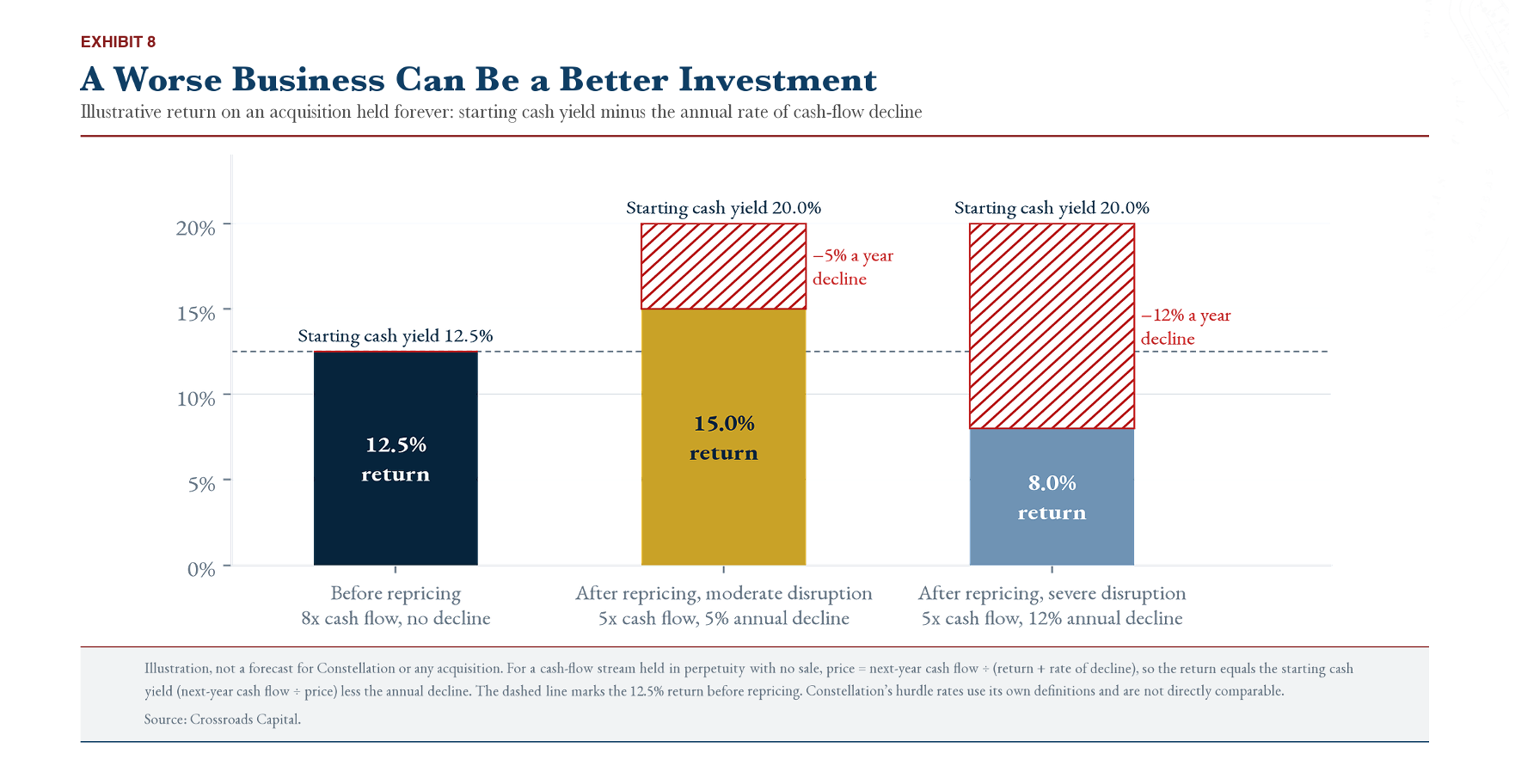
Simple arithmetic shows why (Exhibit 8). For a business that is held forever and never sold, the return on the purchase is roughly its starting cash yield minus the rate at which its cash flow declines. Buy a stable business at 8x next year’s cash flow, and the return is 12.5%. Buy one whose cash flow shrinks 5% a year at 5x, and the return rises to 15%, because the 20% starting yield more than pays for the decline. A worse business can be a better investment if its price falls far enough. The limit is just as clear: at the same 5x, a business shrinking 12% a year returns only 8%, which is to say that a lower price helps only when it falls further than the cash flow does. Rest assured it’s no accident that Mark Leonard chose return on invested capital plus net revenue growth as the yardstick for CSU’s bonuses, as it approximates the same arithmetic: a starting yield plus growth, or minus decline.28
Keep in mind too that the spread between what CSU pays and what a business’s cash flows are worth in its hands, the reinvestment spread at the heart of its acquisition engine, has always been the primary driver of CSU’s returns, far more than organic growth. CSU generally acquires slower-growth businesses. Recurring revenue has grown organically at around 5% a year, and total organic growth has typically run in the low single digits,29 yet the stock has compounded at about 30% a year since its 2006 IPO (Exhibit 1). The difference comes from reinvesting cash, year after year, at prices well below what that reinvestment is worth. If anything we think AI’s terminal value question is more likely to widen that spread than narrow it, not to mention lower prices let more businesses clear CSU’s existing hurdles and let every retained dollar buy more future cash flow, so the engine can accelerate without its standards slipping. And because CSU funds its acquisitions with its own cash, a wider spread creates value whether or not the market ever pays a higher multiple for CSU itself.
To be clear, none of this makes CSU immune to AI. The businesses it already owns were bought at historical prices, and those prices don’t reset when AI risk rises. Put differently, the same repricing that improves tomorrow’s acquisitions can impair yesterday’s. But when viewed through the lens of the whole company, the real test is whether the value of better future acquisitions exceeds any damage to the cash flows of the existing portfolio. We think that’s very likely the case, but in the meantime we’ll be watching what CSU pays, the cash yield it earns, and how well each year’s acquisitions hold their cash flow.
What Would Change Our Mind
We own CSU because we believe the engine keeps running. Three developments would tell us it is sputtering. The first is organic growth in maintenance and recurring revenue running below 3% in constant currency for several consecutive quarters without the kind of one-off explanations management offered in Q2 2026. That would suggest AI is eroding the base, not just the narrative.
The second is deployment that keeps pace with cash flow while hurdle rates fall on deals of comparable size, or acquisitions that drift toward businesses whose cash flows are shrinking faster than CSU can price them. The clearest public signal would be return on invested capital, on the acquisition-cost basis described earlier, slipping below 15% for several quarters while the capital base keeps growing.
The third is evidence that the post-Leonard organization is centralizing decisions or loosening its discipline. Mark Miller, Leonard’s successor and previously Constellation’s chief operating officer, inherits a culture built to outlast any one person.
Conclusion
AI may be eating software, but CSU has been feasting on software companies for thirty years, and the menu just got cheaper. During the SaaSpocalypse, the market priced CSU as if it were on the menu rather than at the table. The market had stopped looking around. We hadn’t. At the price we paid, we didn’t need to know exactly how the contest ends. We needed to believe that CSU’s existing businesses would generate enough cash, for long enough, to let its capital allocators keep buying whatever survives. That’s an opportunity only if CSU can tell a survivor from a stranded asset, as our thesis rests on CSU’s ability to make exactly that distinction, and on a portfolio broad enough that it doesn’t have to be right every time.
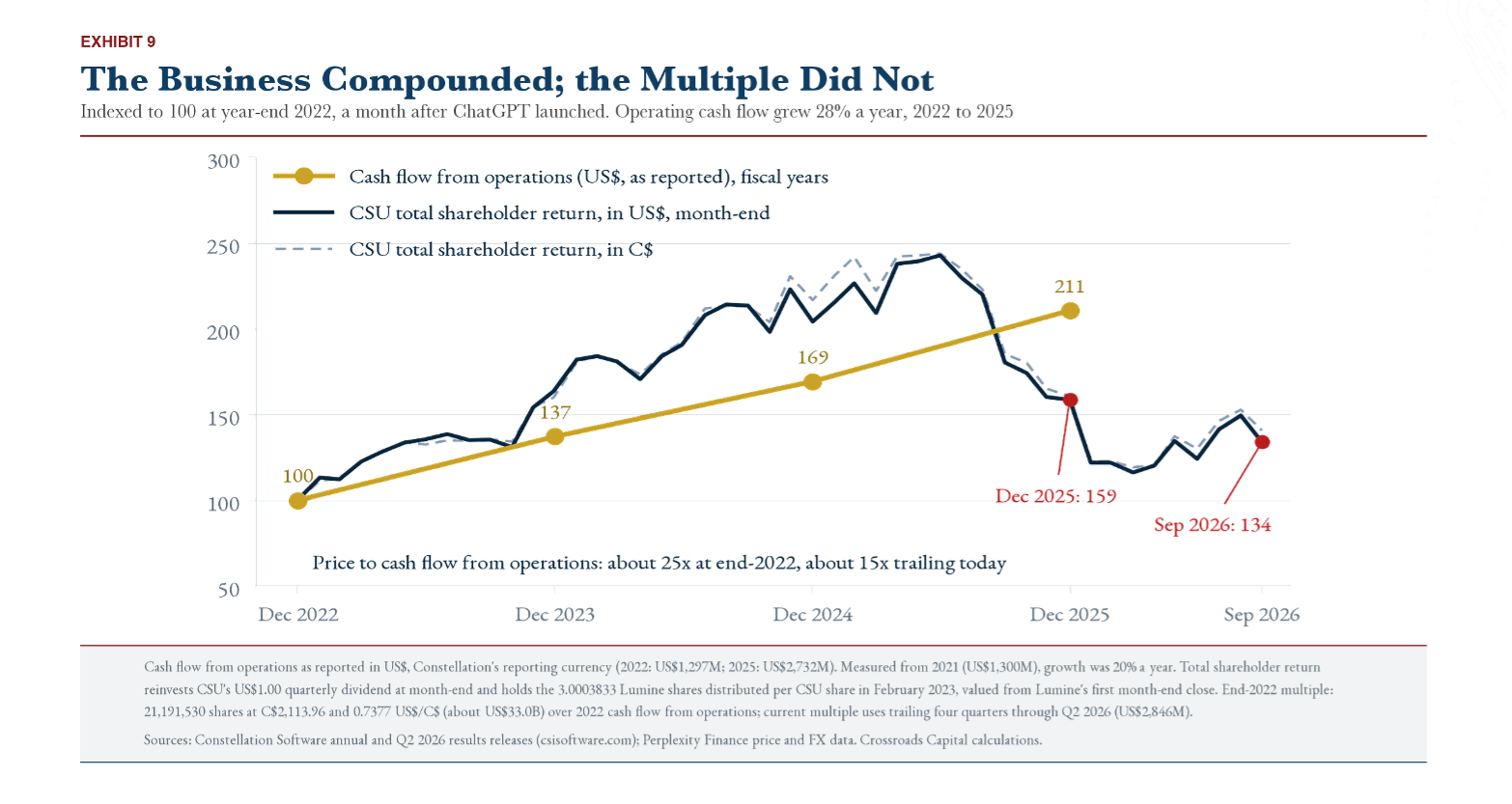
Thus far, the business has held up its end. From the end of 2022, a month after ChatGPT launched, to the end of ‘25, cash flow from operations compounded at roughly 28% a year in US dollars, CSU’s reporting currency, from US$1.3B to US$2.7B.30 Over the same three years, the stock returned about 17% a year in US dollars, including dividends and the Lumine spin-off, and it has since given back much of that. Measured from the end of 2022 through September 30, 2026, the return falls to about 8% a year. At the end of 2022, investors paid about 25x cash flow from operations for CSU; today they pay about 15x for a business generating more than twice as much cash (Exhibit 9). CSU was producing far more cash, and the market was assigning far less value to each dollar. That divergence created the opportunity.
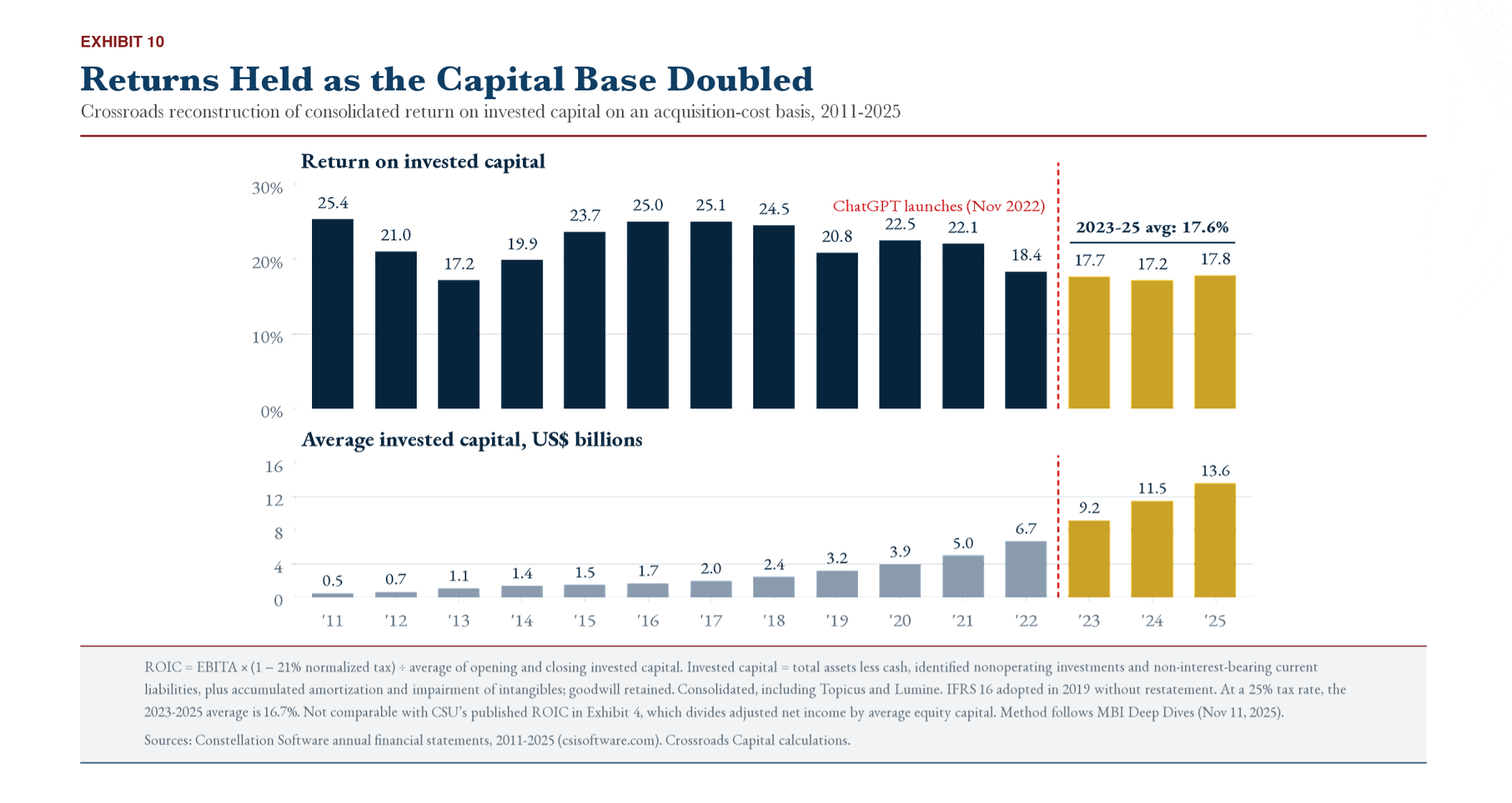
Returns held up too. On the acquisition-cost basis described earlier, CSU earned about 18% on its invested capital in 2022 and 17-18% in each of the three years since, even as its average capital base doubled to roughly US$13.6B (Exhibit 10). The roughly US$1.2B of additional after-tax operating profit came on about US$6.9B of additional capital, a return of about 17%, i.e., the new money has earned about what the old money did. MBI Deep Dives, which tracks a similar measure quarterly, shows the same pattern through June 2026: high-teens returns on capital that grew from US$6.4B to US$14.4B.31
To see what the market is actually paying for, split CSU into two parts: a steady-state portfolio of software businesses and the acquisition engine that sits on top of it. A steady-state business growing 4% organically, discounted at a 10% cost of equity, is worth about 17x its free cash flow (1.04 ÷ 0.06). Four percent sits between the roughly 5% CSU has historically earned on recurring revenue and its 2-3% total organic growth. At the end of September, CSU’s market capitalization of roughly US$43B was about 21x its trailing FCFA2S of roughly US$2.0B, which leaves around US$8B of value for an engine that committed US$1.7B to acquisitions in the first half of 2026 alone. Both this multiple and the 15x above are trailing; FCFA2S simply runs below operating cash flow because it deducts interest, lease payments, capital spending and minority interests. Halve organic growth to 2% and use a 9% cost of equity, and the steady-state multiple falls to about 15x, leaving roughly US$13B for the engine (Exhibit 11).
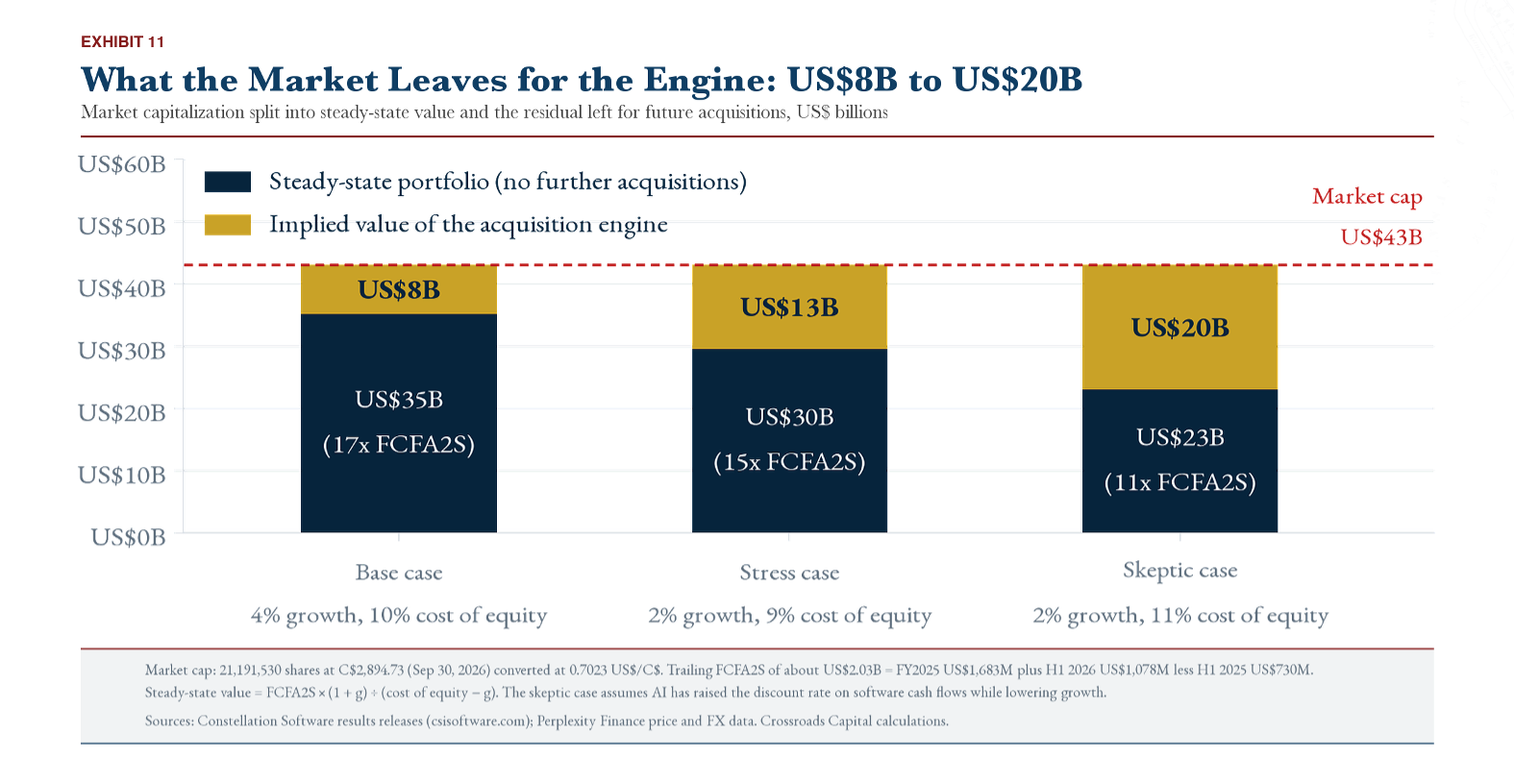
A skeptic would push the other way. Since AI arrived, investors have arguably assigned software cash flows both a higher discount rate and a lower growth outlook, even though the deterioration they fear has yet to appear in CSU’s reported cash generation. At 2% growth and an 11% cost of equity, the steady-state portfolio is worth only about 11x, and the market is paying closer to US$20B for the engine, the third case in Exhibit 11. That’s a fuller price, and it puts the weight of the case where it belongs: on how many dollars CSU can put to work, and at what spread. So far, the dollars are moving in the right direction: CSU spent about US$1.6B in cash on acquisitions in the first half of 2026, more than two and a half times the US$604M it spent a year earlier.32 CSU doesn’t disclose what it pays, but its returns give a fair read on the spread. At our 10% required return, capital earning 17-18% is worth roughly 1.75 times what it cost. Deploying approximately US$2B annually at that return therefore creates on the order of US$1.5B of value each year, meaning the US$8B assigned to the engine in our base case is only about five times one year’s value creation at the current run rate.
Raise the required return to the skeptic’s 11%, and each dollar deployed at 17-18% is worth closer to 1.6 times cost, implying that US$2B of annual deployment creates roughly US$1.2B of value. The US$20B assigned to the engine is therefore about seventeen times one year’s value creation at today’s run rate. Seventeen times is a fuller price, but CSU has already sustained this process for three decades,33 its cash available for deployment continues to grow, and US$2B is a starting point rather than a ceiling. In present-value terms, the market is underwriting roughly 5% perpetual growth in annual value creation, or about 7% over another thirty years. Those are real expectations, but they hardly look heroic for a platform that spent US$1.6B on acquisitions in the first half of 2026 alone while continuing to earn high-teen returns. In short, the market is not giving the engine away, but it’s likely charging for far less of its runway than remains. Meanwhile, every seller facing AI’s terminal-value question has a reason to accept less. CSU’s own share price is largely beside the point, as it generally finances acquisitions with cash generated by its existing businesses, rather than by issuing new shares. In other words, CSU’s multiple may determine how the market eventually values the acquired cash flow, but it does not determine the return CSU earns by purchasing it. What matters is whether the acquired cash flow endures, how much additional capital the business requires to sustain it, and whether CSU can keep repeating the process without sacrificing returns.
That last condition is what separates a good acquisition from a great compounding machine, which is to say the value of CSU’s model depends on whether it can repeat the process across a growing capital base without surrendering the persistently high returns in lockstep. That is the rare part. Warren Buffett wrote in 1992 that, “Leaving the question of price aside, the best business to own is one that over an extended period can employ large amounts of incremental capital at very high rates of return,” adding that this type of business “is very hard to find.” 34 Even on the skeptic’s math, we think the market is charging too little for the part that is hard to find.
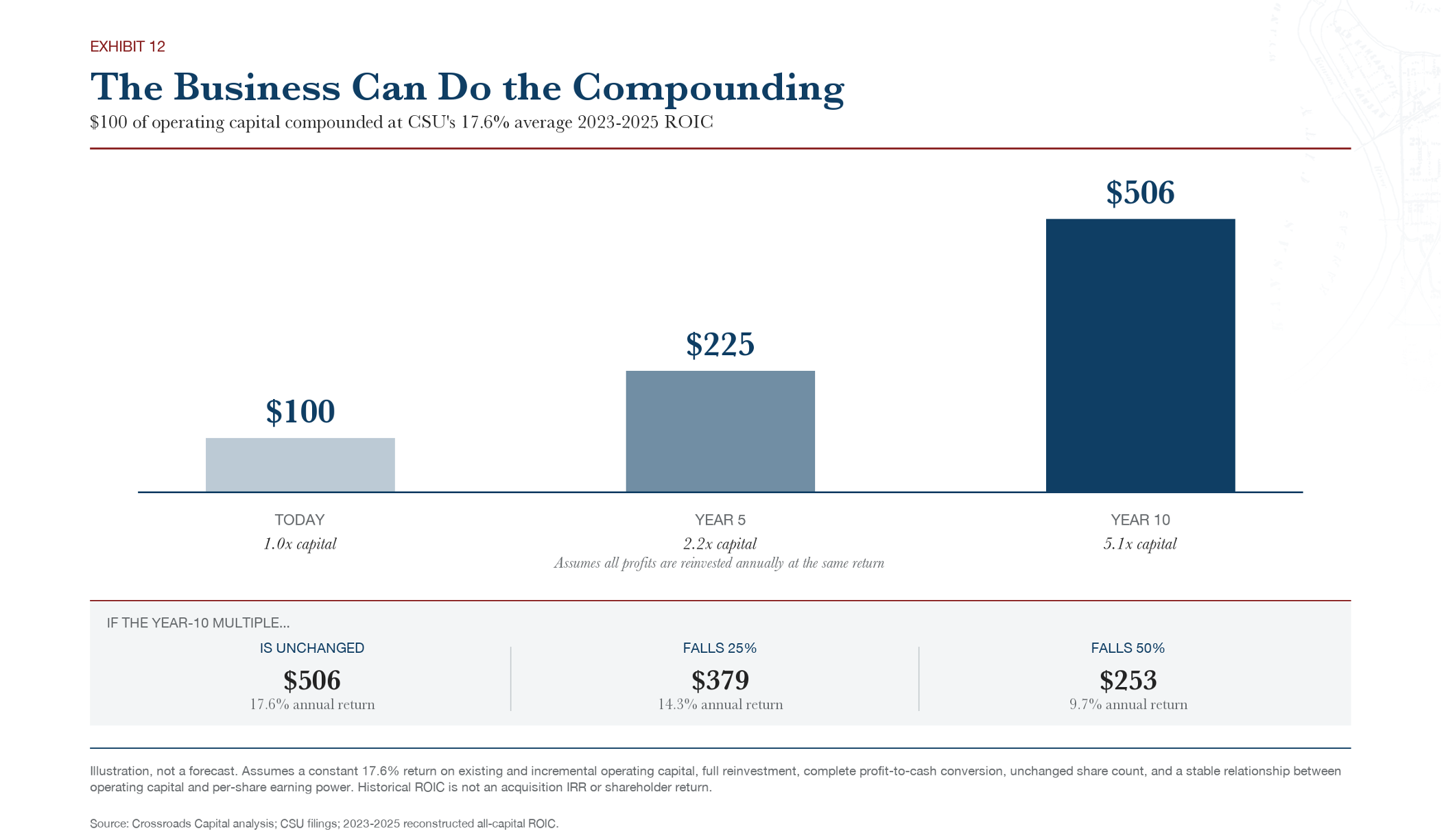
The arithmetic behind Buffett’s point is simple. Our reconstructed all-capital ROIC for CSU averaged approximately 17.6% from 2023 through 2025. If CSU could reinvest all of its profits at that rate for ten years, each $100 of operating capital today would grow to approximately $506. Under the further simplifying assumption that earning power grows with capital, even a 50% reduction in the valuation multiple over the decade ahead would leave that original $100 worth approximately $253, equivalent to an annual return of about 9.7%.
This is not our forecast, but an overly simplified illustration that nevertheless makes the source of the upside tangible. If CSU can continue putting growing sums to work at anything close to its recent returns, the business can do most of the compounding for us, even if the market never restores its old multiple.
The exhibit isolates the compounding mechanism. Our three scenarios return to the present and translate CSU’s trailing cash flow into a share price. Trailing FCFA2S of about US$2.0B works out to roughly US$96 a share, and because CSU’s share count has not changed since its 2006 IPO, growth in its total cash flow has been growth in cash flow per share. Each scenario applies a multiple to that trailing figure and converts the result to Canadian dollars at the September 30 exchange rate. To distinguish the outcome of our original underwriting from the opportunity available today, we measure each scenario against both our average cost of approximately C$2,526 and the September 30 closing price of C$2,894.73. The arithmetic is straightforward; what changes is the world each multiple describes. The first is the one the market increasingly appears to fear: software Armageddon.
In HBO’s The Last of Us, Joel Miller survives not by restoring the old world, but by learning how to operate in the far more hostile one that replaced it. If AI destroys much of the existing software industry, we think CSU can do something similar. Some business units hold up while others enter a prolonged decline, but even CSU’s zombies continue generating cash as customers leave gradually and investment is cut back. CSU can return that cash to shareholders or use it to acquire other declining assets at prices reflecting that it may be their only willing buyer and best available custodian (“caretaker” might be more apt here).
In that world, we see the market paying 11-14x FCFA2S, roughly where the skeptic’s math places the steady-state portfolio. That is the multiple of a low-growth business with questionable terminal value, but also one whose high-margin cash flow can continue growing through M&A even as organic revenue contracts and negative operating leverage erodes earnings power.
In a middle-ground scenario, AI captures parts of the customer interface and software spending without displacing the best vertical applications. Some BUs win, some lose, and the majority of the portfolio largely marches on. More important, the economic engine remains intact. Market dislocation lowers seller expectations and turns the industry into a buyer’s market, exactly the conditions CSU has built its entire model around, and capital is deployed at returns in line with, or better than, historical levels. Here, the market likely pays 21-27x FCFA2S, from today’s multiple to just below the 28x it paid at the end of 2020, and still well short of the roughly 39x it paid when ChatGPT arrived.
If the reports of software’s death have indeed been greatly exaggerated and the AI infection doesn’t spread, CSU is once again viewed as the Berkshire Hathaway of software, a world-class acquisition platform with three decades of experience buying, operating, and reinvesting the cash flows of indefinite-life software assets. What’s that worth? Reasonable minds can disagree on the exact multiple, but 35-40x FCFA2S feels right in our view, well short of the roughly 50x the market paid at the May 2025 peak.
Across all three scenarios, the common thread is that CSU can do well even if much of software doesn’t. With more than 1,100 businesses, CSU doesn’t need every software category or business unit to escape disruption. It needs the portfolio to keep generating enough cash to fund the engine, and it needs each new acquisition to earn an attractive return after whatever damage AI delivers. That’s the same assignment CSU has carried out for thirty years: stay disciplined on price, and keep directing capital toward the niches, geographies, and deal sizes everyone else can’t be bothered with. Wee Willie Keeler’s hitting advice could double as CSU’s mandate: “Keep your eye clear and hit ’em where they ain’t.”35
Disclaimers
+ Ownership of mentioned companies
At the time of publishing this report, we are long Constellation Software Inc. (TSX: CSU) equities. We may at any time and for any reason exit or reverse that position.
+ No guarantee of investment performance
Past performance of the financial instruments mentioned in this report should not be taken as an indication or guarantee of future results. The price, value of, and income from, any of the financial instruments mentioned in this report can rise as well as fall and may be affected by changes in economic, financial and political factors. Any projections, market outlooks or estimates in this presentation are forward-looking statements and are based upon certain assumptions. Other events that were not taken into account may occur and may significantly affect their returns or performance. Any projections, outlooks, or assumptions should not be construed to be indicative of the actual events that will occur. Future returns are not guaranteed. If a financial instrument is denominated in a currency other than the investor's home currency, a change in exchange rates may adversely affect the price of, value of, or income derived from that financial instrument. In addition, investors in securities such as ADRs, whose values are affected by the currency of the underlying security, effectively assume currency risk.
+ No guarantee of accuracy
While the information prepared in this document is believed to be accurate, Crossroads Capital, LLC (the “Investment Manager”) makes no representation or warranty as to the completeness, accuracy or timeliness of such information. The Fund and the Investment Manager expressly disclaim all liability for errors or omissions in, or the misuse or misinterpretation of, any information contained herein.
+ No obligation to update or act on information
The Investment Manager has no obligation to update any information contained herein, and may make investment decisions that are inconsistent with the views expressed herein. Any holdings of securities discussed herein are under periodic review and are subject to change at any time, without notice.
+ Not a recommendation to buy or sell any security
This report does not provide investment recommendations specific to individual investors. As such, the financial instruments discussed in this report may not be suitable for all investors, and investors must make their own investment decisions based upon their specific objectives and financial situation utilizing their own financial advisors as they deem necessary. Investors should consider this report as only a single factor in making an investment decision. All information provided is for informational purposes only and should not be deemed as investment or other professional advice or a recommendation to purchase or sell any specific security.
+ Not an offer to invest in our Fund
This report shall not constitute an offer to sell or the solicitation of any offer to buy limited partnership interests of Crossroads Capital Investment Partners, LP (the “Fund”) which may only be made at the time a qualified offeree receives a confidential private offering memorandum (“CPOM”), which contains important information (including investment objective, policies, risk factors, fees, tax implications and relevant qualifications), and only in those jurisdictions where permitted by law. In the case of any inconsistency between the descriptions or terms in this document and the CPOM, the CPOM shall control. The interests shall not be offered or sold in any jurisdiction in which such offer, solicitation or sale would be unlawful until the requirements of the laws of such jurisdiction have been satisfied.
+ Other disclaimers
All trade names, trademarks, and service marks herein are the property of their respective owners, who retain all proprietary rights over their use. This document may not be reproduced without the prior written consent of the Investment Manager.


