If you’d like to subscribe to Crossroads Capital Insights, please enter your email
Insights
Thank you! Your submission has been received!
Oops! Something went wrong while submitting the form.
Special Commentary
Avoiding Dogmatism and Managing Momentum
September 4, 2026
In his H1 letter to Fundsmith Equity Fund investors this past July, Fundsmith CEO Terry Smith surprisingly announced that he had pivoted to a more momentum-driven style of investing. Smith said he wasn’t sure when momentum investing would stop working, only that it will. He is correct, because, of course, all factors stop working eventually. But momentum (while it certainly has its fits and starts, as we’ve seen recently) has worked well: As any quant will tell you, it’s one of the most robust factor premia on record, persisting out of sample across time periods, geographies and asset classes.
The S&P 500 momentum index selects roughly 100 S&P 500 companies based on prior risk-adjusted momentum, excluding the most recent month, and applies volatility-based weighting and concentration constraints. It’s outperformed the regular S&P 500 by 4.6% annually over the ten years to 31 July 2026—and that’s after an 11% pullback in July. Momentum has clearly worked not just this year, but for the last decade. Anyone who dogmatically derides it isn’t paying attention.
As value-focused investors (with a differentiated view on what constitutes value), we’re momentum-agnostic. Many of our peers view momentum as a dirty word, often using the pejorative “momo” to describe both the style of investing and the stocks themselves. But this view ignores the fact that some stocks deserve strong momentum because their fundamentals are strong and inflecting. We’d go so far as to say that if, at any given time, at least one of your stocks isn’t in someone’s momentum bucket, you’re probably doing something wrong. To be clear, this is not an endorsement of momentum. Nor is it our “Fundsmith Moment.” We’re not announcing a pivot towards momentum investing. Rather, as value-oriented investors who have owned so-called “momentum stocks,” we feel it’s important to point out that the current discourse is entirely too polarized.
We believe the optimal state is to be momentum-agnostic but aware. Investing solely on price momentum is foolish, but ignoring momentum, and the massive pools of capital invested in the style, is also foolish—as is letting a stock’s classification as a “momentum stock” skew your analysis of its intrinsic value. Dogma is a dangerous thing in this business. Ten years of data might argue for leaning into momentum. But the same index has seen its annualized outperformance narrow over 20 and 30 years (~1.5% over 20 years and ~2.2% over 30) to a level we believe fundamental analysis can beat over similar horizons. So, while momentum is a durable investment “theme,” it has its own ebbs and flows, and those bring plenty of risk. Perhaps Fundsmith is discovering that now.
So, what should value investors do when they find themselves owning momentum stocks? First, unlike our peers, we do not believe stocks with positive momentum are inherently bad. If anything, we assume something good is happening at the fundamental level. We hunt for mispricings, and the common belief is that they appear only when price action is falling or sluggish. That’s often true, and we love to bottom-feed as much as anyone. But it’s just as common for a stock with strong momentum to remain underpriced, with the market only partially pricing in the positive developments and their potential. Nvidia is the classic example: the market simply couldn’t comprehend how good things were.
Sometimes, though, momentum gets ahead of itself and prices run too far. That does not mean a stock’s value won’t be higher in the future. It means a lack of catalysts, or a negative one, can break the momentum before that potential value is crystallized, and the position becomes a short-term drag on performance. Sometimes the right move is to sell and buy back later. But as tax-aware investors, with most of our capital in taxable accounts, we often have better options. Let’s look at some examples:
From the Book
Nebius’ price rose rapidly in June, thanks to Nasdaq-100 inclusion, the acquisition of Eigen AI, which strengthened its position as a full-stack AI cloud, and the growing trendiness of the neocloud trade. The move was grounded in fundamentals, yes, but its velocity indicated that the stock was a momentum darling. Our price target still sits above the June highs, but we looked to the options market for positively skewed risk/reward to exploit.
Layering options onto core convictions does several things for us. First, it removes some of the need to time a reversal perfectly. Selling or trimming and then buying back or adding to a position all depend on timing. The options market gives us longer-dated windows in which to create our own risk arbitrages. In this instance, we wrote calls at $300 and $350 that, if assigned, would have represented about 1/3 of our Nebius position, and turned a nice profit on them when the AI trade unwound in July. Had the momentum continued, we would have been happy to take assignment on those options and offload portions of our equity position at those prices. This was a prime example of our options strategy working as it ought, though success is not always assured.
Sometimes, the benefit of trimming or adding is simply too obvious to ignore. The ASTS drawdown in the last few months was one such instance, and we added near the lows. Given the serious catalysts we see in the next six to eighteen months, the price was too attractive to pass up. Before adding, though, we wrote $80 puts while the price straddled that level. Could we have simply written more options instead of adding? Sure, but when you know a business as well as we believe we know this one, there comes a point where the instinct to add or trim becomes too strong to sit on. To that end, why limit yourself to exploiting mispricings in one domain, when you can maximize your insights in several of them at the same time? If there’s a mispricing in the equity, there may be a compounded mispricing in the options.
With all that said, we try to avoid pure gut reactions. When we navigate the short-term volatility that comes with momentum trades, our deliberation centers on two areas: (1) testing our own frameworks and (2) reading short-term factors and trading dynamics.
Nick Sleep regularly referred to some variation of the cartoon above when discussing herd mentality. One man looks up into the sky at nothing in particular, and soon a crowd gathers around him trying to see what he sees. Which, of course, is nothing. But the draw to imitate combined with the fear of missing out pushes crowds of people to do irrational things. So when momentum carries a name past its fundamentals, we ask ourselves: Are we getting carried away with the crowd? What are we missing? We constantly try to poke holes in our own arguments. With Nebius in June, the speed of the price action told us expectations were beginning to outrun execution. Not that execution wasn’t around the corner. Rather, the name was being bucketed into a broader trade whose short-term execution and long-term prospects we were less comfortable with. In short, the stock was beginning to run away from us. So, to let profits run while limiting the damage if the move reversed, the options market was the clear answer.
In other instances, we test our conviction in a name against the reality of capital flows, using our internal risk metrics as a quantitative layer on top of our qualitative framework. The qualitative layer asks whether we still believe the thesis, while the quantitative layer asks whether the market’s positioning can hurt us before the thesis plays out. Reading the qualitative sentiment in ASTS is simple. In our view, the market still treats direct-to-device communications as Starlink’s to lose. Only two things will reverse that view: commercial partnerships and satellite launches, because they’re what give investors a line of sight to revenues. Both will take time.
Until then, the stock trades less on fundamentals than on factor exposure, which can dictate large moves. So, we covered some of our downside through the options market while adding to the position. That combination matched our own confidence on one side and the market’s perception on the other. Our hours of research and conversation behind each name make this sort of sense-checking easier to do. It matters most at the extremes, when a drawdown breeds anxiety or a rally breeds exuberance. In those moments we return to our judgment frameworks, use quantitative measures to back-test our intuition, and go to the options market to structure trades we can win. That discipline lets us hold key names through volatility while hedging against the speed of the momentum factor.
Conclusion
As we’ve said throughout, the push of the momentum trade, and its market-moving power, are not something we dismiss or avoid. We remain agnostic and treat it as something to be navigated: a key factor in the public equities game that every fund manager should strategize around. When a stock gets picked up by the momentum trade, we tend to read it as a sign that the fundamentals we underwrote at the start are kicking into full, or at least fuller, gear. But we do our best never to rest on our laurels, or to wallow if we end up on the wrong side of the P&L ledger. Looking for ways to steward our capital, limit our downside, and create our own asymmetric risk/reward is a tenet of our investment philosophy—and a proven winner.
Bloom Energy, Inc. (BE — NYSE) | These Are Not the Numbers You're Looking For
August 5, 2026
We are short Bloom Energy common stock and related derivatives.
Bloom had one job on its July 28 earnings call in our view: answer the scandium questions with actual numbers. Instead, management chose a more familiar routine: espousing theoretical absolutes, lawyered qualifiers, patronizing deflections, and a numbers-free detour through geology, collectively epitomizing everything that is wrong with Bloom’s approach to shareholder communications.
Click the button below to read our post-earnings update. SEE IMPORTANT DISCLAIMERS AT THE END OF THE REPORT.
Bloom Energy, Inc. (BE — NYSE) | Situational Awareness Collides with Physical Awareness—Exposing a Supply Wall and Hidden China Risks
July 9, 2026
We are short Bloom Energy (BE) and related derivatives. In the full report linked below we outline the reasons why we think the stock is not properly pricing in certain risks. We may at any time and for any reason exit or reverse those positions.
The AI build-out has been booming for nearly everything that touches a data center, and for much of it the enthusiasm is deserved: compute must be powered, cooled, and connected, and the firms selling those picks and shovels have watched their earnings prospects and valuations soar. But as adoption accelerates, undercapitalized sub-sectors—memory, substrates, physical power—are having trouble absorbing what amounts to a demand shock, and thus are attracting supernormal investor expectations and outsized share price moves. Solutions to alleviate these critical constraints that otherwise would never have seen the light of day are now not only being evaluated, but are being purchased at volumes that exceed their own capacity to deliver.
The investors swept up in this are best described as “Bottleneck Investors”: chasing constraints in the AI supply chain in the belief that there is multi-year visibility or an evolving moat in the new regime, with little understanding of the technology they are underwriting or the real limitations of what they are buying. While some bottlenecks may have an elongated upcycle and thus have further to go, a demand shock doesn’t typically lend itself to smooth sailing after it is alleviated.
There is one company whose bottleneck-induced upcycle is running straight into a supply wall, one that caps the revenue growth and earnings generation the market is pricing in, and when that becomes visible, the repricing should be severe.
Bloom Energy (BE) has been swept up as one of the bottleneck winners in the power sector. It makes on-site power that does not produce emissions thanks to its solid-oxide fuel cell (SOFC) technology, previously viewed as a science experiment. Now, given AI-driven demand and grid permitting bureaucracy, fuel cells look like an appealing solution despite sitting at the top end of the power-cost curve, with names like Oracle and Nebius booking gigawatts of capacity. The stock has run with additional fuel from retail following the “brand name” investors of this cycle who have what we call “Situational Awareness.” Click the button below to read our full 30-page writeup. SEE IMPORTANT DISCLAIMERS AT THE END OF THE REPORT.
As Crossroads hits a decade of searching for value in public markets, we thought it worthwhile to continue the conversation we began last summer when we discussed our understanding of value (linked here). In brief, our view is that value is dynamic, perhaps better described as organic, and is continuously developing inside the evolving complex markets that remain our hunting ground. In that earlier note, we focused on the directional orientation of valuation. There is backward-looking valuation, driven by metrics and Fama-French categories that characterize the stereotypical “value” investor, and then there is forward-looking valuation, in which businesses are evaluated relative to their normalized earnings power a few years out. Typically the latter is where the real money is made, because the gap between what a business looks like today and what it will look like at a normalized run rate is precisely where the market’s pricing machinery breaks down.
On that note, we’ve often placed our positions into one of two categories: emerging compounders and special situations. But ultimately, value is found in market mispricings, not in the categorical groupings themselves. Recall that the goal of fundamental investing is to pay a price for a stake in a business that is less than its true value in the expectation that price and value will converge, earning an excess return as the gap closes. For that reason, understanding why mispricings emerge and when they can be taken advantage of is the foundation of our ongoing search for value.
There are three general types of mispricings, and in each one human psychology does most of the heavy lifting. Below, we look at each type in turn.
The Three Types of Mispricing
Duration Mispricing
The first type is what we'll call duration mispricing. It’s created by the short-term incentive structures that govern institutional capital: Performance is measured in months, fees are paid against benchmarks reset annually, and careers are made and lost on the next print. The result is a profession whose participants cannot afford to be early even when they’re right. Blaise Pascal wrote in 1670 that “all of humanity's problems stem from man's inability to sit quietly in a room alone.” That line describes the modern institutional investor with uncomfortable precision: all portfolio managers’ miseries derive from their being unable to leave their best positions alone. The asset management profession is structurally designed to prevent exactly the behavior most likely to produce strong returns.
Warren Buffett described the flip side of Pascal’s idea at the 1998 Berkshire annual meeting: “We don't get paid for activity, just for being right. As to how long we’ll wait, we’ll wait indefinitely.” Clearly, Buffett had no problem sitting quietly and letting his investment theses play out. Indeed, Buffett noted in a 1999 BusinessWeek interview that investing success does not correlate with raw intelligence above a modest baseline; instead, it correlates to temperament, specifically the capacity to resist the urges that get other people into trouble.
Buffett’s distinction reframes the entire investing skill set. The binding constraint on returns is not analytical horsepower, but behavioral discipline under conditions that punish that very same discipline in the short run. The investors who blow up are very rarely the dumb ones. Instead, they’re often the bright ones who could not “sit quietly in a room alone” and felt compelled to “improve” a system that did not need improving. Long-Term Capital Management later that decade provide two well-documented case studies of exactly that pathology: extraordinary intellectual firepower, working machines that produced spectacular risk-adjusted returns on autopilot, and then a fatal urge to extract more by fiddling with the very mechanisms that were already working.
In the fight between waiting and wanting, wanting almost always prevails. Incentives form desires, and short-term reward structures hijack the nervous system, producing the stress, anxiety, and emotional irritability that drive bad decisions. Our perception of time also stretches when our wants are forced to wait, and in a culture engineered for instant gratification, the willingness to wait is continuously diminishing. Patience, in our experience, is less an absence of action than what one surgeon described as “staying focused on what matters, even when it takes time.” It can be incredibly difficult to follow the advice of the famous old quip, “Don't just do something—stand there!”
That is duration mispricing in one sentence. Pod shops and benchmark-tethered allocators cannot stand there, so they trade. We can stand there, so we upgrade while we wait. Our patience has been well rewarded since we started Crossroads in 2016, and we believe it will continue to be.
With that in mind, we have continued to see a duration mispricing play out with Nintendo, as pod shops, representing the bulk of institutional capital in the market today, have been unable to look through the perceived near-term headwinds surrounding rising memory input prices, despite it being negligible to both COGS and margins. We think the ongoing structural change in the memory complex is actually a tailwind to Nintendo’s business. We’ll leave the details for a standalone piece, but with Switch 2 competitors substantially more exposed and large quantities of inventory already on hand at Nintendo, these investors simply don’t have the luxury of time to wait for this incorrect view to reverse course. Given that we first invested in the company in 2018, we remain patiently waiting for the market to recognize Nintendo as an economic juggernaut that continues to upgrade its revenue base and increase its incremental margins. And even better, it gives us a high degree of optionality and downside protection while we wait.
Diagnosing a duration mispricing is the easy part. Exploiting one requires a deliberate operating architecture, because the same human wiring that leads other market participants to produce the mispricing also tempts us to accept it as legitimate. Buffett and Munger spent six decades engineering around this problem, and three habits from their record stand out. We’ve tried to implement versions of all three at Crossroads:
The first is timing the search to the cycle. Buffett did not run his idea-screening process continuously at the same intensity. He ran it cold during expensive markets and hot during cheap ones. He terminated his partnership in 1970 and made effectively no public-market investments until 1974, by which point the S&P 500 P/E had compressed from 20 to 7 and he was selling stocks bought recently at three times earnings to buy stocks selling at two times earnings. He repeated the pattern from 1984 to 1987: not a single new equity position added to the Berkshire portfolio across that stretch, sitting on a mountain of cash, doing nothing. Then in the second half of 1987 he deployed over a billion dollars (roughly 25% of Berkshire's book value) into a single non-controlled position in Coca-Cola. The biggest bets came out of the longest waits. The pairing is not coincidental. Waiting is what made the size of the eventual bet defensible.
The second is redirecting intellectual energy into channels where the activity cannot damage the main book. Buffett did not suppress his analytical hunger during the dry stretches. Instead, he transferred that focus and energy into a variety of separate but adjacent interests: Smaller special situations in his personal account that were too small to matter at Berkshire scale. Buying distressed corporate bonds when equities ran rich (over a billion dollars of Finova bonds at deep discounts in 2001). Dabbling in REITs, silver, or asset classes entirely outside the space in which impatience could hurt his partners. Combined with hobbies that absorb intellectual energy outside of markets entirely (bridge for Buffett, omnivorous cross-disciplinary reading for Munger), this architecture is one of deliberately constructed sandboxes for the restlessness that investors can’t will away. The right question is not how to be less curious, but rather where can curiosity be expressed without compromising the discipline that matters?
The third is building an adversarial second filter into the process. Buffett would screen an idea, get past his own evaluation, and then run it past Munger, whose job was specifically to find the flaw and shoot the idea down. Most ideas died there. The ones that survived both filters were, by construction, the no-brainers: what Buffett called “waiting for the phone to ring.” The architecture is adversarial on purpose. It’s much easier for two independent thinkers operating in sequence to kill a bad idea than for one thinker to talk himself out of an idea he’s already partway sold on. We’ve worked to build the same internal dynamic at Crossroads in a way that matches our scale, because the alternative (a single decision-maker increasingly persuaded by his own analysis) is the most expensive failure mode in this business. As PM, the buck stops with yours truly, but letting a devil’s advocate put up roadblocks to prevent mistakes is always a good way of preventing poor judgment in a business where judgment is everything.
Taken together, those three habits point to something beyond Pascal’s maxim: Sitting quietly in a room alone is not a passive state. It’s an actively maintained one, supported by deliberate structure. The investors who succeed at doing nothing for years at a time are not the ones with the least intellectual energy, but rather the ones who have engineered the most disciplined places for its use.
Framework Mispricing
The second type of mispricing is framework mispricing. Market participants are trained to process new information; they are not trained to question whether the framework through which they’re processing it is appropriate. The result is that genuinely new business architectures get evaluated against templates that don’t fit them, and the gap between what the business has become and what the market is willing to call it can persist for years.
While Nintendo fits this category in its own way, our investment in AST SpaceMobile very much remains a framework mispricing in our view: Investors continue to project an outdated and generic mental model onto the space sector, considering it to be an uninvestable wasteland. Layer on the SPAC element, the direct competition with Elon, and the fact that ASTS has been pre-revenue with active ATM programs for much of its public history, and you have ample ingredients for a setup where investors will take years to overcome their cognitive biases. Underneath that framework is a business and management team we believe will ultimately prove the company to be worth many multiples of where it is valued today. In other words, we see ample evidence that AST will emerge as a business of unquestionable quality, backed by numerous moats and a visionary management team, and that it remains grotesquely mispriced by any reasonable measure of its future earnings capacity. In short, the mispricing is due to the framework, not the facts.
Business Transformation Mispricing
A third form of mispricing comes from business transformations. These are situations in which value-unlocking change, driven by structural factors, is overlooked by the market. Markets are pricing engines built for continuity. They extrapolate what a business is worth today into what it will be worth tomorrow. Naturally, when a company transforms internally or its industry restructures around it, the financial data lag reality: earnings reflect the old model, analyst frameworks anchor to historical relationships, and the shareholder base was selected for a company that no longer exists. The bigger the change, the wider the gap—and the longer the gap persists, because the investors who own the stock are often the last ones to recognize what the company is becoming. Crossroads targets this window explicitly, whether the discontinuity originates inside the company or is imposed from outside, and uses the change itself as the resolution mechanism.
Our investment in FTAI aims to exploit that company’s ongoing business transformation: FTAI originally spun out from a conglomerate of industrial transportation assets before evolving into a pure-play aviation platform in 2022. Having started as a conventional jet engine lessor, it continues to advance its vertically integrated economic model with an overlooked pricing engine (bad pun intended), which allowed it to create a novel, nimble, and flexible approach to creating value in an industry predisposed to inertia. More recently, FTAI has begun to replace its invested capital with third-party partners, advancing the business into an asset-light, fee-bearing model. For its next act, FTAI plans to leverage its existing competitive advantages to convert end-of-life engines into 25MW turbines, a material opportunity not reflected in present financial performance. The structural change is real, and the financial disclosures have begun to reflect it—but the market is still processing the company through the template that fit it five years ago.
Why Mispricings Happen
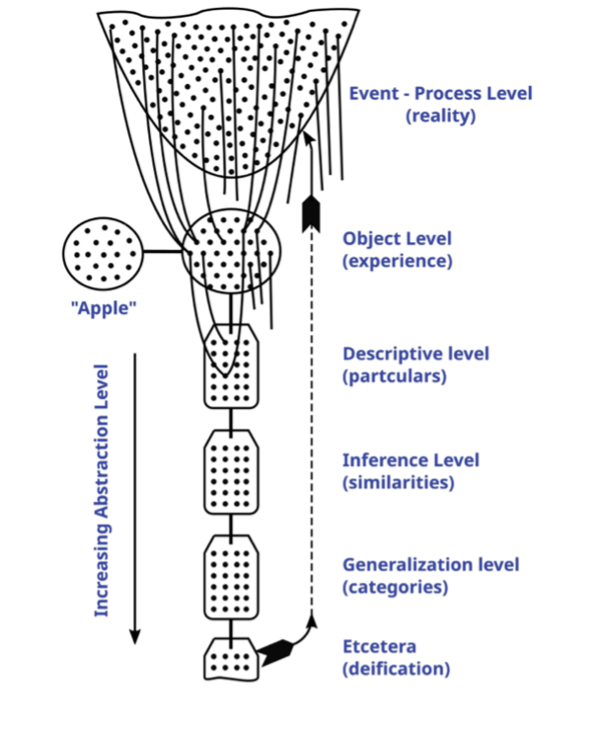
The phenomenon of persistent mispricings across public markets can be linked to the essential nature of the human brain and how we understand reality. We perceive reality through our senses, and we immediately attempt to categorize, name, and assign descriptors to it. The closer, more frequent, and more complete experience we have with an object, the more likely we are to comprehend it. Thomas Aquinas described this concept as the agreement of thought and thing, meaning we are right when the idea we have of something corresponds to the thing itself. A helpful visual for the way in which we come to know things comes from Alfred Korzybski, a philosopher in the realm of semantics. In 1925, he created a training device called the Structural Differential, a model and tool for understanding human knowledge:
As reality presents us with, say, an apple, we experience that reality through our senses and immediately abstract the experience to higher and higher levels of categories, applying tags or labels such as color, shape, form, species, flavor, and so on. Given this process of moving from the particular to the universal, the categories and values we assign to an object are more likely to be correct when we’ve had frequent complete views of, and encounters with, that object. Conversely the farther we are from an object, and the less exposure we have to it, the less likely we are to properly comprehend it. At its core (no apple pun intended), this is a concept everyone intuitively understands. When we tell two people, “Get to know each other”, we obviously don’t mean they should think about the other person, abstracting generalizations about each other from across the room. No, of course we mean they should spend time together, speak to each other, observe each other, and so forth. In short, knowledge is tied to experience.
This is all well and good, but what does it have to do with investing? The willingness to “get to know” a business determines the accuracy of our understanding of that business. Mispricings are really instances in which the market’s “thought” about a business does not match the “thing” itself, as investors attempt to categorize and understand something they have not taken the time to truly experience. A business undergoing a transformation, or whose thesis takes longer to play out than institutional capital is willing to wait, is like a speck on the desert horizon. That speck could be an oasis or a mirage. The heat haze obscures your vision. Ultimately, we don’t know what it is until we get close enough to see it clearly. But markets move fast. They see the speck of dust, and given incentive structures, timelines, and capacity for patience, categorize it. They’ve seen specks of dust like it before and apply that same thinking to this new spot on the horizon. By working to truly know the true nature of that spot on the horizon, by trudging along until we can get close enough to see it clearly, we are, on occasion, rewarded with an oasis—an investment opportunity that rewards our effort even though (or arguably precisely because) the market overlooked it.
Indeed, a willingness to pay close attention can yield surprisingly powerful results. Vincent Van Gogh was an almost obsessive observer of nature, spending much of his time outdoors. It might seem odd, then that his famous work "Starry Night" (shown below) is quite abstract. It doesn’t seem to be the work of someone who paid close attention to the details of the night sky.
In fact, critics initially deemed “Starry Night” too stylized, abstract, and unrealistic. However, it has since been commended by physicists and fluid dynamicists who found that it accurately depicts the mathematical theory of turbulence (the dynamism of energy through air in patterns that resemble eddies or waves) with near-perfect precision in at least fourteen different instances.
Coincidence? Perhaps. But Van Gogh’s willingness to stop and stare, to “get to know” his subject matter, may have helped him to create something almost miraculous. His painting may be quite abstract, but his abstractions are rooted in a deep, intimate understanding of his subject. "Starry Night” demonstrates the revelations that close attention to a subject matter can produce. At Crossroads, we take the time to immerse ourselves in the details of the companies we research, with the goal of being able to see things others can’t, like the swirls Van Gogh saw in an empty night sky.
To summarize, humans have a better chance of correctly understanding reality when they experience it directly and closely, instead of perceiving it through abstractions made at a distance. Fortunately for us, markets are constantly moving, with many investors glancing at events and announcements made by businesses and quickly assigning categories and values to them. These investors therefore often misunderstand or completely fail to recognize the true nature of these events. Mr. Market looks at reality from thirty thousand feet (or, if you prefer, a corner office on the fiftieth floor), so mispricings inevitably occur. Those who get as close as possible to the facts, and who can recognize patterns the abstracting machine has skipped over, are the ones best positioned to exploit value gaps before they close.
Our Edge
We believe our durable edge is thanks to the wealth of information we obtain through deep, close study of our companies and their industries. We try to get as close to events as possible, increasing the likelihood that we’ll understand the reality of the situation. As the spy novelist John le Carré said, “a desk is a dangerous place from which to view the world.”
That proximity is only half of our edge. The other half is the operating architecture described above, and the two halves are inseparable. Close study without behavioral discipline produces conviction at the wrong moments. Behavioral discipline without close study produces patience without a reason to act on it. The combination of deep, detailed work on a small number of businesses, and an operating structure that allows us to wait as long as the gap takes to close, is the edge we believe we possess.
In practice, that means three things. First, we calibrate the intensity of our search to the opportunity set rather than to the calendar. When public equities are richly priced and the obvious work has already been done by everyone else, we slow our equity position decision-making and broaden our aperture to adjacent corners of the capital structure and to special situations where size is not an advantage. We don’t feel the need to fill our portfolio for the sake of filling it, and our partners should not expect us to. Second, we route our analytical restlessness into channels that do not contaminate the core book. The personal-account special situations, the deep dives into industries we do not yet have positions in, the eclectic reading habits that run across disciplines are not hobbies but sandboxes we can play in while sitting still on the names that matter. Third, we have built an internal process in which ideas are stress-tested adversarially before they become positions. Once an analyst has invested time in a thesis, his natural tendency is to find reasons why it’s right. That’s why we construct an environment in which the reasons it might be wrong are surfaced by someone whose job in that conversation is specifically to look for them.
Of course, we still get things wrong. But with a willingness to go one step further than the herd, the patience to wait for a gap to close on a timeline dictated by the business itself (and not by the calendar), and an operating structure that converts intellectual energy into discipline rather than into trades, we believe we can continue to find great businesses at attractive prices. That is the work. That is what we are paid for.
“I assume our whole payment systems will be stablecoins in 10 or 15 years” – Stanley Druckenmiller
I) Introduction
The bank currently prepared to profit from Druckenmillers’ prophecy is currently either underappreciated or ignored.
But what if you could pair the growth potential of a highly scalable tech company with a heavily regulated moat, add in significant optionality in a nascent market, all while trading at 1x 2026 book value and 9x earnings? The founder-led VersaBank (VBNK) is just that, and in our view, one of the rarest setups we come across: a compounding business with second compounding emerging business attached, both available for roughly the liquidation price of the first.
We've been building our position at an average cost basis of roughly $14.97 per share for the U.S. equity (~C$20.70 for VBNK.TO), a price we believe is fair-to-cheap for a specialty lender with a virtually spotless 30-year credit record. And for effectively no incremental cost, we’ve been gifted access to U.S. market entry, where the core flywheel is spinning inside a structurally larger and higher-margin market, with attached optionality on Real Bank Tokenized Deposits, which we believe could be one of the more consequential emerging franchises in fintech this decade.
VersaBank sits squarely inside the framework that has defined our best work at Crossroads: long-duration transformation paired with emerging secular growth, where the market has mistaken a previous chapter for the whole book.
On the surface, VersaBank is priced as a niche Canadian B2B bank, gathering deposits and extending financing digitally through third-party intermediaries. We believe VersaBank will soon be understood for what it is: a high-moat financial-technology business leveraging its proprietary platform to create uniquely profitable outcomes for financial partners. With not one but two imminent growth drivers leading to a rapid inflection in earnings power, we see plausible scenarios where VersaBank equity appreciates 3x, 5x, or 10x over the next 2–3 years.
From its beginnings as a tiny trust company in 1993 with just C$20 million in assets, founder-CEO David Taylor transformed VersaBank into a branchless, technology-driven bank that now boasts over C$6 billion in assets and considerable market share in its Canadian niche. Most of its business comes from its Receivable Purchase Program (RPP), in which the company buys the cash flows of point-of-sale loans while its customer, the lender, keeps the loan on its balance sheet. Impressively, in the 30 years of operations, the bank has incurred virtually zero loan losses due to its unique funding model.
Although timing is never precise in this kind of work, the clock on VersaBank is less ambiguous than most. The U.S. transition is ending after a year of elevated one-time costs and the natural learning curve of entering a new market. The regulation-mandated sale of the non-core cybersecurity business should conclude within the next few months. The RBTD initiative is moving from pilots to production at exactly the moment the GENIUS/CLARITY Acts and the current OCC interpretive letters are clearing a runway for real-bank tokenized deposits. Each of these is the kind of friction that causes investors to ignore a name until the fog lifts, but each area of concern is resolving in the next several quarters. Given the nature of the true business, that fog will benefit investors willing to take a long–term orientation.
The first key catalyst occurred in the late summer of 2024, when VersaBank began its transformation into a U.S. entity with the acquisition of Stearns Bank Holdingford, securing a rare U.S. national bank charter. This move gave VersaBank a permanent platform to expand its unique model into the unpenetrated U.S. market, a market 30x larger than Canada. Not only is the U.S. opportunity vastly larger in scale, but funding costs are structurally lower, enabling VersaBank to capture higher margins than in Canada.
The marriage of larger TAM and higher margins sets up VersaBank's U.S. expansion as one of the most important growth vectors in the company's history, with the potential to multiply assets and earnings far beyond what the Canadian franchise could achieve.
As the U.S. business begins to demonstrate its high-growth potential, patient investors have the chance to enter a franchise that we believe can conservatively generate 5x returns over the next five years.
The core-business story is persuasive on its own but embedded within VersaBank is a far larger catalyst: a potential 50x-plus return opportunity in Real Bank Tokenized Deposits (RBTDs). VersaBank's RBTD initiative offers a tokenized bank deposit platform that could capture tens of billions in low-cost deposits even if the CLARITY Act does not pass and current OCC rules are implemented. The market hasn't recognized it, and for those who think they have, the true opportunity is orders of magnitude larger than they realize.
II) Investment Thesis
Our report will discuss the company in Canadian dollars as it currently reports as such, though has a NASDAQ listing where we have invested given the domicile transition that is to occur in a few months. At today’s price of ~C$20 per share, VersaBank trades around book value given expected earnings and proceeds from the sale of its cybersecurity business in the next few months. Clearly, the market is effectively assigning minimal credit to U.S. growth or RBTD optionality.
There are several reasons for this current mispricing:
Liquidity constraints created a forced exclusion of mandate–driven investors: Ownership is unusually concentrated with three key players, including Taylor, holding over 40% of the float. With only C$500M+ in market cap and C$500K+ in average daily volume, institutions simply cannot build a position of meaningful size, if at all. Corporate structural change in April coupled with likely inclusion in the Russell 2000 index later this year, means that investors positioning ahead of these catalysts can capture the multiple expansion that follows as a broader investor base closes the illiquidity discount currently embedded in the stock.
Investor base in limbo as VersaBank transitions into a U.S. entity: Caught between two worlds as Versa enters the U.S. market, U.S. investors offhandedly associate it with the Canadian bank cohort and its perceived structural inferiorities. Canadian investors, on the other hand, adopt the “elbows up” approach towards anything American. Investors with a longer time horizon can take advantage of this shift in ownership before the transformation is apparent at all.
Reduced near–term earnings and ROE reaching their inflection points: VersaBank has spent the past two years preparing to operate at scale in the United States. The transition has temporarily reduced near-term earnings by over 20%, reflecting the one-time costs required under Federal Reserve oversight. We expect earnings growth to accelerate meaningfully in 2026, with the U.S. division surpassing the Canadian one within roughly a year or two.
Sell side’s misplaced concern with delays in U.S. RPP rollout: The company’s U.S. RPP rollout has drawn skepticism from investors due to a slower-than-expected start, reinforcing the sell side’s perception that the CEO sometimes “overpromises.” The slow start was really a product of expectations on timing, not RPP viability, as adaption to U.S. processes required four to five months of detailed work to align credit boxes, cash flow mechanics, and servicing protocols. With those hurdles now behind them, asset growth is accelerating.
Real Bank Tokenized Deposits’ true upside completely ignored or misunderstood: VersaBank’s Real Bank Tokenized Deposits (RBTDs) are the first true open-network bank-issued stablecoin alternative, making it deposit-insured, interest-bearing, and blockchain-native, backed by U.S. treasuries. If adopted, they could attract tens of billions in near-zero-cost deposits, fundamentally transforming VersaBank’s funding base.
Sale of DRT Cyber division increases earnings, hones in on core business lines, and adds to margin of safety: The company is in the process of selling its DRT Cyber subsidiary in a mandated sale, expected to close within the next few months as per U.S. banking rules. Since DRTC was run profit neutral, the divestiture of VersaBank’s subsidiary DRT Cyber should improve earnings two-fold via “addition by subtraction” and provide more capital to deploy to core business lines.
We’d be remiss if we didn’t highlight the potential risks embedded in the company which include: execution missteps in the U.S. RPP growth (e.g., slower onboarding of new partners), regulatory delays of RBTDs due to the CLARITY Act legislative fight, and potential credibility concerns around the CEO’s ambitious targets. At the macro level, VersaBank remains moderately exposed to changes in interest rates, broader credit market stress affecting consumer spending, and PoS loan demand, as well as regulatory or policy shifts in either Canada or the U.S. that could alter the economics of specialty finance or digital banking.
In the following piece, we will break down both these core business lines and each catalyst in greater detail.
III) Business Analysis
VersaBank operates through two main segments (once DRTC is sold): its core Digital Banking operations, driven primarily by the RPP for point-of-sale financing, and its nascent Digital Meteor division, which offers Real Bank Tokenized Deposits (RBTDs), a form of tokenized bank deposits. Let’s analyze each segment’s customers, value proposition, and competitive landscape:
i) Digital Banking Division
VersaBank’s Digital Banking division is a federally regulated platform operating as an infrastructure provider to specialty lends and financial institutions. The division utilizes proprietary technology to monitor partner cash flows and credit performance, enabling efficient balance sheet deployment with minimal operating overhead. By leaning heavily on technology, the Digital Banking business has impressive operating leverage. At scale the business can generate a sub-25% efficiency ratio, compared to most U.S. banks’ efficiency ratios of 50–60%.
The company has a very sticky deposit base, with over 200 customers comprised of deposit brokers (80%) and licensed insolvency trustee firms (20%). All deposits are term deposits, removing the risk of capital flight. Additionally, depositors have no direct access to their deposits.
Receivable Purchase Program (RPP) – A Point-of-Sale Financing Engine
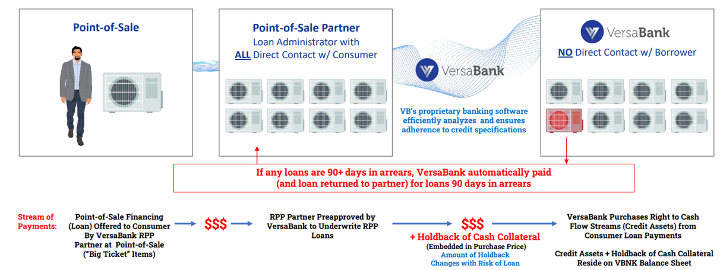
VersaBank’s RPP funding model creates a rare win–win–win ecosystem for consumers, finance partners, and, of course, VersaBank itself. Rather than competing directly for retail customers, VersaBank’s RPP provides funding to finance companies (partners) who extend point-of-sale (PoS) loans and leases to consumers for items like home HVAC systems, pools, appliances, etc. Importantly, VersaBank purchases the cash flow streams from these consumer loans at par (versus ~75% from conventional sources) by supplying the PoS partner with upfront capital. The PoS partner, the loan administrator, keeps the loans on its balance sheet, continues to service the loans, and maintains the customer relationship, while VersaBank earns the interest payments with minimal administrative overhead.
In exchange for providing immediate funding on a PoS loan, VersaBank structures the RPP so that if a borrower defaults, the PoS partner is required to immediately repay the remaining balance to VersaBank, thereby eliminating credit risk. Below is the company’s presentation of RPP.
Consumers and retailers have access to easier sales processes and more affordable financing options. Consumers can finance “big ticket” purchases on installment plans (e.g. a $12K item financed 20% down at ~13% interest, paid in ~$227 monthly installments) at lower rates than credit cards offer, and with less paperwork than a HELOC. This process then gives the retailer an easier path to sales.
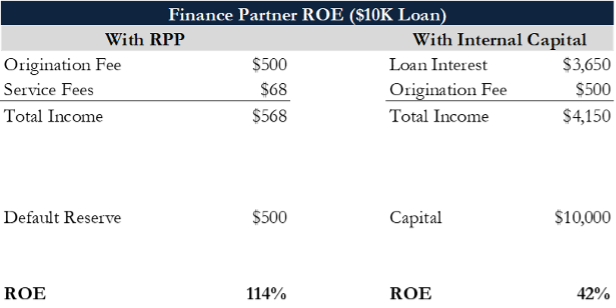
Finance partners are transformed into originators or servicers, with a greater ROE than they’d experience using internal capital. The retailer’s finance partner gets paid immediately (at par or better) for the loans it originated, thereby generating cash flow from origination and servicing the loan. The finance partner can massively amplify its ROE by originating more loans with the freed-up capital. Since the loan stays on the balance sheet, PoS partners’ increased scale gives them access to cheaper funding from other sources, as well as improved data advantages and commercial credibility.
VersaBank is then left with a high–yield loan portfolio with remarkably low credit risk. Importantly, since VersaBank is not customer-facing, it avoids the patchwork of state-level consumer finance regulations that typically slow down specialty finance firms, enabling faster and more scalable growth.
Default Risk: Transferring Loan Responsibility to PoS Partners
VersaBank’s unique RPP structure and its near–total avoidance of default risk are worth further explanation. PoS partners must post 5% cash reserves, ~2x historical default rates, and repurchase or cover any loans that reach 90+ days delinquent, ensuring VersaBank is made whole on the remaining balance. Additionally, VersaBank deliberately concentrates its exposure in large home improvement transactions where loans typically require 20%+ down payments and are often value-accretive for the consumer, with the home itself serving as implicit collateral.
By restricting relationships to established partners serving prime and super-prime borrowers, VersaBank has never recorded a material loan loss, even amidst economic downturns. The necessary environment to produce a loss for VersaBank, after successfully navigating the GFC and COVID, would have to be near apocalyptic. Should specialty lenders default en masse, the loans get put back and VersaBank avoids any loss to book value.
An Illustrative RPP Transaction and its Economics
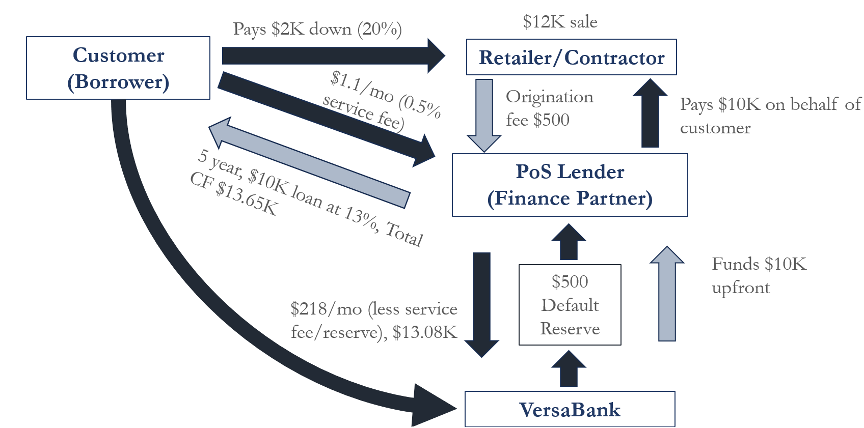
Below is an illustrative example of an RPP loan for a $12K HVAC purchase, at 20% down on a 5-year term, with a 13% interest rate and a 5% origination fee that is paid by the retailer/contractor.
A customer purchases a product or service from a retailer or contractor, who in turn relies on a specialty finance firm to provide financing that supports the sale. VersaBank funds these specialty finance partners by advancing the full loan amount upfront, while requiring the partner to retain only ~5% of the loan’s value (recall this is >2x the lending verticals historical credit losses) on its balance sheet. In return, VersaBank receives the cash flows from the loan, net of servicing fees paid to the finance firm.
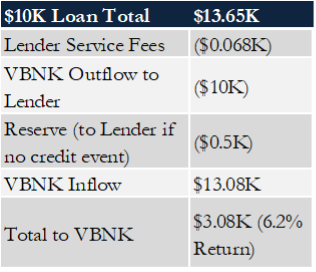
The sources and uses for the loan are detailed below.
Interest rates on loans vary from 9% to 17% depending on the terms, but typically VersaBank targets a 6% return. For cost of funds, VersaBank only issues CDs or GICs to banks and security dealers, ranging from 1 year to 5 years (to match the duration of its RPP portfolio). Recent data shows GICs with 3.7% interest rates (1-3 years), equating to VersaBank’s NIM of 2.5%, consistent with guidance.
In the U.S, management expects to earn higher yields on RPP, which, when accompanied by lower U.S. CD rates, should enable expansion of its historical ~2.5% NIM.
Another avenue for VersaBank is securitization of these loans. Securitization yields a lower margin (~1% fee income), but it frees up capital and allows VersaBank to scale volume beyond its balance sheet. The bank reported adding its first RPP securitization partner in 2025, and plans to expand this channel.
Partner Dynamics: VersaBank Improves ROE, Confers Data Advantages
Partnering with VersaBank’s RPP enables faster growth, stronger cash flow generation, and lower unit costs. Real-time, 100% advance funding positions partners as larger, more competitive players in OEM and retailer RFPs, which in turn compresses spreads across the rest of their capital stack (ABS, bank loans).
VersaBank leverages its proprietary cloud-based Asset Management System (AMS) to onboard partners and automate loan purchases, with minimal incremental operating cost. The platform, which includes API-based funding, real-time reconciliation, and loan-level analytics, enhances underwriting and collections, reducing losses and accelerating decision-making. The result is higher win rates, preservation of lender-of-record status, and more efficient recycling of first-loss equity, which in turn yield greater operating leverage and higher ROE for partners.
The remarkable economics VersaBank’s partners receive by way of ROE improvement are worth breaking down. Notably, the following is ex cost–of–funds for simplicity. With originated loans effectively carried only against a ~5% default reserve, the RPP structure frees significant capital for partners, allowing them to scale more rapidly and shift their economics from yield management toward capital-light origination and servicing.
Discussions with multiple partners indicate that VersaBank’s RPP is so accretive to ROE that it now accounts for nearly 50% of their funding mix.
Competitive Dynamics: Unique Product Protected by Focus and Low-Cost Ops
VersaBank’s RPP stands apart as a purpose-built funding alternative for point-of-sale lenders. Unlike traditional warehouse lines or securitizations, the program delivers real-time, 100% advance funding without competing for the end customer relationship. This creates a “banking-as-a-service” niche, where partners can scale origination rapidly, market themselves as larger counterparties in OEM and retailer RFPs, and tighten execution costs across the rest of their capital stack. Conversations with VersaBank partners highlight their strong focus and service-oriented approach, making them highly collaborative and noticeably more attentive than competitors.
An additional advantage stems from the company’s development of an AI module to ingest real-time loan data from partners, accelerating the time to assess and purchase a loan from days/weeks to minutes/hours. Traditional options such as bank credit lines, securitizations, or retained equity, are slower, more restrictive, or scale-dependent, leaving a gap that RPP squarely fills. With a 15-year operating history, proprietary API-based infrastructure, and loan-level analytics, VersaBank has engineered a system that improves underwriting discipline, accelerates collections, and materially enhances ROE for its partners.
Even if peers attempt to replicate the product with less efficient infrastructure, VersaBank’s digital-first operating model should ensure that its cost and speed advantages remain intact. It’s worth reiterating that RPP converts specialty finance firms from balance-sheet-intensive lenders into capital-light originators and servicers. In our view, it’s rare to find a business whose core product is as transformative and scalable as VersaBank’s RPP solutions. Should others enter the space, we would expect an industry-wide shift from ABS to RPP financing, rather than a displacement of VersaBank.
Market Trends: Larger Markets and Structurally Higher NIM
In Canada, VersaBank has 30 finance partners and holds an estimated 50% share of the Canadian PoS market (~C$65B market, ~10% financed). Home improvement financing makes up almost half of the Canadian PoS market. From industry conversations in Canada, the financing share of this market is expected to expand to 75% financed over time, growing to ~$C50 billion, ~20% per annum over the next ten years. In total, the financing market applicable to Canadian RPP should grow 15%-20% per annum.
The U.S. home improvement market is ~$400B and has no competing solution to RPP, as many U.S. firms use ABS or bank lending. VersaBank’s differentiated offering fits naturally between the two. A flagship example in the U.S. is Watercress Financial, a fast-growing originator of home improvement loans via a contractor network that became VersaBank’s inaugural U.S. RPP partner in 2025. VersaBank has added 4 more RPP customers this year and we believe it has a line of sight to 10 new logos this year.
The total U.S. PoS market is enormous, estimated to be almost $2 trillion. Another vertical in the U.S. utilizing a similar form of financing is the heavy equipment industry (farming, mining, construction), estimated at ~$500 billion.
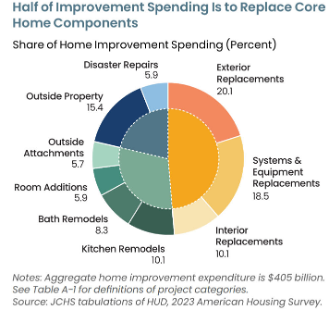
The U.S. housing market is defined by aging stock, with the average home nearly 44 years old. This drives ongoing demand for big-ticket replacements. Together these items represent roughly 50% of a $400 billion market, as shown below.
Source: Harvard Housing Study 2023.
In the home improvement market, roughly 80% of purchases are funded with cash or home equity loans, ~5% with credit cards, and only ~2% through VersaBank’s specialty: contractor-arranged financing. Comparatively, mature markets for large-ticket items, such as autos, typically normalize at ~80% financed, suggesting home improvement financing is still in the early stages of penetration and has substantial room to grow.
Our discussions with large originators, such as GreenSky, point to this market expansion which has accelerated in the last few years as cost pressures on consumers increased in parallel with housing stock needs.
To reiterate, U.S. banking market has structurally higher NIMs than in Canada, by roughly 150 bps at ~3.5%. As VersaBank scales its U.S. operations, we expect its consolidated NIM to expand accordingly. Given the size of the market, its low financing penetration, and the lack of an existing RPP presence, VersaBank does not need dominant share to scale materially. Even a handful of strong partnerships can drive significant asset growth in this under-served segment, with returns exceeding those historically generated.
ii) Digital Meteor Division: Real Bank Tokenized Deposits (RBTDs) or “Stablecoin-as-a-Service”
VersaBank’s Digital Meteor division has developed a bank-issued stablecoin or tokenized deposit, branded as Real Bank Tokenized Deposits (RBTDs). The initial technology was developed in 2018, and the first pilot, titled VCAD, launched in Canada in 2021 before regulators blocked any potential use cases. Today, the company is piloting the USDV RBTD, which should be active in 2026 with regulatory tailwinds from the GENIUS Act's implementing rules and anticipated passage of the CLARITY Act. Additionally, Canada has become more receptive to the technology as its adoption gains momentum in the United States.
Each RBTD represents a one-for-one claim on cash held at the bank and is fully collateralized by actual deposits at VersaBank. Unlike conventional stablecoins such as USDC or Tether, RBTDs are like any other deposit — issued by a federally regulated institution, carrying deposit insurance, and are interest–bearing—advantages that crypto-native issuers cannot legally match.
In practice, RBTDs move across blockchain networks (currently Algorand, Ethereum, and Stellar), enabling 24/7 settlement and near-instant payments. At the customer level, VersaBank’s RBTD interface (VersaView) is designed to be familiar, a digital wallet that operates no differently than a standard bank account.
Issuance and redemption are managed through the bank’s proprietary VersaVault infrastructure and VersaView e-wallet, both SOC2-audited systems with layered encryption and compliance controls.
VersaBank has two options: 1) hold third-party stablecoins for thin NIMs, or 2) issue its own RBTDs and capture the full float, fee, and licensing economics. The first is an extension of existing services; the second is the order-of-magnitude opportunity which we will describe in further detail below.
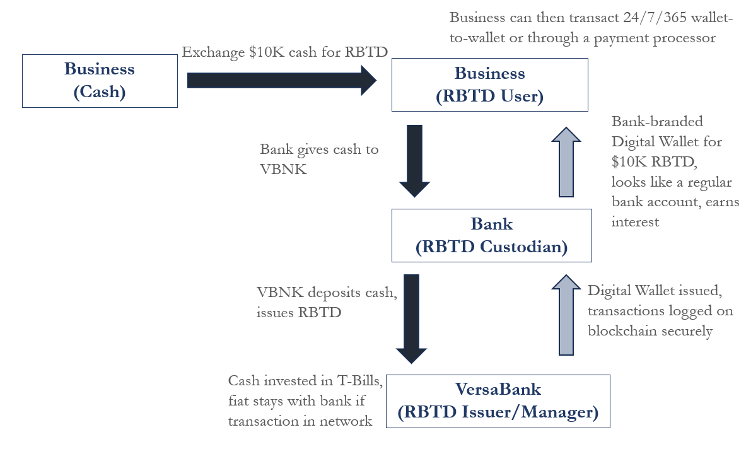
Illustrative RBTD Conversion Process
The process of converting fiat into RBTDs is quite simple. The key point is that all transaction capital in the RBTD system resides at VersaBank as low-cost funding. That capital stays parked so long as activity remains on-network, with VersaBank sharing issuance and servicing economics with partners, while customers gain 24/7 payments, lower transaction costs, and interest on their balances.
RBTD balances would sit on VersaBank books as ultra-low-cost deposits, which can be recycled into interest-earning assets. At the very least, fiat is placed into Treasuries for a risk-free spread. Management, however, has indicated possible regulatory clearance to allow channeling the cash into high-yield RPP loans. Either way, RBTDs function as a scalable, cheap, deposit base with considerable earnings potential at high margins.
Presented below are two possible NIMs for RBTDs assuming 1% interest rate (though most deposit accounts are ~0.1%), on $10 billion in total deposits.
With just $10B in RBTD deposits and no incremental costs, VersaBank could generate 5-10x of its current net income on just the float. Recent early RBTD clients, at 0.5% NIM, are not representative of future earnings potential, as the company tests monetization by offering initial partners a larger split of the earnings as an incentive. Either way, any margin would be plenty of upside.
Should VersaBank sit at the center of a RBTD network as the issuer and settlement anchor, it can also generate considerable earnings by managing the capital flows in the system. Even with lower fees than competing payment rails, and sharing 50% of the fees with partners, these earnings amount to billions in transaction volume. A generalized RBTD fee schedule is detailed below.
If the illustrative $10 billionin transactions turns over about six times per year, the resulting fees couldresemble the figures in this table.
VersaBank’s fees alone in this conservative example could equal 2-3x VersaBank’s current net income.
While $10 billion sounds like a large number, the amount of capital in just CAD/USD FX is in the trillions, and we believe VersaBank has a line of sight to capture $100 billion in potential RBTDs.
Customer Dynamics: Ease of Digital Payments with the Benefits of a FDIC-Insured Bank
VersaBank is positioning RBTDs as a “deposit-as-a-service” solution for other institutions and fintechs, white-labeling its technology so that banks, payment providers, large retailers, and other fintech companies can easily launch their own branded digital tokens with the deposits at VersaBank.
Outside of the few largest banks, most institutions should see access to VersaBank’s RBTD platform as logically attractive. Using VersaBank’s platform allows them to bypass regulatory processes and any significant investment to build their own blockchain infrastructure, while defending deposits from fintechs and megabanks, monetizing transaction flow, and positioning themselves in digital finance.
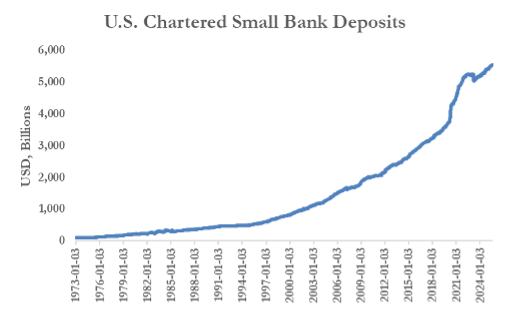
U.S. small banks hold nearly $6 trillion in deposits. Within that pool, corporate treasury and FX accounts, VersaBank’s initial RBTD target market, represent an estimated 5-10% of deposits, or $275-$550 billion. Capturing just 1–2% of that market would translate to $50-$100 billion.
Source: FDIC.
When a U.S. bank’s customer purchases RBTD tokens (representing U.S. dollar deposits), the underlying funds are placed with VersaBank to back those tokens.
Partner banks don’t view this as a capital loss. RBTD-funded dollars might otherwise leave the bank entirely if customers moved funds to alternatives. The tradeoff for partner banks is as follows: forego marginal funding income in exchange for reduced regulatory burden and a competitive digital product, without materially altering the bank’s own balance sheet.
How does this benefit Versa, since its model of holding and managing partner RBTD reserves increases its own asset base, potentially diluting its regulatory ratios? Versa views this as a revenue opportunity to maximally monetize its existing balance sheet by capturing the full effect of fees and interest, with the potential to deploy that money into higher-yielding vehicles.
And let’s not forget about payment processors. Firms like Fiserv and Jack Henry could license VersaBank’s RBTD platform to embed a regulated, interest-bearing digital money layer directly into their core banking and payments infrastructure. While these firms already power account processing, ACH, wires, and card acquiring, they currently lack a compliant mechanism for tokenized real-time deposits that can move across blockchain rails. VersaBank’s infrastructure would let it offer bank-grade digital receipts (CADV/USDV) to thousands of mid-tier banks, enabling instant B2B payments, FX, and programmable treasury tools. This expands its platform defensibility and opens new revenue streams via transaction fees, API access, and yield-sharing on deposit float.
Competitive Dynamics: The Only Institutionally Ready Multi-Party Solution
The concept of tokenized bank deposits is new, but interest is growing in the financial industry. A few large banks have experimented internally (JPMorgan’s JPM Coin for institutional clients), and consortia have discussed interoperable deposit tokens.
However, VersaBank is one of the first to publicly pilot a retail/business-facing deposit token on public blockchains, and importantly, to offer it as a service to other firms. We believe numerous FX trading firms and North American corporations have already signaled their interest in VersaBank’s solution for FX and day-to-day treasury management.
Major stablecoin issuers like Circle (USDC) and Tether could be seen as indirect competitors, but if regulations require stablecoins to be bank-issued, those companies might instead become partners or clients (by partnering with banks for issuance). The GENIUS Act already prohibits stablecoin issuers from paying interest directly, and the OCC's February 2026 proposed rules go further by targeting third-party workarounds like the Circle-Coinbase arrangement. RBTDs, as bank deposits, face no such restriction, and therefore can legally pay interest under existing banking law.
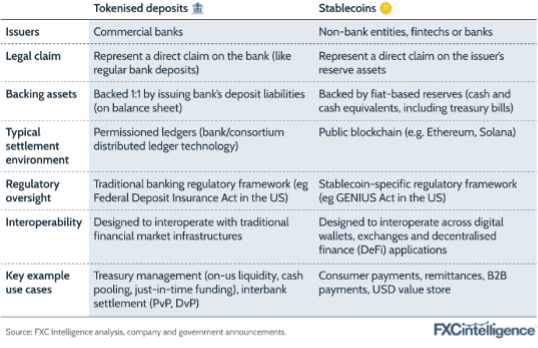
A comparison of tokenized deposits versus stablecoins is shown below.
Source: FXCintelligence.
Along the lines of the comparison above, Visa and Stripe are piloting stablecoins largely aimed at consumer-facing use cases such as retail checkouts, gig economy payouts, and card-like settlement flows where ease of acceptance matters more than yield or balance sheet treatment. In contrast, tokenized deposits like RBTDs are built for institutional money movement: interbank transfers, corporate treasury, and cross-border FX where settlement risk, deposit insurance, and the ability to earn interest on idle balances matter. It may be that stablecoins dominate where commerce meets the consumer, while RBTDs are better suited to the plumbing of wholesale payments and liquidity management.
For now, VersaBank’s first-mover advantage and proprietary IP should give it a head start. Even if that head start translates into only a few percentage points of total market share, the sheer scale of trillions in capital flows could grow the RBTD business exponentially, leading to earnings potential up to 100x its current RPP franchise.
Market Trends: Huge Transaction Volume and Regulatory Tailwinds
The total addressable market for RBTDs is vast, especially when you consider opportunities outside of FX. Extension into interbank treasury liquidity ($500+ billion), institutional cash management ($100+ billion), merchant settlement rails ($10+ billion), and programmable payouts for embedded finance systems ($10+ billion) for Versa’s RBTDs should be considered live options. The stablecoin market itself provides a useful proxy: issuance has already more than doubled to ~$300 billion, and forecasts suggest it could reach $2 trillion by 2028 as tokenized cash becomes a backbone of payment infrastructure, and a possible demand source for U.S. treasuries.
The regulatory background includes two pieces of legislation which both benefit RBTD adoption. The GENIUS and Clarity Act, besides acting as a tailwind for VersaBank’s RBTD offering, indicate that the banking lobby has made sure that the playing field tilts its way. If the rules come out as expected (benefitting FDIC-insured issuers and restricting non-bank stablecoins), VersaBank will have a green light to commercialize RBTDs with far less uncertainty. That could spur rapid growth in deposits and trigger partnerships with fintechs or even bigger banks that prefer not to build their own tech.
Our conversations with regulators suggest there is little concern about the rapid growth of this type of deposit base, given that it is expected to be backed by Treasuries.
iii) DRT Cyber (~C$10M in Revenue, Regulatory Sale by mid-2026)
VersaBank also owns a small U.S.-based cybersecurity consulting subsidiary (DRT Cyber), which performs services like penetration testing for financial institutions and police departments. While a solid business with ~400 clients, it’s non-core. Under U.S. bank regulations, VersaBank is required to divest DRT Cyber by 2026, and as discussed earlier, the likely sale of this unit is a catalyst to simplify the story and return focus to the high-margin banking segments. DRT Cyber is expected to be sold for C$30-$50 million later this year.
iv) Management: “Outsider” Founder-CEO with Impressive 30-Year Track Record
VersaBank is led by David Taylor, a career banker and technologist who has built the institution from the ground up. In 1993, he acquired a small trust company with just C$20 million in assets and used proprietary software to transform it into one of the world’s first fully digital, branchless banks, today exceeding C$6 billion in assets.
Over three decades, his model has delivered virtually zero loan losses, even through multiple credit cycles, underscoring a disciplined approach to risk management. Taylor is known for being ahead of the regulatory curve—sometimes to the bank’s short-term detriment, but consistently validating his vision over time. Taylor retains a ~5% ownership stake, ensuring alignment with shareholders, and his reputation and credibility with regulators have greatly aided VersaBank’s ongoing transformation. Going forward, we believe he has effectively created a regulatory moat, positioning the bank to scale faster and with fewer compliance hurdles than peers.
III) Valuation Analysis
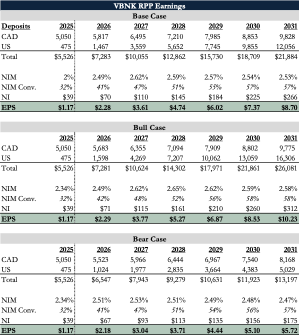
VersaBank is rapidly scaling its RPP product in the U.S. while continuing to grow strongly in Canada. We assume RPP assets expand into the tens of billions, maintaining historical economics, even though early signs suggest the U.S. rollout could prove more profitable.
To frame the opportunity, we present three scenarios in which RPP earning assets reach approximately C$13 billion, C$20 billion, and C$25 billion by 2031. In each case, we adjust net interest margins accordingly, while keeping NIM conversion fixed, as the model’s operating leverage should materialize with any level of asset growth. All figures are shown in Canadian dollars.
At a share price of C$20/share, our RPP scenario above implies an earnings yield ranging from 30% to 60%. With future growth, VersaBank trades at 2x to 3.5x P/E depending on the scenario. Through a cycle, considering the bank is highly unlikely to take credit losses and therefore incur book value impairments, we see the bull forecast as an “when, not if” scenario.
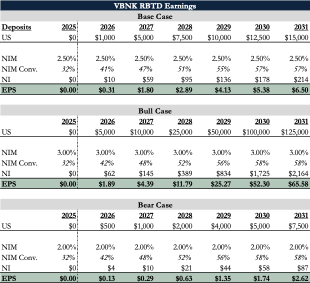
Turning to RBTDs, we model three scenarios where treasury-backed earning assets scale to C$7.5 billion, C$15 billion, and C$100+ billion by 2031. We assume a net interest margin of 2% to 3%, though the spread could be higher if RBTDs pay under 1% interest while treasuries yield around 4%.
With earnings yield scenarios ranging from a 15% increase to our bull scenario where EPS is three times the current share price, these projections remain surprisingly conservative on total amount, NIM, and NIM conversion.
As stated before, we believe that the existing customers in discussion with VersaBank already amount to $100 billion in possible RBTD assets set to come on stream in the next few years.
In the case of NIM, this analysis assumes that VersaBank cannot apply some of the capital deposited for RBTDs towards RPP. And with NIM conversion, while we apply VersaBank’s strong operating leverage from RPP to the RBTD analysis, most scaling costs for the RBTD business are already in the past. This means the assumed NIM conversion understates the true profitability since these assets convert nearly 99% of earnings directly to the bottom line, with taxes as the main expense (NIM conversion should be 75%).
Lastly, we don’t include potential earnings from transaction fees, as the upside here is already impressive, though we described them in the RBTD section above.
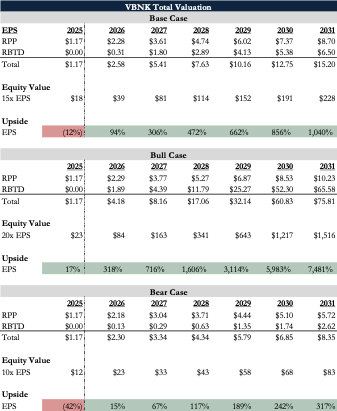
Bringing everything together, below is our combined valuation of RPP and RBTD for each of the scenarios.
The upside distribution here is uniquely asymmetric, and in the case of RBTD, mostly “free”. Even in the worst case, there’s a 15% gain in 2026 (with 2025 behind us, though shown for completeness). But if RBTD assets scale to $100+ billion in earning assets, the return generated explodes to an astonishing 75x by 2031. This rare risk-reward profile highlights the transformative potential in RBTDs.
Again, we haven’t included license fees that could come from the likes of Fiserv and others. The opportunity set presented above is plenty bullish for now.
IV) Why Now?
VersaBank has spent the last two years laying the groundwork for its U.S. expansion, and that heavy lifting is finally behind it. The upfront costs associated with the acquisition of a U.S. bank charter, and the one-time costs tied to regulatory approvals and operational systems are near completion. The sale of DRT Cyber should free up capital to fund new RPP assets. Against this backdrop, the business is poised to begin scaling RPP in the U.S. at structurally higher margins. And as we hope we’ve made clear, the Real Bank Tokenized Deposits (RBTD) business is primed for a zero-to-one inflection in the next 6-12 months, an option completely free to investors today.
V) Downside Protection
VersaBank is trading around book value and has unique downside protection as a bank that has reported nearly zero credit losses over 30 years. Its RPP contract structure forces partners to repurchase loans that go 90 days delinquent, shielding it from consumer credit risk. Additionally, the sale of DRT Cyber for C$1-$1.60 per share (~10%) further protects VBNK investors’ downside.
VI) Conclusion
Mispriced as a sleepy Canadian bank, VersaBank is a founder-led technology platform with proven credit discipline, downside protection, and a clear runway for asymmetric growth. With U.S. RPPs now scaling, one-time costs rolling off, and index inclusion likely, the stock offers investors a rare chance to buy a compounding bank franchise at around book value. Even with simple improvement in the base business, we believe VBNK can conservatively return 5x over the next five years, a 35%+ IRR per annum.
If RBTDs scale as our research suggests, VersaBank could evolve from a niche bank valued near book into a core infrastructure provider for the next generation of digital payments, commanding fintech-style multiples. Even a modest $10 billion in RBTD deposits could drive an almost 10x return, while $100 billion, already within line of sight from our exhaustive research, could imply over 50x upside.
Disclaimers
+ No guarantee of investment performance
Past performance of the financial instruments mentioned in this report should not be taken as an indication or guarantee of future results. The price, value of, and income from, any of the financial instruments mentioned in this report can rise as well as fall and may be affected by changes in economic, financial and political factors. Any projections, market outlooks or estimates in this presentation are forward looking statements and are based upon certain assumptions. Other events that were not taken into account may occur and may significantly affect their returns or performance. Any projections, outlooks, or assumptions should not be construed to be indicative of the actual events that will occur. Future returns are not guaranteed. If a financial instrument is denominated in a currency other than the investor's home currency, a change in exchange rates may adversely affect the price of, value of, or income derived from that financial instrument. In addition, investors in securities such as ADRs, whose values are affected by the currency of the underlying security, effectively assume currency risk.
+ No guarantee of accuracy
While the information prepared in this document is believed to be accurate, Crossroads Capital, LLC (the “Investment Manager”) makes no representation or warranty as to the completeness, accuracy or timeliness of such information. The Fund and the Investment Manager expressly disclaim all liability for errors or omissions in, or the misuse or misinterpretation of, any information contained herein.
+ No obligation to update or act on information
The Investment Manager has no obligation to update any information contained herein and may make investment decisions that are inconsistent with the views expressed herein. Any holdings of securities discussed herein are under periodic review and are subject to change at any time, without notice.
+ Not a recommendation to buy or sell any security
This report does not provide investment recommendations specific to individual investors. As such, the financial instruments discussed in this report may not be suitable for all investors, and investors must make their own investment decisions based upon their specific objectives and financial situation utilizing their own financial advisors as they deem necessary. Investors should consider this report as only a single factor in making an investment decision. All information provided is for informational purposes only and should not be deemed as investment or other professional advice or a recommendation to purchase or sell any specific security.
+ Not an offer to invest in our Fund
This report, which is being provided on a confidential basis, shall not constitute an offer to sell or the solicitation of any offer to buy limited partnership interests of Crossroads Capital Investment Partners, LP (the “Fund”) which may only be made at the time a qualified offeree receives a confidential private offering memorandum (“CPOM”), which contains important information (including investment objective, policies, risk factors, fees, tax implications and relevant qualifications), and only in those jurisdictions where permitted by law. In the case of any inconsistency between the descriptions or terms in this document and the CPOM, the CPOM shall control. The interests shall not be offered or sold in any jurisdiction in which such offer, solicitation or sale would be unlawful until the requirements of the laws of such jurisdiction have been satisfied. This document is not intended for public use or distribution.
+ Other disclaimers
All trade names, trademarks, and service marks herein are the property of their respective owners, who retain all proprietary rights over their use. This document is confidential and may not be disseminated or reproduced without the prior written consent of the Investment Manager.
"Roads? Where we're going, we don't need roads." —Dr. Emmett Brown, Back to The Future
Why Merlin?
At the end of the 1985 classic sci-fi comedy Back to the Future, the eccentric but brilliant scientist Emmett “Doc” Brown utters the famous quote on the cover page of this report as his DeLorean lifts into the sky: “Roads? Where we’re going, we don’t need roads.” In aviation, Merlin Labs (MRLN) is making a similar conceptual leap—away from the traditional limitations of runways and human pilot constraints, and toward a world where autonomy radically expands the capabilities of legacy airframes.
Merlin is building one of the world’s first autonomous digital pilots—not an incremental improvement to legacy autopilot systems, but a fundamental reimagining of how autonomy integrates with human‑crewed aircraft. Traditional autopilot handles steady‑state cruise; Merlin’s aircraft‑agnostic AI listens to live air‑traffic control radio, interprets complex human instructions in real time, and executes entire missions from taxi to landing. Unlike traditional autopilot, its AI “flight OS” is designed to make real‑time decisions, operate in GPS‑denied environments, and replace the scarcest, most expensive input in aviation: skilled pilots on critical missions. On the defense side alone, Merlin already has over 800 aircraft under contract across platforms like the C‑130J and KC‑135, implying roughly $3 million per tail in upfront integration and $2 million in annual recurring software revenue once fully ramped—a $1.6-billion ARR line of sight within the next several years on just these two aircraft alone. At our roughly $6.80 per‑share economic cost basis via rights (BACQR), we believe the current valuation reflects SPAC stigma and general investor ignorance more than business quality, creating a rare case where a frontier defense‑grade autonomy asset trades at a deep discount to normalized earnings a few years from today.
Our variant view is simple: the market sees a quirky SPAC and a hard‑to‑model autonomy story without much disclosure; we see the leading candidate to become the operating system of record for defense‑grade autonomous flight, backed by tier‑one partners (GE Aerospace, Northrop Grumman, Honeywell), Baillie Gifford and other high‑signal PIPE investors, and an installed‑base licensing model with clear unit economics. If Merlin merely executes on existing defense programs, we see multi‑bagger potential; if it successfully extends into broader U.S. and allied defense fleets and selected civil use cases over time, the upside is an order of magnitude higher.
Why Now?
Merlin’s first day of trading was March 17, 2026, after going public via a business combination with Inflection Point Asset Management (more on them later). We believe the company sits ahead of the competition to establish itself as a category-defining AI-driven defense and autonomy platform—a market niche that commands among the highest multiples within the broader software market. In our view, Merlin is the rarest kind of IPO: one where the technology is already flying, the contracts are already signed, and the insiders who know the story best used the quiet period before public price discovery to increase their positions rather than cash out. We think now is the inflection point because three structural pressures are converging. First, the U.S. Air Force has been roughly 2,000 pilots short of its 21,000‑person requirement for over a decade, with shortages projected to worsen as pilots age and demand rises. Second, pilot expense accounts for roughly 11–25% of total operating costs for commercial cargo operators, making any credible single‑pilot solution immediately interesting to both defense and civil customers. Third, GPS‑denied navigation has shifted from theoretical edge case to operational requirement in modern electronic warfare environments, elevating the value of Merlin’s ability to operate independently of GPS or continuous ground links.
We believe Merlin’s shrewd decision to focus near‑ and medium‑term on semi‑autonomous, single‑pilot operations—rather than going straight for fully autonomous flight—is a key part of the story and couldn’t have come at a more opportune time. In practical terms, taking DoD aircraft from two pilots to one with Merlin installed represents around $7 million of annual savings per aircraft and hundreds of millions in aggregate on a $7–10 billion annual aircraft and pilot operations budget. Regulatory progress is tracking that pragmatism: Merlin is the only peer to have secured U.S. FAA approval for a key avionics’ module, a roughly five‑year process that confers a meaningful first‑mover advantage and has already achieved SOI‑2 regulatory milestones with New Zealand’s aviation authority under a framework that can accelerate reciprocal FAA approval. Naturally we believe retrofitting existing aircraft is the near-term commercial beachhead. Merlin’s platform‑agnostic, backwards‑compatible system allows customers to upgrade in‑service military and commercial fleets rather than rip‑and‑replace for new-built hardware, converting tens of thousands of already‑owned aircraft into a future recurring‑software revenue base. That retrofit‑first strategy, combined with cost‑plus to fixed‑fee contract structures and IDIQ ceilings that can be raised without re‑bids, creates a capital‑efficient path from initial engineering programs to high‑margin software annuities as fleets are converted over time. Together, these forces don’t just create a market opportunity—they create an urgency that rewards whichever platform establishes fleet-wide lock-in first, making the architecture and contract structure of Merlin’s business a central question. In our view, Merlin’s architecture and contract structure matter because they are what turn a one‑off autonomy demo into a durable, high‑margin software annuity: a retrofit‑first, aircraft‑agnostic “flight OS” installed via cost‑plus IDIQ contracts that then convert into $2 million per‑tail annual licenses across an 800‑aircraft (and growing) defense fleet. Business Overview
Merlin first appeared on our radar somewhat by chance. As a concentrated fund with large investments in AST SpaceMobile (“ASTS”) and FTAI Aviation (“FTAI”), we spend a disproportionate amount of time studying adjacent space‑technology and aerospace/defense themes, and Merlin emerged from that work as an unexpected potential category leader. Discovering a company with a plausible pole position at the vanguard of a paradigm shift in aviation was not on our bingo card, to put it lightly.
As noted above, Merlin is developing “aircraft‑agnostic” AI software known as the Merlin Pilot, with the long‑term goal of giving every plane the power to fly itself from takeoff to touchdown. What stands out is not just the ambition, but the sequencing: management has taken an astute, pragmatic path, moving in lockstep with customers, partners, and regulators with a near‑ and medium‑term focus on semi‑autonomous, single‑pilot operations rather than leaping straight to full autonomy.
Recall, Pilot is a platform‑agnostic, integrated system that is backwards‑compatible with older and in‑service aircraft. This matters because retrofitting existing aircraft is by far the most relevant near‑term use case, as customers can meaningfully reduce human‑pilot hours and mitigate structural pilot shortages without buying a single new airframe.
By focusing on semi‑autonomous retrofit, Merlin has aligned itself with the current appetite of regulators and defense customers, establishing real product‑market fit instead of building science‑project technology years ahead of demand. In our experience aviation software is crowded with moonshot R&D programs that promise the world but require heavy maintenance overhauls and/or full fleet rip‑and‑replace approach. Merlin’s backwards compatibility, by contrast, unlocks massive capital efficiency and rapid market penetration by upgrading existing military and commercial fleets rather than waiting for new‑build aircraft. In plain English, Merlin is turning tens of thousands of already‑owned planes into a future high margin recurring revenue base, with far lower upfront cost and fewer regulatory and operational hurdles than alternative paths.
Regulatory progress is tracking this strategy. Merlin is the only peer to have secured U.S. FAA approval for a key avionics module, a roughly five‑year process that confers a meaningful first‑mover advantage. Outside the U.S., the company has obtained a flight‑testing certificate and Stage of Involvement 2 (SOI‑2) clearance from New Zealand’s aviation authority for its software review process—a milestone that confirms a significant portion of Merlin’s Flight Control Computer data and testing has been reviewed and accepted. Bilateral arrangements between New Zealand and the FAA for reciprocal recognition of certain airworthiness approvals should, in our view, accelerate progress toward full U.S. certification.
On the commercial side, Merlin Pilot targets cargo and regional operators seeking autonomy without buying new airframes. Early work with Ameriflight already points to strong retrofit demand and compelling fleet economics. That said, we expect the near‑ and medium‑term story to be dominated by military and defense applications, where Merlin appears almost unnaturally well suited to the moment.
All of which is to say that the operating momentum building beneath the surface is real. Merlin has successfully leveraged deep industry relationships to secure tier‑one partnerships across the U.S. military and defense ecosystem. USSOCOM has awarded a $105 million production contract to automate the C‑130J, and the U.S. Air Force has signed an additional agreement to test Merlin’s AI‑enabled software on the KC‑135. These programs create a visible pathway from prototypes to fleet‑wide adoption. Put differently, Merlin is not just another autonomy vendor bidding for grants; we believe it is on track to become the first true defense‑grade autonomy prime contractor in aviation—a substantial feat, and one that should be well rewarded in public markets if the team simply continues to execute on existing contracts. Pivotal Players Merlin is led by founder and CEO Matt George, who previously served in the Executive Office of the President of the United States, where he supported presidential initiatives with a focus on healthcare and data analytics, and who subsequently founded and led venture-backed transportation startup Bridj. George conceived Merlin after a near-miss with a JetBlue aircraft while learning to fly in Vermont—an experience that crystallized the case for aviation based autonomous systems that could eliminate the most common sources of human error. He has been building Merlin ever since (November 2018), deliberately sitting out the SPAC frenzy of 2020–2022 to focus on product development and contract execution before bringing the company public.
George’s public statements reveal a founder who speaks with the clarity and conviction of someone who knows exactly where the company needs to go. At the BCA signing, he declared: “We’re taking Merlin public to deliver the world’s first defense-grade autonomy stack and advance towards delivering the operating system of record for aircraft big and small. Our national security represents the highest stakes proving ground. Defense airframes log over four million flight-hours per year; AI that has earned trust there earns it anywhere.” And when the PIPE was upsized, the message carried the same frequency: “This additional capital reflects the strong momentum we’ve built since announcing our SPAC transaction and the confidence investors have in our revenue growth, scalability, and path toward becoming a public company.”
We believe George has the disciplined urgency of a pioneering founder who has spent seven years building Merlin in the shadows before inviting in the spotlights of public markets. We believe Merlin is a long-term story, one measured in fleet penetration and software annuity revenue, not quarterly earnings beats, as the technology seeks to become an operating system of record offering defense-grade autonomy. For a better sense of why we think Mr. George is the right kind of crazy for this mission, read his first letter to shareholders released in the days leading up to this week’s IPO.
We’ve also been impressed with the team George has assembled around him, a necessary ingredient for any scale up operating in a frontier industry. CTO Tim Burns brings deep aerospace engineering credibility: Chief Engineer positions at Honda Aircraft Company and L3Harris Technologies, and Vice President of Engineering at Thales Aerospace. Chief Program Officer Krishnan Anand, who oversees management and strategic execution of Merlin’s autonomy programs, brings prior experience at Supernal, Wisk, and Lockheed Martin. In advance of the public listing, Merlin further expanded its leadership bench with new CLO Leslie Ravestein, CPO David Lasater, and CFO Ryan Carrithers—signaling a deliberate build-out of institutional-grade corporate infrastructure, exactly as we’d expect to see at this critical juncture.
Most importantly, this is a team that has prioritized execution over promotion. Merlin did not pursue a traditional roadshow ahead of its listing. Management stayed quiet during the SPAC process—an approach we read as intentional and revealing. When insiders have conviction in a story that the market has not yet priced, the rational move is to accumulate before public price discovery, not to generate attention that competes with their own buying. That is precisely what happened here. Michael Blitzer and Kingstown Capital Then there is Michael Blitzer—the man behind the SPAC itself. Blitzer is the founder and co-CEO of Kingstown Capital Management, which he launched in 2006 and grew into a multi-billion-dollar asset manager serving some of the world’s largest endowments and foundations. After starting his career at J.P. Morgan Securities—Blitzer joined Gotham Asset Management (later Gotham Capital), the investment fund founded by the legendary Joel Greenblatt. Greenblatt, for those unfamiliar, is the architect of the “Magic Formula” and one of the most respected value investors of his generation. To us, working under Greenblatt means learning one thing above all else: how to identify situations where the market is profoundly wrong and bet accordingly.
As Chairman and CEO of Inflection Point Acquisition Corp., Blitzer is the architect of the Merlin SPAC. This is not his first rodeo. Previous SPAC deals include Intuitive Machines (LUNR, +65% from trust), USA Rare Earth (USAR, +41%), with another, Air Water Ventures, coming soon. Blitzer’s 19-year investment track record suggests he knows how to identify asymmetric opportunities but also, the ability to bring to market companies in the defense and strategic-tech niche.
Blitzer’s own words paint the picture beautifully: “We believe that Merlin is primed to become a national asset that will play a critical role in the future of aerospace and defense for both military and commercial applications.” And on the PIPE upsizing: “Merlin’s expanded PIPE is a validation of its continued execution on its business plan and the critical role it holds in the nation’s aerospace and defense industries. The company’s AI powered software is quickly becoming a strategically important technology asset that has been adopted by leading companies such as GE Aerospace and Northrop Grumman.” When an investor such as Blitzer calls Merlin “a national asset,” that carries weight beyond the usual SPAC sponsor rhetoric. This is not a typical SPAC promoter looking for a fee—it’s a career special situations-centric value investor who we believe sees the same asymmetric setup we do.
Skin in the Game: The 100% Equity Rollover
Existing Merlin shareholders rolled 100% of their equity into the new public company. Not 80%. Not 90%. One hundred percent. In a typical SPAC, insiders take partial liquidity at close—a rational move that provides a personal hedge while maintaining exposure to the upside. George and his team did the opposite. They chose to convert every dollar of their private equity into New Merlin Common Stock, binding themselves with strict lock-up agreements that prohibit selling, pledging, or hedging their economic interest. This is not a well marketed IPO where previous owners cashed out through the merger. Rather, it’s a backdoor IPO done quietly, where all of the company’s pre public equity holders decided to bet everything on the public market’s ability to eventually recognize the value in what they’ve built - and continue to build.
The signal value here is mathematically profound. At the $800 million pre-money equity valuation established in the BCA, the legacy Merlin Equity Holders (excluding pre-funded convertible notes) were allocated approximately 71.39 million shares. Matt George, as founder and CEO, holds a significant portion of that equity. While exact founder ownership has not been publicly disclosed, a realistic implied range based on typical founder stakes in venture-backed companies at this stage (10%-30%) puts George’s equity value at the IPO somewhere between $80 million and $240 million.
That is not play money. At the midpoint of that range, George has roughly $160 million riding on the exact same shares trading in the open market today. He has no structured liquidity event. Every dollar of upside—and every dollar of downside—accrues to him in the same proportion as it does to Crossroads. When a founder puts $100–200+ million of personal wealth (essentially their entire net worth) into a public vehicle with no exit hatch, you do not need to read the investor deck to understand his conviction level.
And George is not alone. On the SPAC sponsor side, Blitzer’s Inflection Point entity holds a locked-up block of 8.80 million shares. This consists of 8.33 million Founder Shares acquired at a nominal cost (approximately $0.003 per share) following a partial forfeiture plus 467,500 shares from private placement units. Blitzer’s economics are tied directly to the stock’s long-term performance—his promote is only meaningful if the deal works.
The Denominator Effect: Super-Concentration by Redemption
What makes this setup entirely unique based on our memory of recent de-SPACs is how the public market’s skepticism actually fortified insider control. At the merger vote, 90.3% of public shareholders redeemed, draining 22.55 million shares from the public float, an outcome we believe was engineered by design, but more on that at another time.
For now, consider how Merlin’s 90.3% redemption ratio created a massive "denominator effect." Because the 71.39 million legacy shares and the 8.80 million sponsor shares were fixed and non-redeemable, the elimination of the public float mechanically concentrated their power. The remaining shareholder base is now overwhelmingly composed of the Merlin founding team, the SPAC sponsor, strategic PIPE investors, and long-duration institutional capital like Crossroads.
In our experience, the single best predictor of long-term equity returns is insider alignment. When the founder rolls 100% of his equity and the anchor PIPE investors commit over $200 million above trust value to ensure the deal will close under all scenarios—going as far as to fund nearly $80 million of the business combination in cash at the deals announcement (rather than at close![1])—that is a setup that immediately raised an eyebrow and set this investment team to work.
[1] A first forany SPAC as far as we’re aware. Common sense told us we should look deeperbased on this data point alone.
In fact, several aspects of this transaction struck us as specifically designed to enable knowledgeable insiders to obtain additional shares while simultaneously discouraging outside investors from participation. But wait, why would they want to discourage participation prior to close you ask. Isn’t that effectively the same as wanting a low price for their IPO?
Yes, that’s exactly what we are saying. Paraphrasing the great Peter Lynch, what happens when the founder, directors, early marquee investors, and the SPAC sponsor who put the deal together and who hope to buy more shares, are all on the same side of the table - especially when the insiders themselves aren’t legally required by fiduciary duty to price a stock that they themselves are going to buy? Well, wouldn’t you want the same thing if you wanted to buy more of something?
Although we typically steer clear of investments that are hard to grasp, this situation warranted an exception. Once we realized that insiders were essentially hoping SPAC IPO investors would pass on the new issues post IPO equity, that became all the motivation needed to dig in and figure out exactly what was going on here. Follow the Money
“Value investing…as in, buy something when all is quiet…when the company is trying to keep things quiet and insiders are accumulating…when the silence is designed to shake you out of your position.” – Michael Burry
We think insider behavior around the Merlin Labs transaction tells a clearer story than any investor deck. The headline 90.3% redemption rate looks like a red flag if you pattern‑match to the average de‑SPAC, but in this case it neither impaired Merlin’s balance sheet nor meaningfully threatened deal closure. Instead, insiders and long‑duration capital engineered a non‑redeemable backstop that effectively used the SPAC structure to concentrate control in the hands of the people who know the asset best should it’s public offering be ignored.
As the Business Combination Agreement (BCA) progressed, that “smart money” doubled down. By November 17, 2025, the Closing PIPE investor increased its commitment to 100 million dollars of Series A preferred at $10.20 per share, supplemented by an additional $20 million tranche at $12 per share from other accredited investors. Pre‑funded convertible note holders injected roughly 78 million dollars at signing and later added $9.3 million more, bringing total pre‑funded capital north of $87 million. Net of transaction costs, Merlin emerged with approximately $146 million in cash—enough to fund three to four years of burn at current run‑rates and likely engineered to support an accelerated R&D and production ramp plus selective M&A over the next couple of years.
While we’d never rule out additional capital raises or debt down the line if revenue doesn’t ramp as quickly as expected, the more consequential points revolve around the pivotal players involved. In other words, we’d propose the real signal sits in who wrote those checks. Baillie Gifford—whose early, high‑conviction bets on Tesla, SpaceX, and Amazon are institutional lore—was already on the cap table and then chose to participate again in the PIPE and again when it was upsized from $125 million to more than $200 million. Michael Blitzer and Inflection Point committed heavily on the sponsor side, aligning their promote economics with long‑term stock performance rather than a quick flip. To protect this $200 million+ capital injection, the consortium secured meaningful warrant coverage, including downside protection that can reset exercise prices to a $5.00 floor if the stock underperforms.
While the warrant structure represents a theoretical dilution overhang, we believe the signal is unambiguous: the investors closest to the technology and the contracts—those with the deepest diligence—wanted more. Which makes all the sense in the world, if only because all of this unfolded against a backdrop of steadily improving fundamentals. Since the deal was announced, Merlin secured a $105 million C‑130J IDIQ with USSOCOM, airworthiness approval on the KC‑135, Stage of Involvement‑2 certification from New Zealand’s Civil Aviation Authority, and a GE Aerospace “Program of Record” designation for integration into its Flight Management System. Each of these milestones should, in a normally marketed pre-IPO roadshow, have driven meaningful appreciation in the stock ahead of listing; instead, Merlin stayed almost entirely silent while insiders and anchor investors increased their stakes, stabilized the balance sheet, and let redemptions wash short‑term capital out of the float. In our experience, that pattern—quiet fundamentals up and quiet insider buying—is rarely random.
PIPE Investor Analysis: Baillie Gifford and the Conviction Signal
When Baillie Gifford writes a check, the smart money pays attention. Indeed, over the last decade Baillie backed several notable multi-baggers including NVIDIA, Tesla, Netflix, Amazon, and Spotify, all multiplying in value by a factor of 10x or more. We mention it up top because this is not an index hugging generalist allocator chasing deal flow—this is the Edinburgh-based firm that backed Tesla at $6 per share (pre-split), held Amazon through a 30x run, was an early investor in SpaceX, and provided critical growth capital to Illumina, Shopify, and Moderna before the market understood what any of them were building. Their investment philosophy—identify transformational companies at key operational and cash flow inflection points, take concentrated positions, and hold through volatility—is among the most successful long-duration strategies in institutional asset management. This also describes what we aim to do at Crossroads in finding emerging compounders, the next cohort of unknown, exemplary businesses of today likely to become household names tomorrow.
At any rate, it’s important to know that Baillie Gifford was already a Merlin investor before the SPAC. They also participated in the PIPE and yet again when the PIPE was upsized from $125 million to over $200 million. At every turn they were among the existing investors who increased their commitment. A series of moves we see as signal more than noise. After all, the firm built its reputation on early-stage conviction in generational companies—and whose track record at doing so is essentially without peer. Ballie Gifford has looked at Merlin’s technology, contracts, and management team and decided to buy more. Not once or twice but many times over the years.
The PIPE structure itself tells us something important. At $12.00 per share for the additional commitment, these investors were paying a meaningful premium to the $10.39 trust redemption price—a price that implies they see substantial upside from here. This is not the behavior of investors looking for a quick flip. Rather, it’s what you’d expect of a firm that believes Merlin’s autonomous aviation platform might represent the same kind of category-defining opportunity they identified in Tesla’s autonomous driving ambitions or SpaceX’s reusable launch economics.
To be clear, we do not invoke Baillie Gifford’s presence as any type of authoritative proof Merlin will be a winner. Their involvement is hardly a guarantee of success and no investor is infallible, especially on a name where the range of outcomes is this wide. But their track record of identifying transformational technology companies at inflection points, combined with the fact that they increased their position during the PIPE upsizing rather than holding steady or trimming, is precisely the kind of institutional validation from smart money that should make serious investors take a harder look at what’s happening here. To say the same thing in a slightly different way, when the firm that saw Tesla, SpaceX, and Amazon before the market did decides to double down on an autonomous aviation play, it’s worth asking: what do they see that the rest of the market doesn’t?
Economic Logic and Installed‑Base Math
Merlin’s emerging moat is economic as much as it is technical. The company has over 800 military aircraft under contract across platforms like the C-130J and KC-135, embedding a path to roughly $1.6 billion of high-margin recurring AI-software revenue once integrations scale. Per management, each tail carries a $3 million one-time integration fee and $2 million in annual recurring licensing—implying $25-$35 million in lifetime value per airframe (10-15 years minimum life post integration) and an annuity flywheel that strengthens as the installed base ramps, and not to mention a nonexistent CAC thanks to the cost-plus integrations. An LTV/CAC ratio that would make any software company green with envy.
The retrofit model is central to this. Rather than selling new airframes, Merlin upgrades existing fleets, turning sunk capital in legacy aircraft into a software-monetized asset. For U.S. DoD customers, the economics are straightforward: if Merlin’s autonomy reliably replaces a second pilot or enables contested-environment capabilities that would otherwise be impossible, price sensitivity is low and the $2 million annual license is a rounding error relative to mission value. For civil cargo operators, where pilot costs run 11–25% of total opex, a credible single-pilot solution that delivers hard, auditable savings can support similar pricing.
What makes this flywheel credible is who has chosen to validate it. Honeywell, Northrop Grumman, and GE Aerospace have each entered formal partnership agreements with Merlin—not as passive observers, but as active integration partners embedding Merlin’s autonomy into their own flagship platforms. Honeywell’s October 2024 MOU integrates Merlin’s solutions with its Aerospace Technologies division for military aircraft retrofit. Northrop’s June 2025 agreement pilots Merlin as the platform to validate mission-autonomy software for future defense programs via Beacon, its flight operating system. Most significantly, GE Aerospace’s September 2025 integration links Merlin directly to its Flight Management System—the operating system of record for over 14,000 aircraft globally—beginning with replacement of obsolete cockpit components. These aren’t endorsements as much as hyper capital efficient distribution channels characterized by demand side network effects and increasing returns to scale.
Merlin’s contract structures amplify this leverage further. Initial programs are cost-plus, de-risking engineering spend during integration. As fleets transition to steady-state operations, those same contracts convert to fixed-fee licenses with attractive incremental margins as upfront R&D is leveraged across an expanding fleet. IDIQ language allows contract ceilings to be raised via administrative amendment rather than full re-bid, turning successful pilots into multi‑year revenue streams without repeated competitive knife fights. Layer on a regulatory moat—FAA module approval, SOI-2 certification in New Zealand, bilateral FAA/NZ arrangements—and Merlin’s combination of installed-base retrofit flywheel, Tier-1 partnerships, and a commanding lead on certification pathways begins to look more like structural advantage than transient edge.
Competitive Landscape
No competitor that we know of occupies the same position as Merlin. Shield AI ($6 billion private valuation, currently raising at $11–12 billion) builds AI-powered autonomy for drones via its Hivemind software—a complementary but fundamentally different product focused on small UAS and swarm operations, not manned/large-frame aircraft retrofit. Reliable Robotics is pursuing FAA-certifiable autonomy for commercial cargo aircraft (recently selected for the FAA’s eIPP program in Albuquerque and deploying a Cessna 208B for the Air Force in Guam) but operates at a fraction of Merlin’s scale and lacks the defense contract base. L3Harris has autonomous systems capabilities concentrated in maritime and flight termination, not full-spectrum manned aircraft autonomy. In our view, none of these competitors can replicate Merlin’s combination of: (1) a live, flying autonomy stack proven across five aircraft platforms, (2) $105M+ in prime defense contracts, (3) dual civil-defense certification in progress, and (4) partnerships with GE Aerospace and Northrop Grumman. The competitive moat is not one barrier but the compounding of all four. Autonomous Flight vs. Driving: First Principles Differences and Why Merlin is Likely to Succeed
The difficulty of autonomy scales with the number of independent variables the system must handle simultaneously, and critically, with how those variables interact. In driving, that variable universe is enormous. There are dozens of uncoordinated actors with unknown intent. Road geometry changes with every construction zone. Localized surface hazards can be invisible to sensors until you're on top of them. Decision windows at two-meter separation distances are sub-second. And these variables are multiplicative. A pedestrian stepping off a curb during rain while an ambulance approaches from behind isn't three problems. It's one compound scenario drawn from a space of roughly 10^8 to 10^10 distinct edge cases. This is why full self-driving remains unsolved after two decades and tens of billions of dollars of R&D. The combinatorial explosion of the driving environment is, for all practical purposes, infinite. Aviation is a structurally different problem, and the distinction is not one of degree but of kind. Every actor in the airspace is identified, transponding, and following published procedures under positive control. The geometry is fixed and three-dimensional with separation buffers measured in miles, not meters. Weather is volumetric and forecast hours in advance; you route around it rather than react to it at close range. Most importantly, altitude buys time. A system failure in cruise gives you minutes to diagnose and respond. The equivalent failure in urban driving gives you milliseconds. The result is an edge-case space roughly four orders of magnitude smaller than driving. To put that in perspective, the gap between these two problem spaces is roughly the same as the gap between the number of people in a small town and the population of the planet. This is the structural insight the market is missing with Merlin. Investors pattern-match "autonomous aviation" to the Waymo and Cruise difficulty curve and assume a similarly long, capital-intensive slog to certification. But the problem Merlin is solving is categorically more tractable. The environment is cooperative by design. The failure modes are well-enumerated with published procedures. The physics give any autonomous system time to think. Aviation as it is structured and regulated in the modern era, was built for humans to follow rules in a structured, procedurally controlled airspace. That's precisely the kind of domain where autonomy excels. It’s why we’ve had autopilot solutions for decades while self-driving is still in its infancy. Merlin isn't trying to solve a harder version of self-driving. It's solving an easier problem in a domain whose engineering constraints were designed from the start to make automation possible, albeit with more rigorous qualification via the FAA et al. The market hasn't figured this out yet, and that's our opportunity.
Management Guidance: Is 2027 the Inflection to Escape Velocity?
We believe the revenue build management presents was purposefully non-promotional and stopped at 2026, the reasons for which are detailed above, ensure an informational asymmetry so as to own as much as Merlin as possible post de-SPAC.
Even still, Matt George has been explicit: Merlin’s near-term revenue trajectory is anchored to the C-130J and KC-135 programs, with 2025E revenue of ~$8.5 million and 2026E of ~$32 million—a 276% year-over-year growth rate driven by initial integration deliveries and early license payments. And beyond 2026, the company has guided to an identified pipeline of $3 billion, but management has declined to provide detailed year-by-year projections, again we point to the incentives above. Excluding that dynamic, the reasoning is sound: at this stage, the variables that drive 2027–2030+ revenue—the pace of fleet integration, the timing of civil certification, the conversion rate on pipeline opportunities—are dependent on execution and we believe the company wants to set good expectations to beat, rather than over-promise.
We respect that discipline. In our experience, founders who resist the temptation to project hockey-stick revenue five years out tend to be the ones who actually deliver it.
Post-Redemption Transaction Summary
Before wading into the scenario work, the post-redemption capital structure is critical context. Redemptions came in at 90.3%—an outcome that was better for all the pivotal players and clarifying for equity investors now that the business combination is behind them. The resulting pro forma structure is lean, concentrated, and favorable to long-duration holders:
A few points worth emphasizing. First, the $146M in pro forma net cash provides meaningful runway and eliminates near-term dilution risk—Merlin doesn’t need to tap the market to fund operations through the critical 2026–2027 contract ramp. Second, the ~5M-share public float creates a supply/demand dynamic that, while volatile in the near term, should amplify any positive catalysts—contract wins, certification milestones, or institutional discovery—into disproportionate price action. Third, and most importantly for our purposes, Crossroads’ entry at $6.80 via the rights structure provides a structurally advantaged cost basis that offers meaningful downside cushion even in our Bear Case.
Pro Forma Share Count Breakdown
Warrant Overhang: ~11.05M total PIPE warrants at $12.00 exercise (with $5.00 floor reset provision). Fully diluted share count including warrants: ~112.1M shares.
Addressable Fleet and Total Addressable Market
The breadth of Merlin’s addressable fleet is one of the most misunderstood aspects of the story. Most investors, to the extent they’ve ever heard of the company or done any work at all at this point, focus narrowly on the C-130J contract—the $105M sole-source prime that put Merlin on the map. But the installed-base opportunity extends far beyond a single airframe. As the chart below illustrates, Merlin’s TAM spans 13,000+ aircraft across military, strategic, and civil categories—a number that dwarfs the 800 tails currently under contract, underscoring the magnitude of the optionality embedded in this platform.
Fleet TAM Detail
The takeaway is straightforward: the ~800 aircraft currently under contract represent just 6% of the addressable military fleet and barely a rounding error on the total global opportunity. Every platform Merlin integrates with from here—the C-17, the B-52, the CCA program—is additive to the annuity base, and every civil certification milestone unlocks a market that is an order of magnitude larger than the defense beachhead that started it all. The $39 billion integration TAM figure above doesn’t even capture the annual recurring license revenue that follows—at $2M per tail per year, full penetration of the military fleet alone implies $6 billion in recurring annual revenue. Add civil, and you’re modeling a $26 billion annual revenue opportunity at maturity. These are not speculative numbers; they are the arithmetic consequence of known fleet sizes and Merlin’s stated pricing.
And here’s the thing about that $2M per tail per year: it’s an absolute bargain relative to the cost savings it delivers. Per management a single plane flying for the US military requires 14 pilots annually (7 per seat) at an approximate all in cost of $7mn per seat given the use of expensive third party contractors in lieu of the ongoing pilot shortage—meaning Merlin’s $3mn install fee and $2M license pays for itself in under a year on labor savings alone as the aircraft goes from two human pilots to one. This is before accounting for the operational value of GPS-denied capability, reduced mission-readiness bottlenecks from the labor shortage, and the ability to fly higher-tempo sortie schedules. For commercial cargo operators, where pilot costs run 11–25% of total opex, the math is even more compelling: SPO adoption on a fleet of 300+ mainline freighters translates to $2+ billion in aggregate savings against a Merlin licensing bill of $600M—a 3–4x return on spend, every year, in perpetuity after accounting for one-time hardware installation costs.
We repeat this is not a cost line-item customers will fight over; it’s a win-win of the first order—the kind of value proposition that we believe ensures not just rapid adoption, but tremendous pricing power for Merlin over the life of these contracts. A natural result when your product saves customers multiples of what you charge them.
Valuation
Merlin’s installed-base opportunity is vast and, in our view, profoundly underappreciated by a market that still reflexively applies the SPAC discount to everything that emerged through that channel. The company’s global TAM across USAF and Part 25 cargo fleets exceeds 13,000 aircraft—roughly 16x larger than the ~800-unit serviceable addressable market already locked in under existing DoD contracts. Per management guidance, each aircraft generates a $3M one-time integration fee (hardware and software installation) plus a $2M annual recurring license—if the average aircraft lives another 10 to 15 years, that’s a $25M to $35M lifetime value per tail and a clear path to$1.6 billion in annual recurring revenueat contracted-fleet maturity for just the C-130J and KC-135 programs already awarded.
Apply what we believe is a conservative 12.5x SaaS/defense EV multiple to that recurring stream alone and you arrive at a $20 billion+ terminal enterprise value—roughly 25x the $800M pre-money ascribed in the SPAC combination, and approximately 50x our rights-adjusted cost basis of $6.80 per share.
Putting this in context with our scenario framework: in a Bull Case where 12,000 aircraft at 50% adoption are served at a 12.5x sales multiple, you’re looking at over $1,000 per share. The Base Case—Merlin ramps on the existing 800 contracted aircraft (C-130J + KC-135), with no commercial TAM expansion—yields $350+ per share. Even the Bear Case—just the C-130J, taking longer than expected—puts you at $30–50 per share. Relative to our rights adjusted $6.80 entry, every scenario delivers meaningful upside. While we’ve yet to have a discussion with our Scottish peer, we believe Baillie sees the exact same math we do.
What follows is the full scenario framework, revenue build, sensitivity analysis, and peer comparables that underpin our conviction. We present this work not as a prediction of any single outcome, but as a disciplined attempt to bound the range of possibilities—and to quantify why we believe the current valuation gap constitutes a genuine margin of safety, despite what admittedly looks like expensive trailing-twelve-month math.
Scenario Valuation Framework
We model three scenarios to bound the range of outcomes, calibrated to different assumptions about fleet penetration, timeline, and the appropriate valuation multiple. Each scenario holds constant Merlin’s unit economics ($2M annual license + $3M one-time integration per tail) and the post-redemption capital structure (101.06M pro forma shares, $146M net cash). The only variables are how many aircraft, at what pace, and at what multiple the market capitalizes the resulting revenue stream.
Bear Case: C-130J Only, Delayed Ramp (~$53/share)
The Bear Case assumes Merlin executes on the existing C-130J contract (~300 aircraft) but fails to expand beyond that single platform—no KC-135 follow-on, no commercial certification, no pipeline conversion. The ramp is slower than management’s guidance, and the market assigns a compressed 7.5x EV/Revenue multiple reflecting execution skepticism. Even in this deliberately punitive scenario, the implied share price of ~$53 represents roughly 7.7x our $6.80 entry—a return profile that would be enviable for most investments, let alone a downside case. The key insight: the C-130J contract alone, at Merlin’s stated unit economics, generates $600M in annual recurring revenue at maturity. That’s real money, on a single platform, under a contract that already exists, with a single customer (Uncle Sam) with literally zero credit risk!
Base Case: C-130J + KC-135 Fleet (~$366/share)
Our Base Case assumes Merlin scales across both currently contracted platforms—the ~300 C-130Js and ~376 KC-135 Stratotankers, plus ~124 aircraft from the near-term pipeline (because we like big round numbers and precision is hardly necessary in an exercise like this one)—totaling 800 aircraft served at maturity with no commercial TAM expansion. We apply a 20x EV/Revenue multiple, reflecting Merlin’s SaaS-like margin profile, defense-anchored revenue visibility, a near endless high return reinvestment runway, and the scarcity premium the market has historically awarded to category-defining defense software. At $1.6 billion in annual recurring revenue and 60% EBITDA margins, this implies an enterprise value of ~$37 billion and a share price of ~$366—a 54x return from rights adjusted entry. We consider this the most probable outcome conditional on competent execution.
Bull Case: Full TAM Penetration (~$1,708/share)
The Bull Case models what happens if Merlin’s technology proves as transformative as we believe the early evidence suggests. We assume 12,000 aircraft across military and civil fleets, with 50% Merlin adoption—6,000 tails generating $12 billion in annual licensing revenue. Even at a relatively modest 12.5x EV/Revenue multiple (well below where Palantir, Aurora, or True Anomaly trade today), this implies a $172+ billion enterprise value and a share price exceeding $1,700—a 251x return from our cost basis. Is this aggressive? In absolute terms, certainly. But consider: Palantir trades at 105x revenue today; SpaceX conducted its most recent tender at $800 billion and is reportedly filing for an IPO targeting $1.75 trillion+; Waymo just raised $16 billion at a $126 billion valuation. If Merlin genuinely becomes the operating system for autonomous aviation—and the evidence increasingly suggests it could—the Bull Case may prove conservative in hindsight. And yes, that sentence was hard to write but we wrote it anyway as that’s where we believe the evidence points too.
Revenue Build: 2025E–2032E
The estimated revenue ramp below traces the trajectory from Merlin’s current ~$8.5M revenue base to maturity-state revenue across all three scenarios. Note the logarithmic scale—the visual distance between scenarios understates the arithmetic divergence, which is the point. The difference between the Bear and Bull cases by 2032 is not 2x or 5x; it’s nearly 50x, driven entirely by fleet penetration. The unit economics are identical across all three.
Bear Case Revenue Build
Base Case Revenue Build
Bull Case Revenue Build
The revenue build underscores a critical feature of Merlin’s model: the compounding effect of the annuity. In the Base Case, integration revenue peaks around 2029E as the existing fleet is fully outfitted, but license revenue continues to climb as every installed tail pays $2M per year in perpetuity. By 2032E, licensing constitutes 78% of total revenue—a mix shift that drives margin expansion from the cost-plus early phase toward the 60%+ EBITDA margins we model at scale. This is the transition from “defense contractor” to the winner take most “defense autonomy platform” that the market is not yet pricing in.
Sensitivity Analysis
The sensitivity matrix below maps implied share price across the two variables that matter most: the number of aircraft Merlin ultimately serves, and the EV/Revenue multiple the market assigns at maturity. Our three scenarios are highlighted. The takeaway is clear: at virtually any reasonable combination of fleet penetration and multiple, the implied value is a substantial premium to today’s price. The only path to a loss that we see from our $6.80 entry requires Merlin to serve fewer than 150 aircraft at a sub-5x multiple—a scenario that implies the complete failure of the C-130J program, the loss of the KC-135 contract, and a market valuation below distressed hardware companies. We do not consider this a realistic outcome.
Merlin’s valuation cannot be understood in isolation—it must be contextualized and sense checked against the broader defense tech and autonomy universe. The chart and table below position Merlin against public and private peers across these categories. The contrast is stark: at $541M implied EV (our rights adjusted cost basis), Merlin trades at roughly 1/111th the valuation of Anduril, 1/700th of Palantir, and 1/3,000th of SpaceX’s reported IPO target—despite operating in the same defense AI ecosystem, serving many of the same DoD customers, and targeting a TAM that is arguably larger than any of them on a per-unit economic basis. Even Waymo, a pure autonomy play with no defense revenue and no recurring software licenses, just raised at $126 billion—roughly 230x Merlin’s current implied EV.
* SpaceX: $800B December 2025 tender offer; IPO filing reportedly targeting $1.75T+ (Bloomberg, Feb 2026). Waymo: $126B post-money per $16B raise led by Dragoneer/DST Global/Sequoia (Feb 2026). NM = Not Meaningful (pre-revenue or EV/Rev > 90x). Source: S&P Capital IQ, AlphaSense SEC filings, Merlin Public Presentation Nov 2025. Updated March 2026.
True Comps: Defense Autonomy Software Peers
The broad peer set above, while useful for context, conflates hardware-intensive businesses with pure-play autonomy software. To isolate the most relevant comparisons—companies that match Merlin on core product (autonomy/AI pilots), customer base (DoD), and growth stage—we constructed the “True Comps” set below. These are the companies building AI-driven autonomous systems for military platforms, the cohort against which Merlin’s valuation should ultimately be benchmarked.
Comp Multiple Summary
At 16.9x EV/Revenue, Merlin trades roughly in line with the primary comp median of ~17x—a positioning that appears reasonable at first glance until you consider what it implies. Anduril at 14.5x is a $30.5 billion business generating $2.1 billion in revenue at 40–45% gross margins on a capital-intensive hardware model. Merlin at 16.9x is a $541 million business generating $32 million in revenue this year—but with a path to $1.6 billion in software-only recurring revenue at SaaS-like margins, on contracts that already exist. So while the multiple is similar; the growth trajectory and margin profile are categorically different. SpaceX is targeting a $1.75 trillion IPO on the back of Starlink’s recurring revenue model; Waymo just raised at $126 billion without a single dollar of recurring software licensing. In a market where private SaaS companies with strong retention command median EBITDA multiples north of 22x, and infrastructure software reaches 24–36x, Merlin’s current valuation is not just cheap—it may be the cheapest equity relative to its normalized earnings capacity we’ve ever seen. If management can deliver on basic blocking and tackling, today’s equity valuation will appear downright crazy in hindsight. That’s a big if, but it’s worth highlighting.
Implied Merlin Share Price at Comp Multiples
Note: The above table uses 2026E revenue of $32M and current implied EV of $541M. As Merlin executes through 2026–2027 and revenue scales toward $170M+ (Base Case), the relevant comparison shifts from current-year multiples to forward revenue, at which point the discount to peers becomes even more pronounced.
Key Assumptions and Sources:
• Fleet sizes from WDMMA and Merlin Investor Presentation (Nov 2025)
• Waymo: $126B post-money valuation per $16B raise led by Dragoneer, DST Global, Sequoia Capital (Waymo blog, Feb 2, 2026; Reuters, CNBC)
• True Comps sources: Shield AI ($5.6B Series F-1, Bloomberg Feb 2026); Anduril ($30.5B Series G, Reuters Mar 2026); Skydio ($4.2–4.5B Series F, Feb 2026); True Anomaly (~$1.5B Series C, Apr 2025); Applied Intuition ($15B Series F, Jun 2025); Palantir (EV ~$325B, public market, Mar 2026)
• Source: AlphaSense SEC Filings, S&P Capital IQ, Merlin Public Presentation, filed March 12, 2026
Variant Perception: What the Market Gets Wrong
Every asymmetric investment begins with a divergence between consensus and reality. It follows that if the market correctly priced Merlin, there would be no opportunity. The edge here is not so much informational, as every data point in this thesis is publicly available. The edge is interpretation.
Keep in mind SPACs represent one of the many unloved and underfollowed pockets of the market, a pocket that has been a source of profit for Crossroads since the inception of the fund.
Joel Greenblatt, Micheal Blizter’s mentor and one of our investing heroes, describes four key traits for an attractive “special situation” investment, and we think Merlin, via its upcoming transaction with BACQ checks every box. A defined catalyst is required (a Q1/2026 merger in the case of Merlin). Layer in complexity or neglect, management incentives that are aligned with value creation for shareholders, and last but certainly not least, limited downside, and we were able to get there pretty quick.
Regardless, offering a faster (and less stringent) go-public process, SPACs lend themselves to speculative business models, promotional management teams, and sponsors looking to make a quick buck. SPACs also tend to largely surface in boom times, creating a high degree of sensitivity to market timing and sentiment.
So, for all the reasons listed above, combined with nuanced deal structures and merger subtleties, SPACs are neglected by the majority of investors and remain an asset class predisposed to the ‘baby being thrown out with the bathwater’. This creates a perpetual series of opportunities for those willing to turn over a lot of rocks as even the vast majority of shareholders view SPACs as nothing more than an enhanced cash proxy to hold until it’s time to redeem once the merger in question comes up for a vote. The reality is fundamental-oriented investors committing capital ahead of the completed merger as a precursor to the underlying business being acquired are increasingly rare.
Switching gears back to our edge being interpretation…
Consensus says: BACQR is another high-redemption de-SPAC with speculative, pre-revenue exposure to an autonomous drone/defense story. The playbook is familiar—apply the SPAC discount, assume execution risk is unhedgeable, and move on. The rights are option-like instruments that will trade around trust value with binary outcomes tied to deal close – and like we mentioned earlier on, ~90% of SPACs in recent years don’t ultimately reach the finish line.
We say: Merlin is not a drone company, and this is not a speculative pre-revenue bet. It is a first-principles digital pilot platform with a retrofit-driven, defense-anchored annuity model—one that is already flying on five aircraft platforms with $105M+ in prime defense contracts, a live GE Aerospace Program of Record, and a regulatory pathway that is years ahead of any competitor. In this case, the rights structure, pre-funded capital stack, and sponsor alignment created unusually strong closing odds—odds that have now been realized. As far as the unhedged position we continue to hold, at our entry economics, we are paying a fraction of where clearly inferior autonomy stories already trade on EV/Revenue.
The mispricing persists because the market barely even knows it exists and investors that are aware are likely applying a categorical heuristic—“SPAC = junk”—to a company that was specifically engineered to be the exception to the rule. Matt George waited seven years to bring this public. Baillie Gifford increased their position through the PIPE. Blitzer committed $100M of his own fund’s capital. The 90.3% redemption rate, which consensus reads as a red flag, is actually the mechanism that concentrated the cap table into the hands of the most informed, longest-duration holders, ensuring they would walk away from the IPO with more ownership, not less. From what we’ve been able to gather, the market sees the SPAC wrapper and pattern-matches to the last hundred de-SPACs that cratered. We see a founder-led, defense-anchored software platform entering the public market at 16.9x 2026E revenue—a trough-year on a business with a line of sight to growing revenue 50-fold over the next three to five years.
Peter Lynch once advised investors to “search for promising stocks that are overlooked by most fund managers, where their market cap is too low to qualify for their funds—once these stocks rise in price, so does their market cap, and only then do bigger funds invest in them.” Merlin is precisely that situation. That divergence between what the market sees and what actually exists is the entire thesis. When the market re-rates Merlin from “another SPAC” to “leading defense autonomy platform with contracted recurring revenue and a right-to-win,” the repricing will not be incremental. With ~5 million shares of public float and a cap table dominated by locked-up insiders, even modest institutional discovery will produce outsized price action.
Risk Management and Position Monitoring
Conviction without discipline is speculation. We sized this position with high confidence in the thesis, but we also pre-committed to a set of decision rules that govern how we manage it from here as is par for the course at Crossroads. The framework below defines our key risks, the specific triggers we are monitoring, and the actions we will likely take if the thesis breaks.
Certification and Execution Risk. Merlin’s revenue trajectory is gated by FAA/NZ CAA certification milestones and the conversion of DoD programs from development to production. If the FAA dual-track pathway stalls, or if the C-130J and KC-135 integrations encounter material technical delays, the 2026–2027 revenue ramp could compress significantly. We believe this is the single most consequential risk to the thesis today.
Competition. Shield AI ($5.6B), Anduril ($30.5B), Skydio ($4.3B), and Reliable Robotics are all well-funded and technically capable. While none currently replicates Merlin’s combination of manned-aircraft autonomy, defense-grade certification, and retrofit economics, the defense AI landscape is moving fast. A competitor securing a major manned-aircraft autonomy contract would erode Merlin’s first-mover advantage and force a reassessment of the Base Case multiple and the position more generally.
Market Structure and Liquidity. The ~5 million share public float is a double-edged sword. On the upside, it amplifies positive catalysts into disproportionate price action. On the downside, it creates vulnerability to forced selling, short squeezes, and dislocations that have nothing to do with fundamentals. Post-de-SPAC trading dynamics can be erratic, and we must be prepared for downside volatility that comes with that should management get put in the dreaded deSPAC penalty box.
Customer Concentration. At present, Merlin’s revenue is concentrated in a single customer: the U.S. Department of Defense. While DoD credit risk is effectively zero, programmatic risk is not—budget reprioritizations, sequestration, or a shift in autonomy doctrine could delay or reduce contract execution. Diversification into civil cargo (via FAA certification) is the natural hedge, but that remains ahead, not behind.
Monitoring Plan and Decision Rules
We have defined a set of specific, observable triggers that will help us govern position management. We will use this as a guide; these are not hard rules:
The framework above is designed to keep us honest. The thesis is high-conviction, but conviction must be earned continuously—not assumed in perpetuity. If the milestones hit, we expect to be adding to the position, not managing it down. But if they don’t, the decision rules will help us to act on evidence rather than hope.
Conclusion
This is not a SPAC trade or a momentum play. This is a thesis built on structural mispricing—the kind that emerges when a category-defining technology company enters the public market through a channel the market has learned to reflexively dismiss.
We believe Merlin Labs is building the underlying operating system of record for autonomous aviation. Again, the technology is not theoretical—it is flying today, on five aircraft platforms, with a GE Aerospace Program of Record designation, a $105 million sole-source prime contract with USSOCOM, and a regulatory pathway (SOI-2 certification in New Zealand, bilateral FAA route) that is years ahead of any competitor. The installed base of 800+ contracted aircraft, at $3 million integration plus $2 million per year in recurring licensing, provides a clear and defensible path to billions in annual recurring revenue on existing contracts awarded from Uncle Sam.
Recent insider behavior confirms the thesis. Baillie Gifford—the firm that backed Tesla, SpaceX, and Amazon at inflection points—increased their position during the PIPE upsizing. Michael Blitzer, a Joel Greenblatt protégé who built a multi-billion-dollar firm on identifying asymmetric risk-rewards, structured the deal and called Merlin “a national asset.” Pre IPO Merlin equity holders haven’t sold a share and recently bought more ten seconds to price discovery, doubling down once more after several hugely positive incremental announcements that would have sent the equity soaring if this new issue had been properly marketed pre-IPO.
Finally, the valuation gap identified is real. At our $541 million implied enterprise value, Merlin trades at 1/56th the valuation of Anduril, 1/45th of Palantir, and 1/1,500th of SpaceX’s reported IPO target. The peer comps say the stock should re-rate meaningfully on near-term numbers alone. The terminal value—$20 billion+ at contracted-fleet maturity—says the near-term numbers barely scratch the surface of what this company will earn in the fullness of time. Do we need to say more?
From our $6.80 entry via the rights structure, the asymmetry on tap at Merlin is extraordinary. The Bear Case—C-130J only, delayed ramp, compressed multiple—delivers $30–50 per share. The Base Case—existing contracts executed—delivers $350+ per share. The Bull Case—full TAM penetration at 12,000 aircraft and 50% adoption—exceeds $1,700 per share. There is no scenario we can credibly model that produces a loss from this entry point if management executes even a fraction as well as it has thus far.
We sized this position with conviction because the setup demanded it. The arbitrage leg has now unwound, leaving us with a core position we will flex up or down based on execution. Thankfully the technology is real. The contracts are signed. The insiders are buying. The market has barely noticed. All is quiet—for now. When the cadence of promotion begins in the coming weeks, we doubt the repricing will be gradual; with a roughly 5‑million‑share public float, price discovery is likely to be sharp and one‑directional if management performs.
As James Anderson of Baillie Gifford put it on the OMD Daily Podcast from 2020:[2]
“The asymmetric payoff structure—you can make far more if you're right about a stock than you can lose if you're wrong—is the fundamental attraction of investing in equity markets.” — James Anderson, Baillie Gifford
In a world where pilot scarcity, GPS‑denied environments, and budget pressure are converging, Merlin is effectively asking investors to imagine aviation “without roads”—not by inventing new airframes, but by turning thousands of existing ones into software‑defined assets. For our money, there is no other AI or autonomy company as uniquely positioned as a business, or as asymmetric as an investment, as Merlin is today.
Best,
Ryan O’Connor Crossroads Capital, LLC
Disclaimers
+ No guarantee of investment performance
Past performance of the financial instruments mentioned in this report should not be taken as an indication or guarantee of future results. The price, value of, and income from, any of the financial instruments mentioned in this report can rise as well as fall and may be affected by changes in economic, financial and political factors. Any projections, market outlooks or estimates in this presentation are forward looking statements and are based upon certain assumptions. Other events that were not taken into account may occur and may significantly affect their returns or performance. Any projections, outlooks, or assumptions should not be construed to be indicative of the actual events that will occur. Future returns are not guaranteed. If a financial instrument is denominated in a currency other than the investor's home currency, a change in exchange rates may adversely affect the price of, value of, or income derived from that financial instrument. In addition, investors in securities such as ADRs, whose values are affected by the currency of the underlying security, effectively assume currency risk.
+ No guarantee of accuracy
While the information prepared in this document is believed to be accurate, Crossroads Capital, LLC (the “Investment Manager”) makes no representation or warranty as to the completeness, accuracy or timeliness of such information. The Fund and the Investment Manager expressly disclaim all liability for errors or omissions in, or the misuse or misinterpretation of, any information contained herein.
+ No obligation to update or act on information
The Investment Manager has no obligation to update any information contained herein, and may make investment decisions that are inconsistent with the views expressed herein. Any holdings of securities discussed herein are under periodic review and are subject to change at any time, without notice.
+ Not a recommendation to buy or sell any security
This report does not provide investment recommendations specific to individual investors. As such, the financial instruments discussed in this report may not be suitable for all investors, and investors must make their own investment decisions based upon their specific objectives and financial situation utilizing their own financial advisors as they deem necessary. Investors should consider this report as only a single factor in making an investment decision. All information provided is for informational purposes only and should not be deemed as investment or other professional advice or a recommendation to purchase or sell any specific security.
+ Not an offer to invest in our Fund
This report, which is being provided on a confidential basis, shall not constitute an offer to sell or the solicitation of any offer to buy limited partnership interests of Crossroads Capital Investment Partners, LP (the “Fund”) which may only be made at the time a qualified offeree receives a confidential private offering memorandum (“CPOM”), which contains important information (including investment objective, policies, risk factors, fees, tax implications and relevant qualifications), and only in those jurisdictions where permitted by law. In the case of any inconsistency between the descriptions or terms in this document and the CPOM, the CPOM shall control. The interests shall not be offered or sold in any jurisdiction in which such offer, solicitation or sale would be unlawful until the requirements of the laws of such jurisdiction have been satisfied. This document is not intended for public use or distribution.
+ Other disclaimers
All trade names, trademarks, and service marks herein are the property of their respective owners, who retain all proprietary rights over their use. This document is confidential and may not be disseminated or reproduced without the prior written consent of the Investment Manager.
Comparing AST SpaceMobile and Starlink - Two Satellite Companies that Couldn’t Be More Different
March 5, 2026
AST SpaceMobile remains amongst our highest-conviction investments, and as such has naturally come up in our conversations with new investors in the Fund. For these types of high-conviction investments that almost invariably become large positions, we produce extensive in-depth research on the company for our investors. In the case of AST SpaceMobile, our LPs received a 70-plus page research report in Q4 of 2025. We began releasing abridged and appended excerpts on key aspects of the company and long thesis earlier this year, starting first with the online community of $ASTS investors known as the “SpaceMob.”
We debated which section to release next, but it has become clear to us that the area of maximum skepticism surrounds one key topic: AST’s satellites vs Starlink’s, a natural comparison given the latter has ~9,500 sats currently in orbit (with 650 of them being satellites with direct-to-cell capabilities) and has leveraged its internal launch capabilities at SpaceX to add 1,500-2,000 new satellites annually in recent years. Meanwhile, AST has a grand total of 6 satellites with a plan to grow its constellation to 45-60 by the end of 2026.
This piece will flesh out some of the key differences in satellite design, power, and mobile phone compatibility that should enable AST’s superior performance relative to Starlink as a provider of direct-to-device (D2D) space-based infrastructure technology.
Size Matters: Bigger is Better
In physics, size isn’t vanity, it’s throughput. D2D offerings, be it AST, Starlink, or another potential provider, cannot circumvent the fact that a mobile phone’s ability to receive and transmit power (signal) is limited by the small size of the antenna inside the phone that is trying to connect with a satellite flying ~500-700km above the Earth.
The power that satellites generate scales exponentially with phased array area and volume. Larger satellites amplify the signal detected by a phone to be orders of magnitude stronger, in turn unlocking entirely different capabilities for what’s possible. Power is the scarce commodity and limiting factor in space, and AST’s satellites’ 100-120kW of power makes them the most powerful ever built. AST’s stronger signal means you can receive real-time broadband data, voice, and video directly to your phone. AST is the only company in history to achieve true D2D broadband connectivity without any special antenna or device mediating between the satellite and the handset, a feat only possible due to AST’s satellites being the largest and most powerful ever launched in low earth orbit.
AST’s Block 2 Bluebird satellites are ~2,400 sq ft (~223 m²), in contrast to ~65 sq ft for Starlink’s current V2 satellites, a size difference of 35-40x.
In addition, AST’s stronger signal allows for much greater precision and interference management, resulting in full compliance with the FCC’s out-of-band-emissions (OOBE) requirements. Part of AST’s strategy to address interference management is their patented ability to create fixed “cells” on earth as they orbit overhead, where each “cell” behaves like a fixed cell tower on earth. Ultimately, the combination of high precision power and fixed cell technology means that AST’s larger satellites can achieve higher bandwidth (raw power) levels but also a level of coverage and reliability, that small satellites such as Starlink simply cannot match.
Starlink’s small sats and weaker signal means that energy being transferred between the satellite and mobile device spills sideways where beams should not be. Starlink’s beams continue to hit interference limits, further capping power levels based on non-compliance with regulatory approvals.
While size is a necessary first requirement for D2D broadband capabilities, AST’s constellation is much more than a big antenna in space. It’s the cumulation of nearly a decade of groundbreaking engineering and design innovation for telecommunications.
Unfurl or Unfold?
AST’s satellites travel into space via a small collection of rocket launch providers. Those rockets are themselves subject to the laws of physics, needing to meet mass and volume requirements while still maintaining structural integrity.
If you read our previous piece Connecting the Dots: AST SpaceMobile and the Final Bridge to Universal Human Connectivity, you likely noticed the front-page image of an AST Bluebird unfurling, or perhaps more suitably referred to as unfolding.
This isn’t just an eye-catching graphic; it’s an excellent example of the culture and track record of innovation that have clearly emerged at AST. For competitors such as Starlink, successfully replicating AST’s design and architecture, amidst thousands of protected patents no less, is much more nuanced than the equivalent of copying AST’s homework. We believe it would take years, if not the better part of a decade, for Starlink to recreate what AST already has in place today.
Back to AST’s origami-style unfolding satellite design: Given the physics and design of existing rockets, the fact that AST continues to build the largest LEOs in history is truly amazing. Rockets are tall, narrow cylindrical shells. AST Bluebirds have a huge, flat surface the size of a basketball court, made up of dense electronics. Yet AST uses rockets to carry Bluebirds into space with absolute millimetre precision, so they survive the launch and unfold fully intact. That’s’ not easy.
To redesign its constellation (a feat we believe is necessary for the ability to offer true broadband services), Starlink must not only follow suit with a foldable design compatible with SpaceX rockets, but also must replicate AST’s purpose-built design, a process that will require a new bill of materials. The redesign of the satellite must be oriented around one giant plane and the successful replication of AST’s phased arrays to ensure adequate power for a full mobile broadband offering.
Starlink’s newest V3 satellite remains in production but promises much greater performance than its current V2 sats. Recall that performance and size go hand in hand. Finished V3 sats are estimated to weigh in at 4,400 pounds, more than 4x the weight of V2, with an estimated 20kW of power generation (one-fifthto one-sixth the power of AST), lending some credibility to improved performance for Starlink. Yet despite what is likely a notable improvement over V2, V3 fails to meaningfully close the gap with AST’s satellites—and even worse, SpaceX has no reliable way to launch it.
The V3 satellite is too big and heavy for the workhorse SpaceX Falcon 9 rocket to deploy in economically viable numbers. V3 launches hinge on the success of Starship, SpaceX’s next-generation, super-heavy-lift launch vehicle which remains in testing and development. Starship is targeting mid-2027 for the start of commercial payload launches, despite an original prototype dating back to 2019. This timeline would most likely lead to V3 satellites in orbit no earlier than 2028.
Phased Array Satellite Design
Perhaps AST’s most notable technological feat is its phased antenna arrays design, which allows its satellites to capture the weak signal from your phone.
AST builds its satellites using a very large panel made up of thousands of small, flat tiles packed tightly together. Each tile is a unique, self-contained radio unit that includes tiny antennas, sensitive receivers, signal routing electronics, and a small controller that lets it be individually managed. The tiles can both listen and talk, much like a walkie-talkie, and each can be adjusted independently.
When all these tiles work together, the satellite can create many focused “radio spotlights” instantaneously and simultaneously, covering different areas on Earth. This ability to instantly aim and re-aim radio beams is critical, because phones and satellites both move quickly.
By carefully timing the signals from each tile, the satellite makes the radio waves join to form a massive array (signal) towards the phone it wants to connect to on Earth. By combining individual signals across the massive array, the gain of the overall antenna is multiplied dramatically compared to that of single dishes. This increased gain provides the power needed to close links from space.
Equally important, AST’s design architecture also cancels out the signal in other directions, allowing a satellite to hear weak phone signals clearly without causing interference to other networks and spectrum frequencies. That’s something Starlink has struggled with mightily, given the technological limitations of its mobile broadband offering.
Cell Towers in Space
AST’s sats act as cell towers in space via a direct integration into the core of the land-based cell network, creating higher efficiency and data throughput such that end users can’t distinguish between their phone connecting to a cell tower on their home network or AST’s satellite network.
This is not the case for Starlink. Starlink’s D2D offering shows up as a separate cellular network called “T-Satellite”. Each time you lose bars, the phone must drop the call, log out of T-Mobile, and log into T-Satellite, resulting in massive battery drain and a convoluted user experience which we’ve seen emerge as a common complaint amongst T-Satellite’s beta testers.
This result isn’t surprising, given that Starlink’s satellites were never sized or designed to provide broadband internet for mobile cell phones.
Why is this important? Given the weak signal produced by the satellite and received by the phone, T-Mobile cannot safely let the phone behave as if it’s on the normal T-Mobile network. By doing so, Starlink would have its highly unstable, high-latency signals interfere with T-Mobile’s spectrum already in use on the ground, causing cross-network inference.
Starlink’s technology therefore requires a synthetic overlay to have any chance of being compatible with T-Mobile as stated directly by the company. The overlay can best be thought of as a patch job, but it’s Starlink’s best attempt at integrating its distinct cellular network with that of its partners.
Unlike AST, Starlink is not a true space-based extension of the carrier’s network; it’s essentially a space-based roaming network. Data processing within Starlink’s network occurs ON the satellite before going back to the carrier. Given the lack of fluidity combined with the limited power from the small satellite, Starlink continues to lower the altitude of its satellites closer to Earth in hopes of sidestepping these structural problems. Moving satellites materially closer to Earth to maintain link performance highlights AST’s ability to connect with handsets from much higher altitudes due to its superior radio frequency and engineering design.
Starlink can offer text-only capabilities, but phone calls via Starlink D2D are highly susceptible to call drops, poor indoor performance, and battery drains given the lack of compatibility with the partner’s network and the lack of premium low-band spectrum (we’ll touch on this again later).
While Starlink’s V3 Satellite will be larger and have more power, it will not change the fact that Starlink cannot provide a seamless extension of its partners’ network. And Starlink’s lack of performance isn’t solely due to lack of signal strength. By trying to fit a square peg (fixed broadband) into a round hole (mobile broadband) Starlink lacks a compatible technological architecture and dedicated spectrum, resulting in poor performance and high risk of network interference.
Upgrade Path & Standards Compatibility
One of AST’s many disruptive technological feats is its “bent pipe” architecture, in which the satellite is primary focused on distributing power. We believe this is one of the many factors that contribute to the depth and breadth of AST’s moat vs. Starlink.
AST’s satellites are not involved with carriers’ network equipment or with processing and routing data. Data is sent back to AST’s carrier partners, allowing them to retain control of the core network authentication, billing, device control, and feature rollouts. All that stays on the ground with the MNO. This approach has additional benefits which we’ll flag later.
In contrast, Starlink’s constellation controls network scheduling and routing, product development, and feature enablement, etc. meaning any carrier partnering with Starlink will cede control of their spectrum, data, and customer experience.
Beyond avoiding these obvious conflicts, AST’s approach has two other meaningful advantages relative to Starlink’s: First, it allows AST to be forward compatible with future generations of terrestrial networks, such as 6G, while remaining in line with 3GPP industry regulations.
The evolution of cellular standards is predicated on backwards compatibility (i.e. a 4G phone works with 3G, 5G works with 4G and so on). While most assume that the bottleneck of new network generations stems from cellphone manufacturers such as Apple or Android, it is the cellular network that does the heavy lifting to ensure compatibility while leveraging the new capabilities of a device.
Adding future 6G functionality is as easy as a future software update for AST and its partners: The MNO will upgrade the core and RAN software, while maintaining full control over the rollout of compatible devices and any additional changes required. All this is done via the earth-based ground station controlled by the MNO. However, for Starlink, 6G will mean increased complexity onboard its satellites because that is where the key decisions are made. It is likely that Starlink will require a brand-new generation of satellites for 6G and future generations, given that the “brains” of their system reside in the satellites themselves.
Spectrum: You Either Have it or You Don’t
While we’ve touched on the importance of signal strength, design architecture, and proprietary technology, from our perspective, spectrum represents the “final boss”—the ultimate moat among AST’s numerous competitive advantages over Starlink.
Think of spectrum as a giant highway in the sky that allows radio frequencies to travel. As with any highway, there are a limited number of lanes in you can travel back and forth—even though we’re talking about data traveling on this highway, not cars.AST and Starlink have drastically different methods for accessing this “spectrum highway”.
AST has selected a wholesale partnership model, effectively leasing access to a broad portfolio of spectrum from its partners, Through exclusive agreements with AT&T, Verizon, Vodafone, and carriers around the world, AST has secured the rights and ability to broadcast from space on the same frequencies that your phone already connects to on the ground today, making AST truly an extension of land-based cell networks.
Unlike Starlink, AST has access to a wide selection of low-band and mid-band spectrum around which carriers have spent decades optimizing their networks. In particular, low-band cellular spectrum is the crown jewel for D2D use cases. It works on existing phones, it travels far, it penetrates buildings, and it’s available to AST.
AST’s use of the MNOs’ own licensed spectrum in the most lucrative wireless markets in the world is a key technical and strategic advantage, ensuring better integration, returns on capital, and performance compared to services such as Starlink that will likely have to continue to operate on crowded or less-than-ideal frequency bands for the foreseeable future.
Starlink historically has run its business solely on high frequency bands dedicated to, and licensed solely for, satellite usage. That’s a natural fit for their fixed broadband product offering, but it’s completely incompatible for D2D mobile broadband. Think of it this way: Starlink has built the best hockey stick (fixed broadband for at home internet) to ever hit the market; it’s simply miles ahead of competitors. But Starlink is its now taking this hockey stick and trying to use it to play a round of golf on the PGA Tour. It’s simply the wrong tool for the job.
Today, via its US partnership with T-Mobile, Starlink has what amounts to a narrow service road, not the full spectrum highway. It has access to only a thin slice of mid-band cellular spectrum. Given Starlink’s poor D2D performance and continued interference with terrestrial networks, not to mention what some see as CEO Elon Musk’s increasingly volatile behavior, we see a low likelihood of meaningful spectrum access for Starlink from carriers. That means Starlink will likely be forced to acquire spectrum outright.
Starlink did exactly that in September, spending $17bn to acquire spectrum from EchoStar. But using acquisitions to replicate AST’s spectrum portfolio achieved via its partners would cost trillions of dollars. Yes, trillions with a “T”. That’s a tall task even for Elon and his seemingly infinite access to capital.
And even if it had trillions of dollars in the bank, Starlink would still be forced to seek approval from domestic regulators in each country it operates in and bid against existing strategic spectrum holders for an asset that rarely comes to market. Should it successfully acquire the spectrum via auction, Starlink would then face significant pushback from incumbent carriers around inference rules and questions around data sovereignty from regulators.
On top of these numerous challenges, acquired spectrum still wouldn’t fully address Starlink’s lack of a satellite that could effectively utilize that spectrum for D2D purposes. And finally, unlike AST, which gains instant access to billions of mobile subscribers at scale via its partners, Starlink would need to spend extensively on customer acquisition.
Conclusion
We believe the arguments above show clearly why we think the attempts to equate AST SpaceMobile’s technology with Starlink’s are silly. Technology is one thing, but what matters most in our business is commercial viability. We can already hear Starlink bulls chanting, “Don’t bet against Elon!” And to be clear, we are not betting against Elon, because AST and Starlink aren’t even playing the same game.
Starlink offers the best solution for satellite-hosted home internet today, with almost 10,000 satellites launched into space courtesy of SpaceX. It’s led by the world’s wealthiest man, who is laser-focused on Starlink and SpaceX being valued at $1.5 trillion, nearly 40x the valuation currently assigned to AST by public markets. We more than understand if those facts make Starlink sound virtually unstoppable and impossible to compete with. However, none of them are relevant to D2D and mobile broadband. We believe most people arguing that Starlink will be AST’s undoing have failed to gather all the facts.
It’s not Starlink, but a small, virtually unknown business in the heart of West Texas that we see emerging victorious as the internet’s future “operating system”—one with infinite possibilities and new applications. AST SpaceMobile is that company.
We look forward to sharing more excerpts from our full research report on $ASTS. In the meantime, we welcome your questions, commentary, and critiques.
Disclaimers
+ No guarantee of investment performance
Past performance of the financial instruments mentioned in this report should not be taken as an indication or guarantee of future results. The price, value of, and income from, any of the financial instruments mentioned in this report can rise as well as fall and may be affected by changes in economic, financial and political factors. Any projections, market outlooks or estimates in this presentation are forward looking statements and are based upon certain assumptions. Other events that were not taken into account may occur and may significantly affect their returns or performance. Any projections, outlooks, or assumptions should not be construed to be indicative of the actual events that will occur. Future returns are not guaranteed. If a financial instrument is denominated in a currency other than the investor's home currency, a change in exchange rates may adversely affect the price of, value of, or income derived from that financial instrument. In addition, investors in securities such as ADRs, whose values are affected by the currency of the underlying security, effectively assume currency risk.
+ No guarantee of accuracy
While the information prepared in this document is believed to be accurate, Crossroads Capital, LLC (the “Investment Manager”) makes no representation or warranty as to the completeness, accuracy or timeliness of such information. The Fund and the Investment Manager expressly disclaim all liability for errors or omissions in, or the misuse or misinterpretation of, any information contained herein.
+ No obligation to update or act on information
The Investment Manager has no obligation to update any information contained herein and may make investment decisions that are inconsistent with the views expressed herein. Any holdings of securities discussed herein are under periodic review and are subject to change at any time, without notice.
+ Not a recommendation to buy or sell any security
This report does not provide investment recommendations specific to individual investors. As such, the financial instruments discussed in this report may not be suitable for all investors, and investors must make their own investment decisions based upon their specific objectives and financial situation utilizing their own financial advisors as they deem necessary. Investors should consider this report as only a single factor in making an investment decision. All information provided is for informational purposes only and should not be deemed as investment or other professional advice or a recommendation to purchase or sell any specific security.
+ Not an offer to invest in our Fund
This report, which is being provided on a confidential basis, shall not constitute an offer to sell or the solicitation of any offer to buy limited partnership interests of Crossroads Capital Investment Partners, LP (the “Fund”) which may only be made at the time a qualified offeree receives a confidential private offering memorandum (“CPOM”), which contains important information (including investment objective, policies, risk factors, fees, tax implications and relevant qualifications), and only in those jurisdictions where permitted by law. In the case of any inconsistency between the descriptions or terms in this document and the CPOM, the CPOM shall control. The interests shall not be offered or sold in any jurisdiction in which such offer, solicitation or sale would be unlawful until the requirements of the laws of such jurisdiction have been satisfied. This document is not intended for public use or distribution.
+ Other disclaimers
All trade names, trademarks, and service marks herein are the property of their respective owners, who retain all proprietary rights over their use. This document is confidential and may not be disseminated or reproduced without the prior written consent of the Investment Manager.
AST SpaceMobile ($ASTS) - Introducing the SpaceMob
January 22, 2026
In our Q2 2025 investor letter we made our first formal statements about a stock that has had a tremendous impact on our fund over the past year. That impact has been in terms not only of performance, but of how it has challenged our own thinking about what constitutes value investing. If you have been following us on social media or have seen some of our podcast appearances last year, you may have already guessed that the stock we were alluding to in our “What is Value?” thought piece was AST SpaceMobile ($ASTS).
In our Q2 letter, we referred to a 70-plus page report we would be releasing to our LPs. That report was released to them in Q4 2025. The feedback we received was overwhelmingly positive, and as a result we’ve decided to release a series of excerpts, summaries, and mini-“deep dives” from it.
Many of you may be saying, “But we have a collaborative relationship where we work through ideas together.” If that truly applies to you, don’t worry: We will continue to share our work on an individual basis with those of you who add value to our research process. You know who you are, and you’ve been invaluable to us. Thank you.
Many people have helped us on our $ASTS journey. That’s why when we were discussing which section of the $ASTS report we wanted to release first, it was clear that it could be only one section. Not our valuation math, our comparisons to “competitors” like Starlink (lol), or even our breakdown of the ever-increasing list of corporate and government partners that make this stock so compelling to us. No, it had to be the section about the “SpaceMob” (that’s what the online community of $ASTS-supporting investors call themselves) and the other investors who’ve helped us understand the magnitude of this opportunity.
The following is an abridged and appended excerpt from the report that was released to our LPs in Q4 2025.
Connected Conviction – From Deep Diligence to Lasting Community: AST’s Unique Culture
A close friend of the Fund as well as the individual most responsible for waking us up to the opportunity before you today is Toan Tran of 10West Advisors. Toan summed up the business and larger opportunity with beautiful simplicity last November in a write-up published to Value Investor’s Club, a short excerpt of which we’ve included below:
“ASTS was founded in 2017 by Abel Avellan with a mission to “connect the unconnected.” Abel takes no salary, has never sold stock, and is probably the right kind of crazy. He looks pretty good in a cowboy hat. ASTS has 64 partnerships with over 50 mobile network operators around the world, including AT&T and Verizon in the U.S., that service over 3 billion subscribers. AST will provide service on a wholesale revenue share basis using the partner MNO’s cellular spectrum. For example, if AT&T and Verizon offer AST’s service for $10/month, AST would receive $5/month (50% share). Obviously, not all markets can support ARPUs like the U.S., but AST just needs a little from a lot of people. $1/month from 300 million subscribers is $3.6 billion of super high margin recurring annual revenue from a constellation that costs $1 billion to build and launch. This also does not account for other use cases. The Bluebirds are the largest antennas ever put into orbit with the ability to detect electromagnetic radiation anywhere on earth. I’m sure the U.S. government can figure out something to do with these satellites. Anyway, AST could end up with 1 billion subscribers or something. If that happens, it’s probably worth a lot.”
Looking back at Toan’s remarkably concise assessment, what strikes us most isn’t just the accuracy of his fundamental thesis but the clarity of his thinking as he cuts through market-related noise. His analysis offers a powerful reminder about what separates prescient investment insight from mere luck in a single paragraph. Our view is bold predictions succeed not through an ability to predict the future (which would be absurd), but by doing the disciplined work required to see the present clearly, seeing reality as it is rather than as we wish it would be.
Much like our analysis offered here today, Toan’s commentary anchors on durable competitive advantages: the physics-defying scale of AST’s Bluebirds as “the largest antennas ever put into orbit,” the capital-efficient wholesale revenue-sharing model, and the optionality embedded in its multi-use satellite capabilities. These weren’t hopeful projections but structural observations about why ASTS would become differentiated at scale and remain that way once its global constellation turns on. And his insight that “AST just needs a little from a lot of people” captures the essence of what makes network businesses so powerful once they achieve critical mass – marginal costs approach zero while the addressable market exponentially expands.
In any case, perhaps the most important takeaway here is that where others saw a proverbial “instashort,” i.e., a space SPAC meme stonk with an active ATM, Toan saw, in classic Buffett parlance, a 65 proverbial “inevitable,” i.e., an extraordinary business set to benefit from a perfect storm of factors, including an innovative business model characterized by multiple moats, a large and rapidly expanding addressable market, technological leadership, and excellent execution from a mission driven founder with skin in the game and uncommon competitive intensity. Add in an unsustainably cheap valuation based on normalized economics and worst-case growth prospects, and what more could a defensive margin of safety-focused investor ask for?
On the topic of peers who’ve helped better our understanding of a complicated space (bad pun intended) and the true magnitude of AST’s numerous technological advantages, we'd be remiss to not acknowledge yet another unique aspect of the AST story, "the SpaceMob.”
For those of you that aren’t familiar, the “SpaceMob” – depicted in the picture above – is an eclectic mix of RF engineers, satellite hobbyists, private investors, and space nerds who, rather than chasing meme-stock theatrics, bring both genuine technical chops and conviction to the table. Think of it as a cult following—but one fluent in spectrum charts, orbital mechanics, and the fine print of 3GPP standards.All of which is to say that what’s emerged around AST SpaceMobile is more than just a shareholder base – it’s a community, and an exceptional one at that, filled with dozens of contributors that we’re proud to call friends. With time we’ve come to believe this borderless investor community (brought together by the very digital connectivity that underpins AST’s larger mission) reflects the best of what happens when people come together to pursue a shared mission. The journey is about much more than financial opportunity – it’s a living testament to distributed intelligence, collective action, and what’s possible when we’re earnest in striving to make the world better.
Perhaps more to the point, this unlikely group has become both a proprietary expert network and sounding board for us during our ongoing due diligence – which candidly amounts to almost a fulltime job in and of itself. Blending grassroots enthusiasm with real world expertise, unflinching intellectual honesty and a world class sense of humor, the SpaceMob carries diamond hands and more importantly, knows exactly what they own™.
This unique differentiation is fundamental and multifaceted. In contrast, most meme-stock cults, or “stonk” crowds, are driven primarily by emotional momentum, superficial social media hype, and unsophisticated speculation – often wildly detached from fundamental business analysis and characterized by little understanding of what these companies truly do or how they generate lasting value.
Again, unlike meme stock communities, investors in the SpaceMob do their homework – reading technical filings, analyzing regulatory filings, and directly interacting with management and industry experts. There’s a culture of collective enlightenment and robust debate about both risks and opportunities. The former is marked by crowd psychology, echo chambers, and reactionary trading – often jumping in after viral trends, squeezing shorts, or chasing rumors.
SpaceMob is a genuine expert network that frequently acts as an informal “distributed expert network,” with actual practitioners in related telecom fields influencing community understanding and helping others separate hype from reality. Meme stock communities as traditionally understood lack this knowledge base, are more likely to misinterpret essential business facts, not to mention generally act in a manner that is anathema to the principles of long-term wealth creation.
We could go on, but the larger point is that the “SpaceMob” stands apart from the average meme stonk crowd by being a deeply informed, technically conversant, and values-driven investor community that supports AST SpaceMobile’s mission with conviction based on rigorous analysis and foundational understanding—not just internet hype or fleeting retail mania.We repeat: Unlike retail “meme stonk” crowds, which thrive on fleeting emotional momentum and superficial social media chatter, AST’s SpaceMob is defined by a depth of understanding and technical fluency rarely seen in public markets. Members dissect FCC filings, analyze satellite constellations, and debate regulatory nuances. This is due diligence elevated to an art form: collaborative, rigorous, global, and unafraid of complexity—all in the pursuit of truth, wherever the truth leads them. Better yet, seeing the active resistance of the “institutional imperative” by this amazing group over the last year has been nothing short of inspirational.
Moreover, with time and reflection, it’s ironic it took us so long to realize that what makes this tapestry possible is the boundaryless connectivity of our time. No longer limited by geography, class, or credentials, SpaceMob members hail from every continent, their backgrounds as diverse as their talents.
In this globally connected world, it’s fitting that this community harnesses collective intelligence (i.e., the wisdom of crowds) and accountability in a manner that no single individual, research firm, or actively managed investment fund could hope to match on their own. And to be perfectly clear, we really mean that, as we’ve witnessed firsthand how in the act of collaboration, fierce debate, and mutual education, something extraordinary happened amongst this group of retail enthusiasts - call it a distributed “brain trust” that grows smarter and more resilient with every new member and every challenge overcome.
We also want to highlight how, in eras past, investing in emerging technologies demanded physical proximity, access to exclusive networks, or privileged information channels. Today, thanks to the radical connectivity of our age, we are witnessing the emergence of self-organizing global “expert networks”—like AST’s SpaceMob—that bring together engineers, entrepreneurs, scientists, and mission-driven investors from all walks of life. In contrast, we’ve found traditional Wall Street expert networks as well as go-to industry consultants have become closer to contra indicators vs. genuine sources of wisdom and insight. I (Ryan here) can tell you firsthand that we’ve made considerable money on multiple occasions by doing the work on various names where 95% of the expert transcripts that get passed around Wall Street had it exactly wrong.
A strange turn, to say the least, that we ascribe to the typical herd behavior that is deeply rooted in human nature and the fact that a Tegus subscription has become table stakes in investment management and thus has come to represent the opposite of the edge these information sources claim. What they really represent is just a novel way for lazy managers to substitute the thinking of others for doing the hard work to know things for themselves.
In any case, a community that transcends geography, harnessing the world’s collective intelligence to increase conviction, diligence, and original insights amongst its members well beyond what any individual involved could have assembled on their own is ironically a much bigger edge in 2025 than the tens of thousands of dollars spent by the average manager on subscriptions to expert networks and/or industry consultants. We often laugh about how if the shorts could spend even a day within the private SpaceMob thread they’d freak out, fire their consultants, cancel their expert network subscription and cover their short, all within a week or less.
We suspect that lesser value investors would have locked into any number of irrelevant factors, focusing on things like book value, perceived funding shortfalls, trailing financials, or a variety of other traditional metrics that couldn’t be more beside the point.
At any rate, we highlight the above because this is what we meant in our latest thought piece “What is Value?” when we talked about how the best valuation work – indeed, the best security analysis - isn’t about what looks cheap now; it’s about uncovering what becomes obvious later, not to mention having the courage to diverge from consensus well before the herd catches on. It’s also why developing a deep understanding of the intrinsic nature of a company’s business, as well as a very good idea of how that business will operate, improve, and scale over time, is fundamental to investing excellence, now more than ever.
The claim may annoy or even anger many Fama French style cigar butt investors, but we’re going to say it anyway, not only because it’s the Truth, but because identifying and owning the next great growth business before its widely understood and therefore priced as one, requires an act of forward-looking business analysis by definition. In today’s day and age, the ability to sustainably outperform the broad market indices over the fullness of time absolutely requires one to think ahead to where a company will be several years down the line rather than relying on crude heuristics or backward-looking GAAP financial statements.
As much as we wish we could go back in time and invest in the grossly inefficient markets of the great depression or the late 1950’s when Buffett was running laps around the competition, with the full benefit of hindsight, the reality is that world no longer exists and investors that don’t evolve to succeed by adapting to the realities around us, will fail – as so many of our peers have more recently.
It’s also what we mean when we talk about investing with a 5 to 10-year view – as the ability to see second-order effects and structural shifts before they become obvious to consensus thinking is the essence of analytical sophistication and genuinely insightful security analysis. Anyone telling you that durable alpha can be garnered by picking randomly from a basket of statistically cheap stocks culled from the most recent 52-week low list either has a newsletter to sell you or candidly, doesn’t know what they are doing – and that’s being kind.
Given the number of times we’ve seen this stock derided by the lazy for its resemblance to some of the most egregious retail-driven meme stocks, we felt it was important to address some common criticisms of the SpaceMob, and to explain why we take a different view of the company’s association with a passionate group of retail investors. We understand why pod shop analysts and similarly credentialed professional investors residing on either coast may look at this association and say, “I can’t take this to my PM. My career would be over if this blows up in my face. What if he finds out I found this idea on Twitter?” This fear is our opportunity. We will gladly welcome those investors to the SpaceMob once the clouds of uncertainty part and what has been clear to us and the scrappy bunch of investors we are proud to be a part of is rapidly priced in by the backward-looking, Daloopa-worshiping class that dominates Wall Street.
There has been one group of retail investors that resembled today’s SpaceMob: the early Tesla bulls. Before Tesla became a ~$1.5t company, Elon Musk’s grandiose vision for it was better understood by retail investors than it was by Wall Street. Reasonable people can debate whether Tesla deserves its staggering market cap – and we would certainly fall in the skeptical camp – but that’s beside the point. Those Tesla bulls saw what Wall Street couldn’t, invested in that potential, and (aside from a few early institutional converts and Elon himself) were the biggest winners.
Interestingly, Elon has likewise set his sights on satellite broadband internet via his company Starlink, and that decision has thrust the Tesla and AST investing communities together. Each group recognizes the importance of the technology, but disagree on who the eventual winner will be. The SpaceMob spends a considerable amount of time fielding questions from, and battling what we believe are uninformed criticisms from, Starlink bulls. Our next mini-deep dive excerpt will be dedicated to comparing these two companies’ technologies, products, and business models. We hope it will become the go-to reference on the subject, saving our SpaceMob friends the time and effort of typing out the same explanations and counter-arguments over and over again.
We look forward to sharing more excerpts from our full research report on $ASTS. In the meantime, we welcome your questions, commentary, and critiques.
Disclaimers
+ No guarantee of investment performance
Past performance of the financial instruments mentioned in this report should not be taken as an indication or guarantee of future results. The price, value of, and income from, any of the financial instruments mentioned in this report can rise as well as fall and may be affected by changes in economic, financial and political factors. Any projections, market outlooks or estimates in this presentation are forward looking statements and are based upon certain assumptions. Other events that were not taken into account may occur and may significantly affect their returns or performance. Any projections, outlooks, or assumptions should not be construed to be indicative of the actual events that will occur. Future returns are not guaranteed. If a financial instrument is denominated in a currency other than the investor's home currency, a change in exchange rates may adversely affect the price of, value of, or income derived from that financial instrument. In addition, investors in securities such as ADRs, whose values are affected by the currency of the underlying security, effectively assume currency risk.
+ No guarantee of accuracy
While the information prepared in this document is believed to be accurate, Crossroads Capital, LLC (the “Investment Manager”) makes no representation or warranty as to the completeness, accuracy or timeliness of such information. The Fund and the Investment Manager expressly disclaim all liability for errors or omissions in, or the misuse or misinterpretation of, any information contained herein.
+ No obligation to update or act on information
The Investment Manager has no obligation to update any information contained herein, and may make investment decisions that are inconsistent with the views expressed herein. Any holdings of securities discussed herein are under periodic review and are subject to change at any time, without notice.
+ Not a recommendation to buy or sell any security
This report does not provide investment recommendations specific to individual investors. As such, the financial instruments discussed in this report may not be suitable for all investors, and investors must make their own investment decisions based upon their specific objectives and financial situation utilizing their own financial advisors as they deem necessary. Investors should consider this report as only a single factor in making an investment decision. All information provided is for informational purposes only and should not be deemed as investment or other professional advice or a recommendation to purchase or sell any specific security.
+ Not an offer to invest in our Fund
This report, which is being provided on a confidential basis, shall not constitute an offer to sell or the solicitation of any offer to buy limited partnership interests of Crossroads Capital Investment Partners, LP (the “Fund”) which may only be made at the time a qualified offeree receives a confidential private offering memorandum (“CPOM”), which contains important information (including investment objective, policies, risk factors, fees, tax implications and relevant qualifications), and only in those jurisdictions where permitted by law. In the case of any inconsistency between the descriptions or terms in this document and the CPOM, the CPOM shall control. The interests shall not be offered or sold in any jurisdiction in which such offer, solicitation or sale would be unlawful until the requirements of the laws of such jurisdiction have been satisfied. This document is not intended for public use or distribution.
+ Other disclaimers
All trade names, trademarks, and service marks herein are the property of their respective owners, who retain all proprietary rights over their use. This document is confidential and may not be disseminated or reproduced without the prior written consent of the Investment Manager.
Over the last few months, as we have discussed what we believe are our most promising investment opportunities with prospects, a common refrain early on has been something like this: “But that’s not a value stock. I thought you were value investors!” While at times these conversations have been frustrating, we realize the burden of articulating why we believe a particular investment represents mispriced value falls squarely with us. Rather than go into the specifics of one of the names in our portfolio that seems to be generating this friction the most, we felt it would be better to start with a broader problem: Nobody agrees on what “value” means. So, what is value– and “value investing” more generally?
Although remedies in Google's ad tech antitrust trial are still being finalized and likely won’t be implemented until next year, we’re already seeing behavioral shifts at Google (and across the ad tech industry) suggesting that SSPs may realize benefits sooner than expected. Viewed through a real options valuation framework, we believe the market is only just beginning to price in these developments.
Special Situations Update: Long FTAI Aviation (FTAI) - Fallout from Muddy Waters Short Report Creates Asymmetric Opportunity
February 7, 2025
Every so often, a company on our watchlist undergoes a negative event, sometimes self-induced and other times exerted upon it, that creates an opportunity to invest. What’s required to take advantage of the situation quickly is knowledge of the business beforehand (which is why we study businesses every day, despite not investing in them), a network to quickly diligence the issues on the ground, and visibility on a catalyst path that not only resolves the issues in the near term but also sets up market-agnostic returns over a multi-year period. FTAI Aviation is such a company, and the stunning decline in the price of its shares following the Muddy Waters short report is such an event.
Everybody wants to catch the AI gold rush, but who’s making the picks and shovels? If Nvidia’s GPU chips are the raw iron ore, specialized AI cloud computing provider Nebius (NBIS) is building a one-of-a-kind platform for prospectors looking to strike it rich. And with the company's North American expansion plans, soon it won’t be just Europeans relying on Nebius for help. But better yet, what if you could buy shares in this potential AI winner for half off? We think that's exactly what investors can do right now.
Shorts and Ladders - How we think about short selling
October 25, 2024
Ask any fund manager: Shorting is hard. Many elements make it hard to generate a positive return on shorts. After all, in the long run most stocks go up. Even worse, when your shorts move against you, they become larger as a percent of NAV, not smaller – compounding the pain of your mistakes. So why do it? And how do we at Crossroads avoid the common pitfalls? Below is a quick primer on our approach, and an example that fits our criteria.
Our shorting framework
First is the why? At Crossroads, we are dedicated to identifying undervalued businesses and strategically positioning our hard-earned capital to maximize returns as the market recognizes their true worth. This cuts both ways, long and short. The question we ask ourselves is “If we can discover great businesses trading at prices that make no rational sense, why can we then not find the opposite?” More to the point, if we can do it successfully and manage our risk well, we are in a much better position to deliver outsized absolute equity returns while minimizing our market risk, certainly vs. traditional long-only equity strategies.
Granted, it’s true that the risk of a short position is theoretically unlimited, and your upside is ultimately capped at 100%. Yet there is more to this long/short story than investors touting that warning typically suggest. In fact, the practical reality is there are a lot more terrible companies than good ones in public markets. Better yet, we think legendary short seller Jim Chanos said it best when he wryly noted, “I’ve seen a lot more companies go to zero than infinity.” For a less tongue in cheek data point, consider that 40% of equities in the Russell 3k exhibit negative absolute returns over their lifetime, with 66% underperforming the index itself. [1]
Another key fact to consider here is that much of our time at Crossroads is devoted to assessing whether a company is a worthy undiscovered compounder or catalyst-driven “special situation” (or both) for long-term investment. Yet, the truth is for every exceptional business priced to reflect the opposite that we uncover and ultimately invest in, there are dozens of subpar ones we discard — the jetsam of our risk-averse investment process, an unavoidable aftereffect of embracing Peter Lynch’s philosophy that 'He who turns over the most rocks wins.' From our perspective then, better to use it to our collective advantage, especially considering we've already sifted through these opportunities to begin with. Why not flip the script and invert our research focus, leveraging the crème de le crème of the worst ideas we’ve come across when we have a pretty good idea of what will make that particular short candidate work – and more specifically, when? After all, time spent on research is invaluable, and the cost of missed opportunities is high. So, by shorting, we leverage our research process to full effect and maximize our opportunity set to profit from Mr. Market’s manic mood, which in turn puts us in a better position to protect our portfolio of carefully selected longs during downturns. Shorts also provide a critical source of funds in difficult times, allowing us to average down on our highest convictions longs at a time when the implied risk-adjusted forward returns are typically the best.
In any case, a beneficial byproduct of flexible thinking in this manner is that it allows us to sharpen our understanding of a business or sector and not get unmoored from determining truth, whichever way it cuts. And indeed, over time we’ve found that our track record in shorting is better than 50/50 and a net contributor to our returns against a backdrop that, let’s face it, has been anything but kind to the average short seller.
Below, we take a few minutes to briefly describe what our process looks like. Experience has taught us that perhaps the best way to begin articulating our investment framework on short selling is to emphasize what we don’t do. Here are three common short selling tactics we tend to avoid as a general rule:
1. We don’t short frauds, although we do short “zeroes.” Lincoln may have been right when he said you can’t fool all the people all the time, but frauds can fool a lot of the people for a lot longer than you might think. We prefer situations where the negatively reinforcing dynamics are so strong that any financial chicanery or other attempts to arrest the “doom loop” only delays the inevitable.
2. We avoid crowded shorts. Risks compound from the action of other short sellers, and the cost of carry can be exorbitant when fishing in crowded ponds. However, if we see a crowded short with a highly probable event path over a defined timeframe, we may look to the options market. Every now and then, we see a name that’s on its last legs, but with the options market pricing in nothing of the sort. In a case like that, rather than shorting the common equity like everyone else, options often times give us a cheaper, less risky opportunity for profit without costing us our mental health in the process.
3. We don’t short based on valuation. This may sound paradoxical, but it’s in alignment with our overall investment philosophy: We look for mispriced opportunities based on insight into a particular business’s qualitative characteristics and future prospects - and what that tells us relative to the market expectations currently embedded in its equity. Valuation in a vacuum just tells us how large a potential share price correction could be if it surprises the market positively or negatively. After all, when something is trading for a price that’s 3x crazy there is no good reason to believe it can’t trade for 10x crazy, i.e., if you don’t have a crystal-clear idea of what will bring those lofty expectations crashing down to earth in the near-term. For shorts, a high valuation on normalized earnings, with our qualitative work pointing to disappointment close at hand, is always the cherry on top – but never the whole sundae.
So that’s what we don’t do. What do we do? We are looking for businesses undergoing value-destroying change (as opposed to long ideas undergoing value-unlocking change). This change usually comes in the form of new market entrants, structural disadvantages from emerging trends, and an unwillingness or inability to address these threats. This approach lets us short at the outset, and, as the business continues to underperform, add to our position over time (sometimes called ‘laddering’, hence the title of this piece, and no, we don’t mean “short ladder attacks”) Path dependency is critical in shorting, and we believe this approach allows us to be flexible in the face of new developments without getting too offsides.
While some of our shorts have exhibited varying degrees of the characteristics above, our best shorts (or the ones that get us excited) exhibit all these. While we’re understandably quiet on most of our short book, below we take a look at one name that exemplifies our process: ZipRecruiter.
ZipRecruiter: Everything we like in a short, plus an implicit macro hedge
ZipRecruiter (ZIP) claims to be a two-sided marketplace for job seekers and employers that uses a proprietary AI to curate and improve the recruiting process. In actuality, the company is more akin to an employer-paid job advertising channel charging SMBs on a per-job-posting basis that utilizes an inferior business model that requires massive spending in sales and marketing to maintain market share. Structurally, ZIP’s revenue is the first expense cut at an employer when hiring needs fade or a downturn occurs. We could go on, but the disconnect between what ZIP claims to be and what it truly is, couldn’t be more pronounced (qualitatively speaking).
One way this can be gleamed, is by looking ZIP’s leading competitor Indeed, a business that is much better positioned to benefit from the structural trends ZIP claims to be exposed to: digital hiring and onboarding, not just job listings. In a clear sign of superiority, Indeed’s data is now used at the Fed as an input to its labor market analysis. Conversely, the area in which ZIP truly competes, job listings, is a largely commoditized “no moat” niche with dozens of other similarly undifferentiated job sites all fighting for share. Critically some of these sites provide the same service as ZIP but for zero cost to incentivize the use of other more profitable bolt-on services.
To add insult to injury, even a year after the emergence of LLMs (large language models), which offer a cheap way to implement AI solutions, ZipRecruiter still seems intent on spending over 20% of revenue on R&D (~$150M per annum) to refine “Phil,” its AI chatbot. Given that an AI’s improvements come from bigger datasets, Indeed’s larger scale relative to ZipRecruiter makes AI an unlikely basis for ZIP’s long-term differentiation, if not an outright waste of that money. Money that could otherwise be returned to shareholders rather than lit on fire chasing an impossible dream.
Other marks against ZIP include (1) its issuance of high-yield debt to fund a repurchase program seemingly designed to backstop insiders exiting than to create value for ordinary shareholders, and (2) a third-party investor relations team that had no active phone number and that failed to reply to our repeated emails.
At any rate, since the company generates earnings from what is essentially job listings, it’s a bet on the direction of job openings and labor scarcity. When we put on this short in 2023, unfilled open job listing (JOLTs) and labor turnover (quit rates) were ~2x the pre-pandemic norm, unemployment was close to a cyclical low at ~3.7%, and the Fed’s financial tightening was expected to impact the labor market last in a long series of secondary impacts. So here was a company on the cusp of getting hit with a double whammy of micro and macro trends, losing share to lower/zero-cost competitors and a reversion to the mean in job listings partly induced by the Fed.
On valuation, ZIP traded at an unassuming 10x+ adjusted EBITDA (which is mostly stock-based compensation), but this multiple reflected assumptions of unreasonably high margins just as its margins were likely to get destroyed. In short, it was much more expensive than the backward-looking headline valuation suggested. Pair that knowledge with an industry whose trough multiples of earnings in labor market downturns has averaged 5x for peers (historically speaking), and the absolute and relative downside from a one-two punch of multiple compression and decelerating fundamentals looked quite severe under most reasonable future scenarios.
Finally, the stock wasn’t on many people’s radars. Short interest was in the single digits, and cost of carry was nominal.
As such, a short thesis for ZipRecruiter hit all our marks. So how did it turn out?
Outcome and Opportunity
We shorted ZipRecruiter in June of 2023 and exited in August 2024. Over that period the share price declined ~50% from our average entry price to our average exit price. During that time, our thesis largely tracked as expected. That is not always the case, but a welcome situation none the less. While this is in line with what we like to see from our short winners, regulators would like us to remind you that this example is for illustrative purposes. There are certainly times when we are wrong and times when we are right but share price does not decline as much.
As for financial performance since taking our initial position, revenue went down ~45% since the end of 2022, with EBITDA dropping to single digits in dollar amount and margins. Sales and Marketing ran at ~45% of revenue and R&D spending amounted to 25%-30% of revenue. Driving the decline in earnings was a 35% drop in paid employers on the platform, mostly SMBs. This drop was in excess of a ~25% decrease in job openings (JOLTs) during that time period.
The company still seems quite intent on spending over $100M per annum on its AI chatbot “Phil,” but one wonders why they haven’t just bought a ChatGPT subscription and dumped in all their data for 50% of the price. This is half joking and half serious, a company sticking to ‘what has worked’ instead of the newest and most scalable solutions is typically a red flag. Meanwhile, Recruit Holdings (6098.JP), owner of Indeed, is up in both stock price and earnings, as it’s a true enabler of secular digital hiring trends.
Given its depressed earnings, ZIP trades at an elevated 18x adjusted EBITDA, with SBC running at ~80% of adjusted EBITDA and over 100% of CFO.
The consensus holds that ZIP is troughing on its KPIs – and in the near-term it might be right. However, JOLTs are still 20%-25% above pre-pandemic norms, while unemployment is at 4.1%. We may be quite far from a labor market induced economic downdraft. However, in the event of a recession, JOLTs could drop 40% to trough levels with unemployment spiking well above 5%. In that case, a 5x EBITDA valuation on further depressed earnings could result in a share price in the low single digits. So even after a poor couple of years for ZipRecruiter, there’s still plenty of downside given its weak industry position and exposure to labor market trends that have an event path skewed to the downside.
Conclusion
We hope this quick piece helps you understand why and how we short. It’s arguably trendy these days to say that value investing doesn’t work, or shorting doesn’t work. On that last point, recent reports show that short interest, the number of shares borrowed short, are at the lowest levels in decades. Yet we continue to find great opportunities and while they are few, we believe the ability to go short is another arrow in our quiver, helping us to be successful investors over the long-term whatever the future holds. Rest assured we continue to like our odds, at least that much we can say for sure.
On a final note, while this thought piece shows a successful example of short selling, it should be reiterated we’ve had plenty of shorts that were not winners. As always, feel free to reach out to discuss our full track record on shorting, ZipRecruiter, or other opportunities we’re seeing at Crossroads.
Sincerely,
Ryan O’Connor, Founder and Portfolio Manager
Daniel Prather, CFA, Director of Research
No guarantee of investment performance
Past performance of the financial instruments mentioned in this report should not be taken as an indication or guarantee of future results. The price, value of, and income from, any of the financial instruments mentioned in this report can rise as well as fall and may be affected by changes in economic, financial and political factors. Any projections, market outlooks or estimates in this presentation are forward looking statements and are based upon certain assumptions. Other events that were not taken into account may occur and may significantly affect their returns or performance. Any projections, outlooks, or assumptions should not be construed to be indicative of the actual events that will occur. Future returns are not guaranteed. If a financial instrument is denominated in a currency other than the investor's home currency, a change in exchange rates may adversely affect the price of, value of, or income derived from that financial instrument. In addition, investors in securities such as ADRs, whose values are affected by the currency of the underlying security, effectively assume currency risk.
No guarantee of accuracy
While the information prepared in this document is believed to be accurate, Crossroads Capital, LLC (the “Investment Manager”) makes no representation or warranty as to the completeness, accuracy or timeliness of such information. The Fund and the Investment Manager expressly disclaim all liability for errors or omissions in, or the misuse or misinterpretation of, any information contained herein.
No obligation to update or act on information
The Investment Manager has no obligation to update any information contained herein, and may make investment decisions that are inconsistent with the views expressed herein. Any holdings of securities discussed herein are under periodic review and are subject to change at any time, without notice.
Not a recommendation to buy or sell any security
This report does not provide investment recommendations specific to individual investors. As such, the financial instruments discussed in this report may not be suitable for all investors, and investors must make their own investment decisions based upon their specific objectives and financial situation utilizing their own financial advisors as they deem necessary. Investors should consider this report as only a single factor in making an investment decision. All information provided is for informational purposes only and should not be deemed as investment or other professional advice or a recommendation to purchase or sell any specific security.
Not an offer to invest in our Fund
This report, which is being provided on a confidential basis, shall not constitute an offer to sell or the solicitation of any offer to buy limited partnership interests of Crossroads Capital Investment Partners, LP (the “Fund”) which may only be made at the time a qualified offeree receives a confidential private offering memorandum (“CPOM”), which contains important information (including investment objective, policies, risk factors, fees, tax implications and relevant qualifications), and only in those jurisdictions where permitted by law. In the case of any inconsistency between the descriptions or terms in this document and the CPOM, the CPOM shall control. The interests shall not be offered or sold in any jurisdiction in which such offer, solicitation or sale would be unlawful until the requirements of the laws of such jurisdiction have been satisfied. This document is not intended for public use or distribution.
Other disclaimers
All trade names, trademarks, and service marks herein are the property of their respective owners, who retain all proprietary rights over their use. This document is confidential and may not be disseminated or reproduced without the prior written consent of the Investment Manager.
Last September, prior to the start of the DOJ’s trial against Google’s alleged monopolization of the search market, we laid out a thesis that pointed out investors’ complacency about Google’s antitrust risks in both the search and ad tech trials. While the outcomes of the search trial were hard to handicap (until June 4th, more on that later), we saw a very compelling case and a definable set of outcomes in the ad tech trial – and most importantly, wildly mispriced publicly traded beneficiaries in the event of a Google loss. In both cases, the dominoes are starting to fall, and our thesis is coming to fruition.
The UK housing market is egregiously undersupplied to the tune of millions of homes. However, due to regulatory impediments, high capital demands, cyclicality, and now elevated interest rates, new construction has continually failed to rectify the imbalance. As a result, there is wide support across all levels of the UK government for financial aid to potential homeowners and for initiatives to increase home construction.
Against this backdrop, UK homebuilder Vistry Group (VTY.L) is transitioning to a pure-play “partnerships” business model that combines the financial and land resources of local authorities/housing associations, the central government, and even financial institutions with those of the homebuilder to create a capital-light home construction enterprise at the center of a virtuous cycle for all stakeholders. Unlike traditional homebuilders, “partnerships”model builders pre-sell over 50% of their homes at affordable prices mostly to cycle-agnostic local councils/housing associations, shortening cash collection times and considerably reducing the business’s cyclicality and interest rate sensitivity. Vistry’s shift from a hybrid traditional/partnerships housebuilder to a pure-play “partnerships” business will not only make it the UK’s largest affordable housing manufacturer but will also drastically improve its revenue stability and visibility, return on capital, and earnings potential.
21st Century Trust Busting and Tail Risks: Investment Implications of the Possible End of Google’s Ad Tech Monopoly
September 6, 2023
On the eve of Google’s first trial versus the DOJ, in which the government is arguing that the company’s search business is an anti-competitive monopoly, we are more struck by the allegations in a second suit. This second suit brought by the DOJ, which alleges that Google’s dominant ad tech business is an anti-competitive monopoly, should go to trial around January 2024. As we’ll explain below, this is the trial to watch. We believe it has not only a higher probability of success, but also the potential for a greater financial impact on Google, as Google’s ad tech stack powers the rest of its advertising ecosystem.
Amazingly, most investors seem to be uninterested in analyzing the risk/reward to Google’s business should the DOJ prevail in either of these suits. We’ve seen plenty of investment theses recently presented by sophisticated managers highlighting Google’s moat as a de facto monopoly without any consideration of what might happen should that no longer to be the case. And while some investors are choosing to look this drastic potential change right in the eye, we believe they’re applying elements of historical legal precedents incorrectly, leading to an intriguing endgame that Mr. Market isn’t properly discounting.
So, if you read this intro and immediately think “The DOJ successful in breaking up Google? That’s never going to happen!” or you’re a shareholder in Google unsure of the trial outcomes, then this letter is for you (especially if you’re a name-brand investor in Google with a history of successfully hedging tail events in your portfolio).
ZipRecruiter (ZIP) claims to be a two-sided marketplace for job seekers and employers that utilizes a proprietary AI to curate and improve the recruiting process, when, in actuality, the company is more akin to an employer-paid job advertising channel charging SMB’s on a per job posting basis, requiring massive spending in sales and marketing to maintain market share. Even worse, its substantive R&D investment into its AI-based features seems unlikely to offer ZIP any long-term differentiation versus rivals.
Alphawave IP (AWE) is a semiconductor firm focused on developing high-speed wired connectivity IP for data infrastructure end markets. The complexity at the leading edge of semiconductor design is necessitating a new tool kit for wired connections inside and between chips as traditional methods of scaling down wiring no longer yield competitive results. The company’s founders have extensive knowledge of this niche domain (SerDes) and have quickly developed a unique connectivity IP portfolio, already a year or so ahead of competitors, which has allowed them to rapidly gain share in a short period of time. While the company IPO’d in May of ’21 and have incurred erroneous accusations of illegitimacy/self-dealing in the press, the adoption of their solutions is expected to truly materialize in ’23 as design wins from ’19-’21 scale up into full production. With their lead in connectivity IP accelerating, Alphawave is now undergoing a transformation to provide entire connectivity chiplet design solutions in addition to licensing following the acquisition of OpenFive, a SoC design firm. This transaction should create a scaled firm in the style of Marvell as the adoption of chiplets massively increase the number of connection points within data centers/networks and therefore AWE’s market.
There’s a lot to like about Nintendo, but ultimately we own the stock for one fundamental reason: its “goldplated” IP portfolio. Nintendo’s astonishingly lengthy roster of “triple-A” videogame franchises represents a formidable moat that keeps would-be rivals from eating away at the big N’s market share and profits. And this is one moat that’s likely to last. After all, no matter how much technological progress other videogame companies make, and no matter how efficiently they run their operations, they will never have Mario, Pikachu, Link, Kirby, Samus, Donkey Kong, or any of Nintendo’s dozens of other widely beloved characters. Nor will they have the best-selling, industry-leading videogames those characters star in.
Letter to the Board of Directors, Sears Hometown and Outlet Stores, Inc.
August 16, 2019
To the Members of the Board:
I’d like to share my concerns with you about Transform’s plan to acquire the remaining 41.2% of Sears Hometown and Outlets (SHO) for $2.25 per share. I’m writing on behalf of Crossroads Capital, a Kansas City-based value-oriented investment manager that specializes in uncovering underappreciated, high-quality businesses undergoing transformative, valueunlocking change. I also write to represent a number of other funds and individual shareholders that have expressed interest in this letter.
As a longtime significant shareholder with a multi-year history of carefully studying SHO, engaging in thoughtful conversation with many of its senior executives, and building my own demonstrable track record of public advocacy and support for both management and Mr. Lampert, I think I have some standing to discuss the issues presented in these pages.
If you’re a fan of the 1980 comedy Caddyshack, you’ll no doubt recognize the following poem, which Judge Elihu Smails proudly reads at the launch of his sloop, the Flying Wasp:
It's easy to grin when your ship comes in And you've got the stock market beat. But the man worthwhile is the man who can smile When his shorts are too tight in the seat.
Judge Smails is hardly an admirable character. He lacks compassion. He’s quick to take offense. He’s a liar, a cheat, and a hypocrite. Yet his understanding of investor psychology is exactly correct. How many of us grin and pat ourselves on the back for our superior investing acumen when our portfolio is beating the market – only to wince and wonder what we did wrong the moment our outperformance starts to unwind? Few of us, it seems, can smile when our shorts (pants, that is, not positions) are too tight in the seat. Since late September, the markets have been testing our ability to smile. Elevated valuations, rate hikes, a trade war with China, “quantitative tightening”, and more have coalesced in a perfect storm, sending equities sharply lower. Fear, bordering on panic, has returned.