

AST SpaceMobile remains amongst our highest-conviction investments, and as such has naturally come up in our conversations with new investors in the Fund. For these types of high-conviction investments that almost invariably become large positions, we produce extensive in-depth research on the company for our investors. In the case of AST SpaceMobile, our LPs received a 70-plus page research report in Q4 of 2025. We began releasing abridged and appended excerpts on key aspects of the company and long thesis earlier this year, starting first with the online community of $ASTS investors known as the “SpaceMob.”
We debated which section to release next, but it has become clear to us that the area of maximum skepticism surrounds one key topic: AST’s satellites vs Starlink’s, a natural comparison given the latter has ~9,500 sats currently in orbit (with 650 of them being satellites with direct-to-cell capabilities) and has leveraged its internal launch capabilities at SpaceX to add 1,500-2,000 new satellites annually in recent years. Meanwhile, AST has a grand total of 6 satellites with a plan to grow its constellation to 45-60 by the end of 2026.
This piece will flesh out some of the key differences in satellite design, power, and mobile phone compatibility that should enable AST’s superior performance relative to Starlink as a provider of direct-to-device (D2D) space-based infrastructure technology.
Size Matters: Bigger is Better
In physics, size isn’t vanity, it’s throughput. D2D offerings, be it AST, Starlink, or another potential provider, cannot circumvent the fact that a mobile phone’s ability to receive and transmit power (signal) is limited by the small size of the antenna inside the phone that is trying to connect with a satellite flying ~500-700km above the Earth.
The power that satellites generate scales exponentially with phased array area and volume. Larger satellites amplify the signal detected by a phone to be orders of magnitude stronger, in turn unlocking entirely different capabilities for what’s possible. Power is the scarce commodity and limiting factor in space, and AST’s satellites’ 100-120kW of power makes them the most powerful ever built. AST’s stronger signal means you can receive real-time broadband data, voice, and video directly to your phone. AST is the only company in history to achieve true D2D broadband connectivity without any special antenna or device mediating between the satellite and the handset, a feat only possible due to AST’s satellites being the largest and most powerful ever launched in low earth orbit.
AST’s Block 2 Bluebird satellites are ~2,400 sq ft (~223 m²), in contrast to ~65 sq ft for Starlink’s current V2 satellites, a size difference of 35-40x.
In addition, AST’s stronger signal allows for much greater precision and interference management, resulting in full compliance with the FCC’s out-of-band-emissions (OOBE) requirements. Part of AST’s strategy to address interference management is their patented ability to create fixed “cells” on earth as they orbit overhead, where each “cell” behaves like a fixed cell tower on earth. Ultimately, the combination of high precision power and fixed cell technology means that AST’s larger satellites can achieve higher bandwidth (raw power) levels but also a level of coverage and reliability, that small satellites such as Starlink simply cannot match.
Starlink’s small sats and weaker signal means that energy being transferred between the satellite and mobile device spills sideways where beams should not be. Starlink’s beams continue to hit interference limits, further capping power levels based on non-compliance with regulatory approvals.
While size is a necessary first requirement for D2D broadband capabilities, AST’s constellation is much more than a big antenna in space. It’s the cumulation of nearly a decade of groundbreaking engineering and design innovation for telecommunications.
Unfurl or Unfold?
AST’s satellites travel into space via a small collection of rocket launch providers. Those rockets are themselves subject to the laws of physics, needing to meet mass and volume requirements while still maintaining structural integrity.
If you read our previous piece Connecting the Dots: AST SpaceMobile and the Final Bridge to Universal Human Connectivity, you likely noticed the front-page image of an AST Bluebird unfurling, or perhaps more suitably referred to as unfolding.
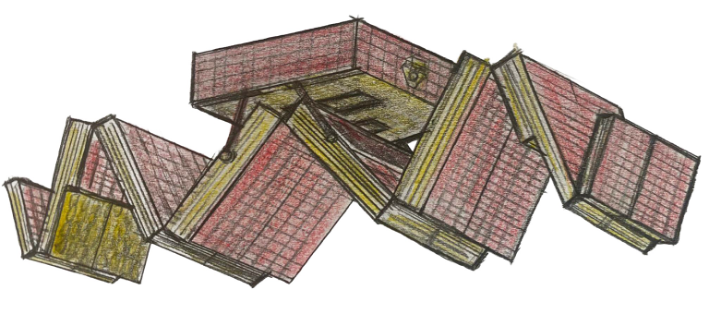
This isn’t just an eye-catching graphic; it’s an excellent example of the culture and track record of innovation that have clearly emerged at AST. For competitors such as Starlink, successfully replicating AST’s design and architecture, amidst thousands of protected patents no less, is much more nuanced than the equivalent of copying AST’s homework. We believe it would take years, if not the better part of a decade, for Starlink to recreate what AST already has in place today.
Back to AST’s origami-style unfolding satellite design: Given the physics and design of existing rockets, the fact that AST continues to build the largest LEOs in history is truly amazing. Rockets are tall, narrow cylindrical shells. AST Bluebirds have a huge, flat surface the size of a basketball court, made up of dense electronics. Yet AST uses rockets to carry Bluebirds into space with absolute millimetre precision, so they survive the launch and unfold fully intact. That’s’ not easy.
To redesign its constellation (a feat we believe is necessary for the ability to offer true broadband services), Starlink must not only follow suit with a foldable design compatible with SpaceX rockets, but also must replicate AST’s purpose-built design, a process that will require a new bill of materials. The redesign of the satellite must be oriented around one giant plane and the successful replication of AST’s phased arrays to ensure adequate power for a full mobile broadband offering.
Starlink’s newest V3 satellite remains in production but promises much greater performance than its current V2 sats. Recall that performance and size go hand in hand. Finished V3 sats are estimated to weigh in at 4,400 pounds, more than 4x the weight of V2, with an estimated 20kW of power generation (one-fifth to one-sixth the power of AST), lending some credibility to improved performance for Starlink. Yet despite what is likely a notable improvement over V2, V3 fails to meaningfully close the gap with AST’s satellites—and even worse, SpaceX has no reliable way to launch it.
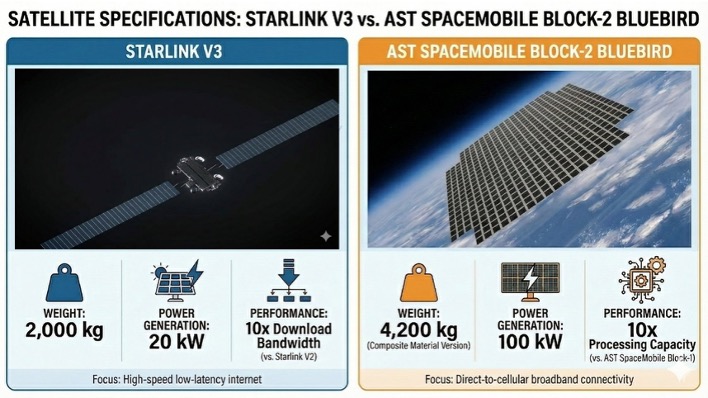
The V3 satellite is too big and heavy for the workhorse SpaceX Falcon 9 rocket to deploy in economically viable numbers. V3 launches hinge on the success of Starship, SpaceX’s next-generation, super-heavy-lift launch vehicle which remains in testing and development. Starship is targeting mid-2027 for the start of commercial payload launches, despite an original prototype dating back to 2019. This timeline would most likely lead to V3 satellites in orbit no earlier than 2028.
Phased Array Satellite Design
Perhaps AST’s most notable technological feat is its phased antenna arrays design, which allows its satellites to capture the weak signal from your phone.
AST builds its satellites using a very large panel made up of thousands of small, flat tiles packed tightly together. Each tile is a unique, self-contained radio unit that includes tiny antennas, sensitive receivers, signal routing electronics, and a small controller that lets it be individually managed. The tiles can both listen and talk, much like a walkie-talkie, and each can be adjusted independently.
When all these tiles work together, the satellite can create many focused “radio spotlights” instantaneously and simultaneously, covering different areas on Earth. This ability to instantly aim and re-aim radio beams is critical, because phones and satellites both move quickly.
By carefully timing the signals from each tile, the satellite makes the radio waves join to form a massive array (signal) towards the phone it wants to connect to on Earth. By combining individual signals across the massive array, the gain of the overall antenna is multiplied dramatically compared to that of single dishes. This increased gain provides the power needed to close links from space.
Equally important, AST’s design architecture also cancels out the signal in other directions, allowing a satellite to hear weak phone signals clearly without causing interference to other networks and spectrum frequencies. That’s something Starlink has struggled with mightily, given the technological limitations of its mobile broadband offering.
Cell Towers in Space
AST’s sats act as cell towers in space via a direct integration into the core of the land-based cell network, creating higher efficiency and data throughput such that end users can’t distinguish between their phone connecting to a cell tower on their home network or AST’s satellite network.
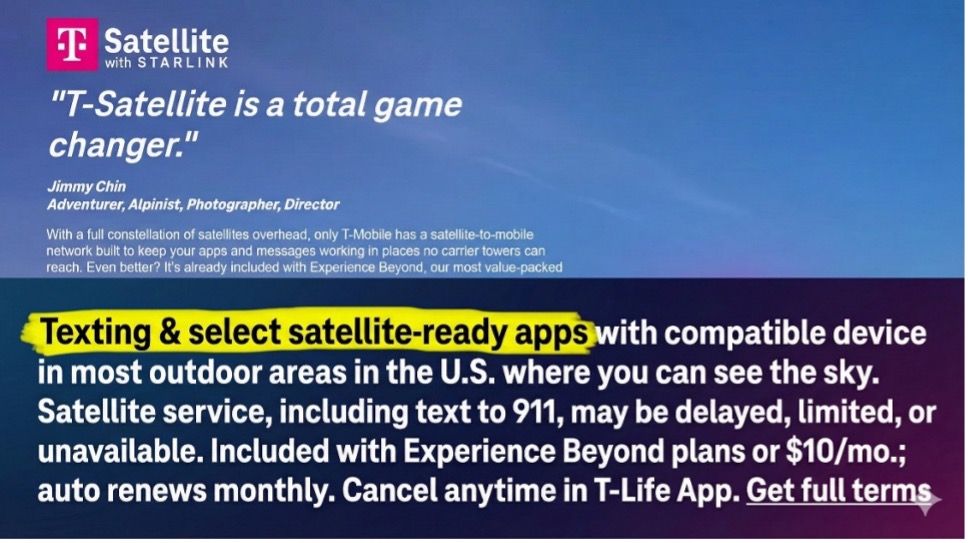
This is not the case for Starlink. Starlink’s D2D offering shows up as a separate cellular network called “T-Satellite”. Each time you lose bars, the phone must drop the call, log out of T-Mobile, and log into T-Satellite, resulting in massive battery drain and a convoluted user experience which we’ve seen emerge as a common complaint amongst T-Satellite’s beta testers.
This result isn’t surprising, given that Starlink’s satellites were never sized or designed to provide broadband internet for mobile cell phones.
Why is this important? Given the weak signal produced by the satellite and received by the phone, T-Mobile cannot safely let the phone behave as if it’s on the normal T-Mobile network. By doing so, Starlink would have its highly unstable, high-latency signals interfere with T-Mobile’s spectrum already in use on the ground, causing cross-network inference.
Starlink’s technology therefore requires a synthetic overlay to have any chance of being compatible with T-Mobile as stated directly by the company. The overlay can best be thought of as a patch job, but it’s Starlink’s best attempt at integrating its distinct cellular network with that of its partners.
AST’s seamless integration into its partners’ core network means the phone never technically leaves home, and the satellite is viewed as another tower in the same cellular carrier network, allowing for a true broadband experience. This outcome has been witnessed by AST’s Japanese partner Rakuten, who demonstrated Japan’s first-ever mobile broadband two-way video call using unmodified smartphones connected directly to AST’s satellites.
Unlike AST, Starlink is not a true space-based extension of the carrier’s network; it’s essentially a space-based roaming network. Data processing within Starlink’s network occurs ON the satellite before going back to the carrier. Given the lack of fluidity combined with the limited power from the small satellite, Starlink continues to lower the altitude of its satellites closer to Earth in hopes of sidestepping these structural problems. Moving satellites materially closer to Earth to maintain link performance highlights AST’s ability to connect with handsets from much higher altitudes due to its superior radio frequency and engineering design.
Starlink can offer text-only capabilities, but phone calls via Starlink D2D are highly susceptible to call drops, poor indoor performance, and battery drains given the lack of compatibility with the partner’s network and the lack of premium low-band spectrum (we’ll touch on this again later).
While Starlink’s V3 Satellite will be larger and have more power, it will not change the fact that Starlink cannot provide a seamless extension of its partners’ network. And Starlink’s lack of performance isn’t solely due to lack of signal strength. By trying to fit a square peg (fixed broadband) into a round hole (mobile broadband) Starlink lacks a compatible technological architecture and dedicated spectrum, resulting in poor performance and high risk of network interference.
Upgrade Path & Standards Compatibility
One of AST’s many disruptive technological feats is its “bent pipe” architecture, in which the satellite is primary focused on distributing power. We believe this is one of the many factors that contribute to the depth and breadth of AST’s moat vs. Starlink.
AST’s satellites are not involved with carriers’ network equipment or with processing and routing data. Data is sent back to AST’s carrier partners, allowing them to retain control of the core network authentication, billing, device control, and feature rollouts. All that stays on the ground with the MNO. This approach has additional benefits which we’ll flag later.
In contrast, Starlink’s constellation controls network scheduling and routing, product development, and feature enablement, etc. meaning any carrier partnering with Starlink will cede control of their spectrum, data, and customer experience.
Beyond avoiding these obvious conflicts, AST’s approach has two other meaningful advantages relative to Starlink’s: First, it allows AST to be forward compatible with future generations of terrestrial networks, such as 6G, while remaining in line with 3GPP industry regulations.
The evolution of cellular standards is predicated on backwards compatibility (i.e. a 4G phone works with 3G, 5G works with 4G and so on). While most assume that the bottleneck of new network generations stems from cellphone manufacturers such as Apple or Android, it is the cellular network that does the heavy lifting to ensure compatibility while leveraging the new capabilities of a device.
Adding future 6G functionality is as easy as a future software update for AST and its partners: The MNO will upgrade the core and RAN software, while maintaining full control over the rollout of compatible devices and any additional changes required. All this is done via the earth-based ground station controlled by the MNO. However, for Starlink, 6G will mean increased complexity onboard its satellites because that is where the key decisions are made. It is likely that Starlink will require a brand-new generation of satellites for 6G and future generations, given that the “brains” of their system reside in the satellites themselves.
Spectrum: You Either Have it or You Don’t
While we’ve touched on the importance of signal strength, design architecture, and proprietary technology, from our perspective, spectrum represents the “final boss”—the ultimate moat among AST’s numerous competitive advantages over Starlink.
Think of spectrum as a giant highway in the sky that allows radio frequencies to travel. As with any highway, there are a limited number of lanes in you can travel back and forth—even though we’re talking about data traveling on this highway, not cars. AST and Starlink have drastically different methods for accessing this “spectrum highway”.
AST has selected a wholesale partnership model, effectively leasing access to a broad portfolio of spectrum from its partners, Through exclusive agreements with AT&T, Verizon, Vodafone, and carriers around the world, AST has secured the rights and ability to broadcast from space on the same frequencies that your phone already connects to on the ground today, making AST truly an extension of land-based cell networks.
Unlike Starlink, AST has access to a wide selection of low-band and mid-band spectrum around which carriers have spent decades optimizing their networks. In particular, low-band cellular spectrum is the crown jewel for D2D use cases. It works on existing phones, it travels far, it penetrates buildings, and it’s available to AST.
AST’s use of the MNOs’ own licensed spectrum in the most lucrative wireless markets in the world is a key technical and strategic advantage, ensuring better integration, returns on capital, and performance compared to services such as Starlink that will likely have to continue to operate on crowded or less-than-ideal frequency bands for the foreseeable future.
Starlink historically has run its business solely on high frequency bands dedicated to, and licensed solely for, satellite usage. That’s a natural fit for their fixed broadband product offering, but it’s completely incompatible for D2D mobile broadband. Think of it this way: Starlink has built the best hockey stick (fixed broadband for at home internet) to ever hit the market; it’s simply miles ahead of competitors. But Starlink is its now taking this hockey stick and trying to use it to play a round of golf on the PGA Tour. It’s simply the wrong tool for the job.
Today, via its US partnership with T-Mobile, Starlink has what amounts to a narrow service road, not the full spectrum highway. It has access to only a thin slice of mid-band cellular spectrum. Given Starlink’s poor D2D performance and continued interference with terrestrial networks, not to mention what some see as CEO Elon Musk’s increasingly volatile behavior, we see a low likelihood of meaningful spectrum access for Starlink from carriers. That means Starlink will likely be forced to acquire spectrum outright.
Starlink did exactly that in September, spending $17bn to acquire spectrum from EchoStar. But using acquisitions to replicate AST’s spectrum portfolio achieved via its partners would cost trillions of dollars. Yes, trillions with a “T”. That’s a tall task even for Elon and his seemingly infinite access to capital.
And even if it had trillions of dollars in the bank, Starlink would still be forced to seek approval from domestic regulators in each country it operates in and bid against existing strategic spectrum holders for an asset that rarely comes to market. Should it successfully acquire the spectrum via auction, Starlink would then face significant pushback from incumbent carriers around inference rules and questions around data sovereignty from regulators.
On top of these numerous challenges, acquired spectrum still wouldn’t fully address Starlink’s lack of a satellite that could effectively utilize that spectrum for D2D purposes. And finally, unlike AST, which gains instant access to billions of mobile subscribers at scale via its partners, Starlink would need to spend extensively on customer acquisition.
Conclusion
We believe the arguments above show clearly why we think the attempts to equate AST SpaceMobile’s technology with Starlink’s are silly. Technology is one thing, but what matters most in our business is commercial viability. We can already hear Starlink bulls chanting, “Don’t bet against Elon!” And to be clear, we are not betting against Elon, because AST and Starlink aren’t even playing the same game.
Starlink offers the best solution for satellite-hosted home internet today, with almost 10,000 satellites launched into space courtesy of SpaceX. It’s led by the world’s wealthiest man, who is laser-focused on Starlink and SpaceX being valued at $1.5 trillion, nearly 40x the valuation currently assigned to AST by public markets. We more than understand if those facts make Starlink sound virtually unstoppable and impossible to compete with. However, none of them are relevant to D2D and mobile broadband. We believe most people arguing that Starlink will be AST’s undoing have failed to gather all the facts.
It’s not Starlink, but a small, virtually unknown business in the heart of West Texas that we see emerging victorious as the internet’s future “operating system”—one with infinite possibilities and new applications. AST SpaceMobile is that company.
We look forward to sharing more excerpts from our full research report on $ASTS. In the meantime, we welcome your questions, commentary, and critiques.

Disclaimers
+ No guarantee of investment performance
Past performance of the financial instruments mentioned in this report should not be taken as an indication or guarantee of future results. The price, value of, and income from, any of the financial instruments mentioned in this report can rise as well as fall and may be affected by changes in economic, financial and political factors. Any projections, market outlooks or estimates in this presentation are forward looking statements and are based upon certain assumptions. Other events that were not taken into account may occur and may significantly affect their returns or performance. Any projections, outlooks, or assumptions should not be construed to be indicative of the actual events that will occur. Future returns are not guaranteed. If a financial instrument is denominated in a currency other than the investor's home currency, a change in exchange rates may adversely affect the price of, value of, or income derived from that financial instrument. In addition, investors in securities such as ADRs, whose values are affected by the currency of the underlying security, effectively assume currency risk.
+ No guarantee of accuracy
While the information prepared in this document is believed to be accurate, Crossroads Capital, LLC (the “Investment Manager”) makes no representation or warranty as to the completeness, accuracy or timeliness of such information. The Fund and the Investment Manager expressly disclaim all liability for errors or omissions in, or the misuse or misinterpretation of, any information contained herein.
+ No obligation to update or act on information
The Investment Manager has no obligation to update any information contained herein and may make investment decisions that are inconsistent with the views expressed herein. Any holdings of securities discussed herein are under periodic review and are subject to change at any time, without notice.
+ Not a recommendation to buy or sell any security
This report does not provide investment recommendations specific to individual investors. As such, the financial instruments discussed in this report may not be suitable for all investors, and investors must make their own investment decisions based upon their specific objectives and financial situation utilizing their own financial advisors as they deem necessary. Investors should consider this report as only a single factor in making an investment decision. All information provided is for informational purposes only and should not be deemed as investment or other professional advice or a recommendation to purchase or sell any specific security.
+ Not an offer to invest in our Fund
This report, which is being provided on a confidential basis, shall not constitute an offer to sell or the solicitation of any offer to buy limited partnership interests of Crossroads Capital Investment Partners, LP (the “Fund”) which may only be made at the time a qualified offeree receives a confidential private offering memorandum (“CPOM”), which contains important information (including investment objective, policies, risk factors, fees, tax implications and relevant qualifications), and only in those jurisdictions where permitted by law. In the case of any inconsistency between the descriptions or terms in this document and the CPOM, the CPOM shall control. The interests shall not be offered or sold in any jurisdiction in which such offer, solicitation or sale would be unlawful until the requirements of the laws of such jurisdiction have been satisfied. This document is not intended for public use or distribution.
+ Other disclaimers
All trade names, trademarks, and service marks herein are the property of their respective owners, who retain all proprietary rights over their use. This document is confidential and may not be disseminated or reproduced without the prior written consent of the Investment Manager.


